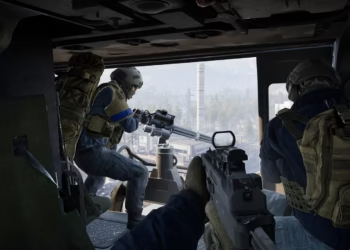


Call of Duty: Modern Warfare 4 is bringing back the Riot Shield, but Infinity Ward is making one crucial change: this time, the shield can be destroyed. The infamous piece of equipment also works differently in multiplayer, transforming from a permanent weapon-slot commitment into a field upgrade that can be carried, deployed, and eventually broken.
That redesign matters because the Riot Shield has always been one of Call of Duty’s most polarizing tools. For some players, it creates interesting tactical possibilities and gives objective-focused teams a way to push through dangerous sightlines. For others, it is a frustrating defensive crutch that can slow matches down and reward passive play.
Modern Warfare 4 appears to be taking a middle-ground approach. The shield remains powerful enough to support an advance or protect a retreat, but it is no longer intended to provide unlimited protection.
A Riot Shield That Finally Has a Breaking Point
In previous Call of Duty games, the Riot Shield’s ability to absorb sustained gunfire made it a reliable answer to frontal attacks. Players could use it to cross open spaces, lock down objectives, or force opponents into awkward flanking routes. That durability was also the source of much of the community’s frustration, particularly when shields became part of highly defensive loadouts.
Modern Warfare 4 changes that equation by making the shield destructible. Activision describes it as durable enough to help players push forward or cover a retreat, but not durable enough to support constant use throughout an engagement.
That distinction could have a significant effect on multiplayer pacing. A shield user may still be able to challenge a chokepoint or buy time for teammates, but opponents should eventually be able to eliminate the protection through concentrated fire. Rather than functioning as a portable wall, the item is being positioned as a temporary resource that needs to be used at the right moment.
The exact balance will likely depend on factors such as damage thresholds, recharge time, weapon types, and how quickly teams can focus fire. Those details will become increasingly important as players learn the beta’s strongest combinations.
From Weapon Slot to Field Upgrade
The other major change is how the Riot Shield fits into a player’s loadout. In Modern Warfare 4, it is unlocked as a field upgrade instead of occupying a weapon slot.
That gives players more freedom to combine the shield with a conventional primary weapon. A player could potentially use the shield while advancing, then switch back to a rifle or submachine gun once the immediate threat has passed. This is a more flexible design than earlier versions, where choosing a shield often meant giving up a standard weapon choice.
However, that flexibility also creates new balance concerns. If the field upgrade becomes available frequently enough, players may be able to access shield protection without making a meaningful sacrifice during loadout construction. The destructible design appears to be Infinity Ward’s answer to that problem, ensuring that the Riot Shield can be useful without becoming a permanent safety net.
Its field-upgrade status also makes the item feel more like a tactical playmaker than a traditional weapon. Players are encouraged to deploy it during specific moments rather than build their entire identity around carrying one.
Plant It, Mount Up, and Hold the Line
Modern Warfare 4’s Riot Shield is not limited to being carried in front of the player. It can also be planted on the ground, creating temporary cover wherever it is deployed.
Once placed, players can mount their weapons to the shield for improved stability. That gives the item a second role beyond personal protection: it can become a temporary firing position for players defending an objective, watching an angle, or attempting to control a long sightline.
This placement option could prove especially valuable in objective-based modes. A team defending a hardpoint or another fixed location may use the shield to reinforce an exposed side of the objective, while an attacking team could deploy one during a push to reduce the danger of crossing an open lane.
The trade-off is that planted cover should be easier to anticipate. Once a shield is placed, opponents know where the defensive setup is located and can adjust their approach accordingly. If it can be destroyed, ignored, or bypassed, the tactical value will come from timing and positioning rather than simply dropping it in the middle of a lane.
That is also where the item’s design could separate skilled users from players relying on it as a crutch. A well-placed shield may protect a teammate during a reload or create just enough stability to win an important gunfight. A poorly positioned shield could simply become a visible target that burns through a field-upgrade charge without accomplishing much.
A New Heavy Melee Attack Adds Offensive Potential
The shield is not purely defensive. Modern Warfare 4 adds a heavy melee attack that can knock enemies down and create space at close range.
This gives shield users a more direct way to deal with opponents who attempt to rush them. The attack could be particularly useful inside narrow rooms, around objective zones, or during moments when a player needs to disrupt an enemy formation rather than secure an immediate elimination.
It also reinforces the idea that the Riot Shield is meant to support movement and close-quarters pressure. Instead of simply waiting behind protection, players can use the shield to force opponents away from key positions before transitioning to another weapon.
Whether that attack becomes a useful tactical option or an aggravating source of close-range deaths will depend heavily on its speed, range, recovery animation, and counterplay. The beta should offer an early indication of how fair those interactions feel in real matches.
When Can Players Try Modern Warfare 4?
The Modern Warfare 4 beta is currently underway for players with early access, with the first testing period beginning on August 21, 2026. The open beta is scheduled to run from August 28 through September 1, allowing players to participate without preordering the game.
The beta includes multiplayer content, a campaign mission called Entrenched, and an early look at the future of Call of Duty: Warzone. It is also set to support PlayStation 5, Xbox Series X|S, PC, and Nintendo Switch 2, although platform-specific beta timing may vary between testing periods.
Modern Warfare 4 is scheduled to launch on October 23, 2026. Its release will mark Call of Duty’s return to a Nintendo platform for the first time since 2013’s Call of Duty: Ghosts, expanding the audience for the series beyond the usual PlayStation, Xbox, and PC player base.
For now, the Riot Shield is one of the clearest examples of Modern Warfare 4 attempting to revisit a familiar mechanic without simply copying its previous versions. The item still offers protection, cover, offensive utility, and objective value. But by making it destructible and tying it to the field-upgrade system, Infinity Ward is signaling that the shield should be a calculated tool—not an excuse to spend an entire match hiding behind armor.
That philosophy sounds promising on paper. The real test will come when players discover how quickly the shield breaks, how often it can be deployed, and whether coordinated teams can use it without making objective modes feel stagnant.
Sources
gamespot.com
activision.com
callofduty.com
xbox.com