
DC’s The Deadman reaches its fourth issue by sending Boston Brand from Hell to Heaven, but neither destination offers the answers he needs. Written by W. Maxwell Prince, drawn by Martín Morazzo, colored by Chris O’Halloran, and lettered by Good Ol’ Neon, the DC Next Level series continues to turn one of DC’s strangest supernatural heroes into the center of a surreal, darkly funny mystery.
That mystery is becoming increasingly important now that DC has expanded the originally solicited six-issue miniseries to twelve issues. For readers who have been enjoying Prince and Morazzo’s unusual take on the afterlife, The Deadman #4 is a strong argument for giving the creative team more room to let its ideas develop.
Boston Brand’s heavenly detour
Boston Brand remains responsible for escorting souls into whatever comes next, though the assignment has become much more complicated than a simple supernatural delivery service. The disturbing Mr. Juan and his Ghost Things continue to prey on the recently deceased, leaving Deadman searching for an explanation that Hell clearly could not provide.
After last issue’s descent into Perdition, Boston tries the opposite direction in #4. His journey to Heaven is not presented as a peaceful ascent or a conventional celestial landscape. Instead, Prince and Morazzo treat the destination as another strange bureaucracy, complete with its own rules, obstacles, and unsettling personalities.
The issue’s opening scenes with Bobby, the ghost child who has become Boston’s most entertaining companion, remain among the series’ best material. Their exchanges are funny, but the humor is paired with a growing sense that Bobby is not simply a sidekick. The two characters appear to be changing in relation to one another, even to the point of trading emotional reactions in ways that suggest something deeper is taking shape beneath the jokes.
Prince has been especially effective at making Boston’s conversations feel both ridiculous and emotionally revealing. Deadman can be impatient, sarcastic, confused, and compassionate within the same scene, and Bobby’s presence brings those contradictions into sharper focus. The result is character work that keeps the issue grounded even when the setting becomes completely bizarre.
Morazzo makes the afterlife unforgettable
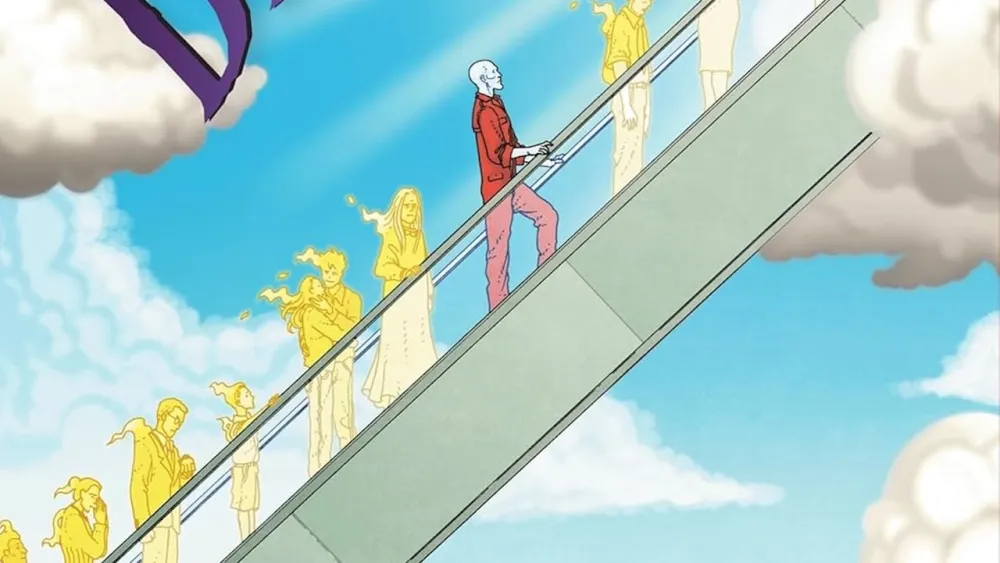
Morazzo’s artwork continues to be one of the biggest reasons to follow this series. The escalator ride into Heaven is a particularly memorable visual sequence, taking an ordinary piece of infrastructure and transforming it into something both comic and otherworldly. It is the kind of simple, unexpected idea that makes this version of the afterlife feel distinct from familiar fantasy imagery.
With O’Halloran’s colors, the book occupies an unusual space between horror, absurdist comedy, and dream logic. The environments are eerie without becoming visually monotonous, while the characters remain expressive enough to sell Prince’s dialogue-heavy scenes. The overall aesthetic has the off-kilter energy of a supernatural comedy, but the imagery is still capable of making the dead feel genuinely unsettling.
Morazzo is also very good at visualizing Boston’s personality. Deadman’s body language often does as much work as his dialogue, particularly when his patience begins to wear thin. The exaggerated reactions add humor, but they also make Boston feel more human than the premise might suggest. He may be a ghost with an impossible job, yet his frustration and curiosity remain recognizable.
Mr. Juan’s mystery gets stranger
The issue provides new information about Mr. Juan, his motivations, his maids, and the Ghost Things that have disrupted the journey of the dead. The revelations do not solve the central mystery, but they give the threat more shape and suggest that the strange machinery of this world is being manipulated by forces Boston does not yet understand.
That slow development may test the patience of readers looking for immediate answers. The larger mystery continues to unfold in fragments, and the series is clearly more interested in atmosphere, character, and peculiar detours than in rushing from one revelation to the next. The planned expansion to twelve issues should give Prince and Morazzo additional space to connect those fragments.
Boston’s encounter with “Pete” is a highlight because it captures the book’s particular sense of humor. The sequence is absurd without feeling disconnected from the story, and it reflects the charm that makes this Deadman more than a parade of supernatural oddities. Even when the issue is being deliberately strange, Boston’s personality gives the comedy a clear point of view.
Another standout moment involves the Presence’s secretary. Prince plays with the familiar notion that divine decisions are mysterious and turns it into something suspiciously administrative. The scene is funny on the surface, but it also carries the suggestion that Boston is being told only part of the truth. In a comic built around hidden rules and spiritual mathematics, that kind of uncertainty feels entirely appropriate.
A cliffhanger with familiar roots
The closing pages bring Swamp Thing into the story and leave Deadman in a situation that will be immediately interesting to longtime readers. The issue appears to revisit territory associated with the classic “GR33N” concept, but Prince gives the idea a new angle rather than simply repeating an earlier story.
That balance between recognition and reinvention is important. The connection gives longtime Deadman fans something familiar to latch onto, while the new hook leaves enough uncertainty for the series to take the concept somewhere unexpected. It is an effective cliffhanger because it expands the scope of the mystery without abandoning the book’s eccentric identity.
The Deadman #4 is another confident installment in a series that understands its appeal. The dialogue is sharp, the Heaven sequence is inventive, and the Mr. Juan storyline moves forward without sacrificing the character-driven humor that has made Boston and Bobby such an engaging pair. Readers who prefer neatly explained mythology may find the pacing deliberate, but those willing to follow the detours will find a comic that is strange, funny, visually distinctive, and unexpectedly heartfelt.
Originally released as a six-issue series, The Deadman is now set to continue through issue #12. Based on the strength of this fourth chapter, that additional room is welcome. Boston Brand still has plenty of places left to visit—and, judging by this issue’s ending, some of them may be considerably stranger than Heaven or Hell.
Sources
aiptcomics.com
dc.com