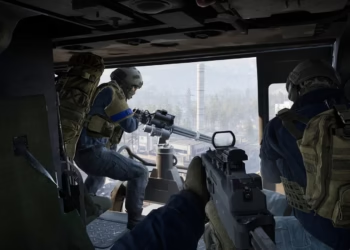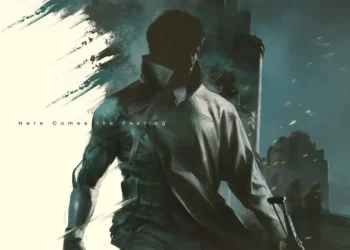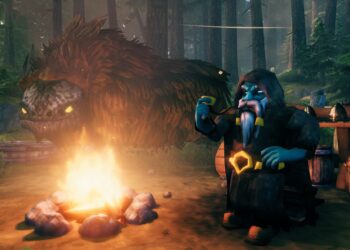

In 2011, North American Nintendo fans were staring at three highly anticipated Wii RPGs they could not play: Xenoblade Chronicles, The Last Story, and Pandora’s Tower. Rather than letting the games disappear behind regional release decisions, fans built Operation Rainfall—a campaign so coordinated, persistent, and media-savvy that it became one of the clearest demonstrations of consumer power in modern gaming.
The campaign did not single-handedly force Nintendo’s hand, and the companies involved later offered more complicated explanations for the games’ eventual releases. But Operation Rainfall proved something publishers could not easily dismiss: a scattered audience of JRPG fans could organize itself, create measurable demand, and communicate in terms the games industry understood.
A Campaign Built Around Three Wii RPGs
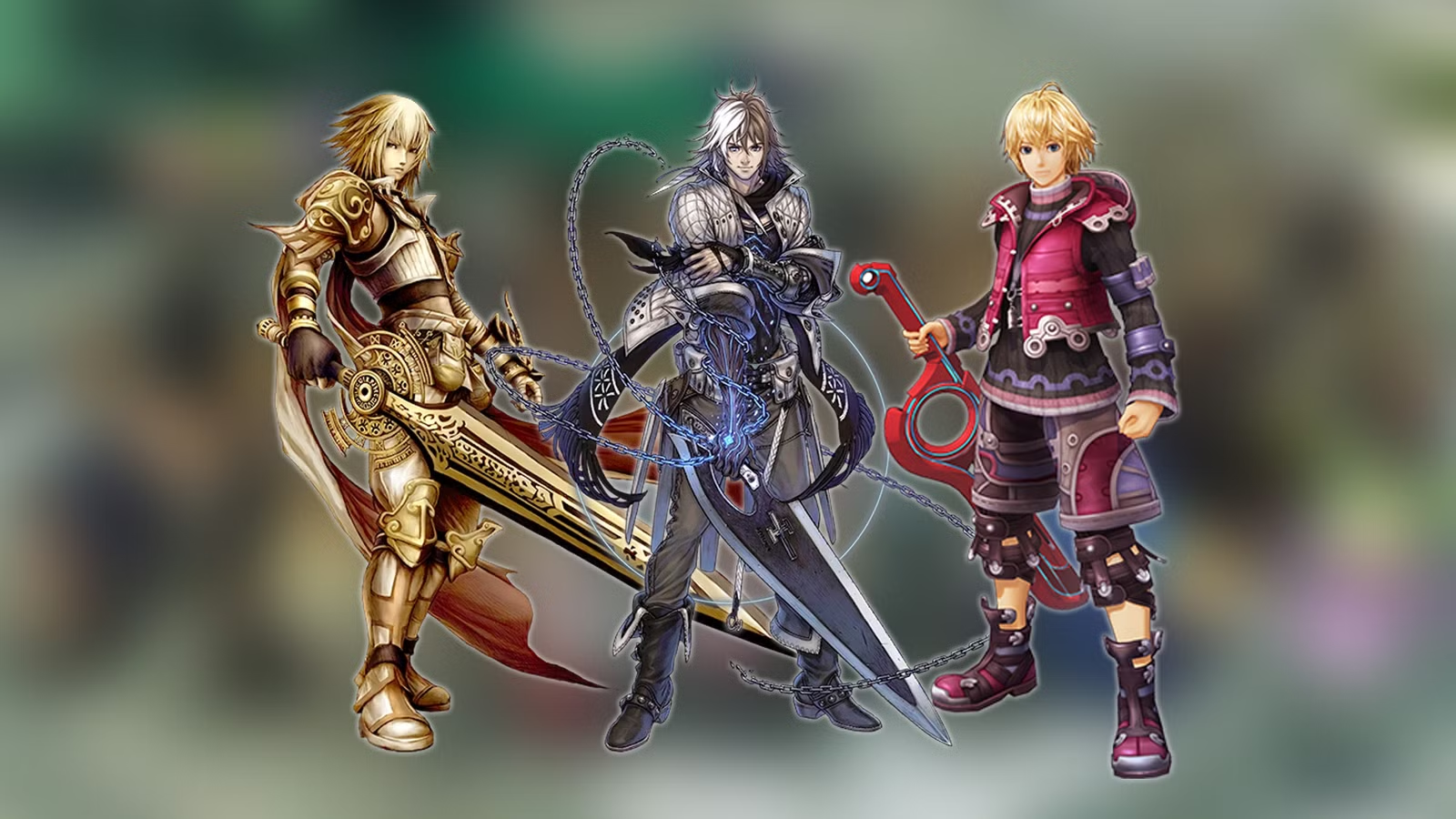
Operation Rainfall began as a response to the uncertainty surrounding Xenoblade Chronicles, which had launched in Japan while North American fans had no confirmed release to look forward to. The campaign soon expanded to include The Last Story and Pandora’s Tower, two other Wii RPGs associated with Nintendo in Japan and Europe.
The timing was especially important. The Wii was nearing the end of its life, and large publishers were becoming increasingly cautious about localizing lengthy, niche Japanese RPGs for North America. These were not obvious mass-market products in the same category as Mario, The Legend of Zelda, or Wii Sports. Their audiences were passionate, but publishers still had to determine whether that passion could become enough sales to justify the cost of localization, manufacturing, marketing, and distribution.
Operation Rainfall understood that simply saying “we want these games” was not necessarily persuasive. The campaign therefore transformed enthusiasm into a structured argument about audience size, purchase intent, and visibility.
Branding Turned Individual Fans Into One Movement
One of Operation Rainfall’s smartest decisions was treating the campaign like an actual organization rather than an endless stream of disconnected complaints. It developed a recognizable name, a consistent visual identity, a website, social media channels, press contacts, campaign phases, and specific instructions for supporters.
That branding mattered because it made thousands of individual actions appear connected. Fans were encouraged to use a raindrop symbol in letters to Nintendo, creating a simple visual marker that identified their correspondence as part of the same campaign. Other supporters sent physical materials tied to the games, including cocktail swords modeled after Shulk’s Monado from Xenoblade Chronicles.
These gestures were more than novelty. They gave the campaign a personality and made it easier for journalists, publishers, and Nintendo representatives to recognize Operation Rainfall as a sustained movement. A single email can be ignored. A recognizable campaign that keeps appearing across forums, social media, news coverage, and physical mail is much harder to treat as random noise.
It Offered Different Ways to Participate
Grassroots campaigns often fail because they expect every supporter to contribute in exactly the same way. Operation Rainfall avoided that trap by creating multiple levels of engagement.
Fans could sign petitions, send emails, make phone calls, write letters, share campaign information, participate in coordinated contact days, and place preorders or wishlists through retailers. The approach gave casual supporters an easy entry point while giving highly committed fans more demanding work to organize around.
This structure also kept the movement active over time. Operation Rainfall was not dependent on one viral post or one large petition. It operated through a series of phases, each with its own goal and method. When Nintendo responded that it had no plans to release the three games in North America, the campaign did not treat that statement as the end. It adapted.
The campaign also responded when Amazon froze the preorder listing associated with Xenoblade Chronicles. Rather than losing momentum, supporters redirected their energy toward letters, calls, and emails. The ability to change tactics without abandoning the central objective became one of Operation Rainfall’s greatest strengths.
Preorders Gave Publishers a Business Argument
The Amazon preorder campaign became particularly important because it attempted to demonstrate commercial demand rather than merely emotional support. A petition can show that people are interested in a game. A preorder suggests that at least some of those people may be prepared to spend money on it.
Operation Rainfall encouraged supporters to preorder or wishlist the game through an Amazon listing that used a placeholder title. The listing climbed the retailer’s rankings before Amazon froze the preorder process. That did not provide Nintendo with a guaranteed sales forecast, but it created a visible signal that the audience was willing to take a concrete action.
The distinction between interest and purchase intent remains central to how publishers assess risk. Fans can sincerely love a game and still decide not to buy it at launch. Operation Rainfall’s strategy acknowledged that reality and tried to make its case using the language of the industry: demand, visibility, and potential revenue.
The campaign continued that emphasis after Xenoblade Chronicles was announced for North America. Supporters were encouraged to buy the game, partly to demonstrate that the other two titles also had a viable audience. Xenoblade Chronicles eventually launched in North America on April 6, 2012, followed by The Last Story from XSEED Games on August 14, 2012. Pandora’s Tower followed on April 16, 2013, also through XSEED.
Operation Rainfall Knew When to Change Targets
Although Nintendo of America was the campaign’s initial focus, the organizers eventually recognized that each game involved different rights holders and business circumstances. That became especially clear with Pandora’s Tower, which required a more direct approach to potential third-party publishers.
Operation Rainfall launched a dedicated campaign around the game, purchased copies, prepared presentation materials, and pitched the title to companies that had experience bringing niche Japanese games to North America. The effort did not give fans control over the licensing process, but it showed an unusually sophisticated understanding of how localization actually works.
A publisher still needed access to the rights, a workable budget, a localization plan, distribution support, and confidence that the audience would buy the finished product. Operation Rainfall could not solve all of those problems, but it could make the market opportunity more visible. In doing so, fans moved beyond demanding action and began presenting a case for why action might make business sense.
Success, Influence, and the Limits of Fan Power
It is tempting to describe Operation Rainfall as the direct reason all three games reached North America. The timeline certainly made the campaign look powerful, and the releases represented a remarkable outcome for a group that began in online forums. However, Nintendo and XSEED later indicated that other factors were involved, and Nintendo representatives did not present the campaign as the sole cause of the decisions.
That nuance does not make Operation Rainfall irrelevant. Even if it was not the deciding factor, the campaign raised awareness, generated press coverage, demonstrated an active audience, and gave fans a recognizable platform for communicating with companies. It also helped establish a precedent for organized localization advocacy at a time when many players assumed regional release decisions were completely beyond their influence.
Its lasting achievement was therefore larger than the release of three Wii RPGs. Operation Rainfall showed that niche audiences could act like a market rather than a collection of isolated enthusiasts. It demonstrated the value of consistent branding, coordinated timing, measurable support, targeted pressure, and long-term persistence.
Publishers still make decisions based on budgets, licensing agreements, projected sales, and internal priorities. Fans cannot simply will every unreleased game into existence. But Operation Rainfall proved that a well-organized community can change the conversation—and sometimes make ignoring that community considerably more difficult.
Sources
dualshockers.com
operationrainfall.com
xseedgames.com
arstechnica.com
nintendoworldreport.com