
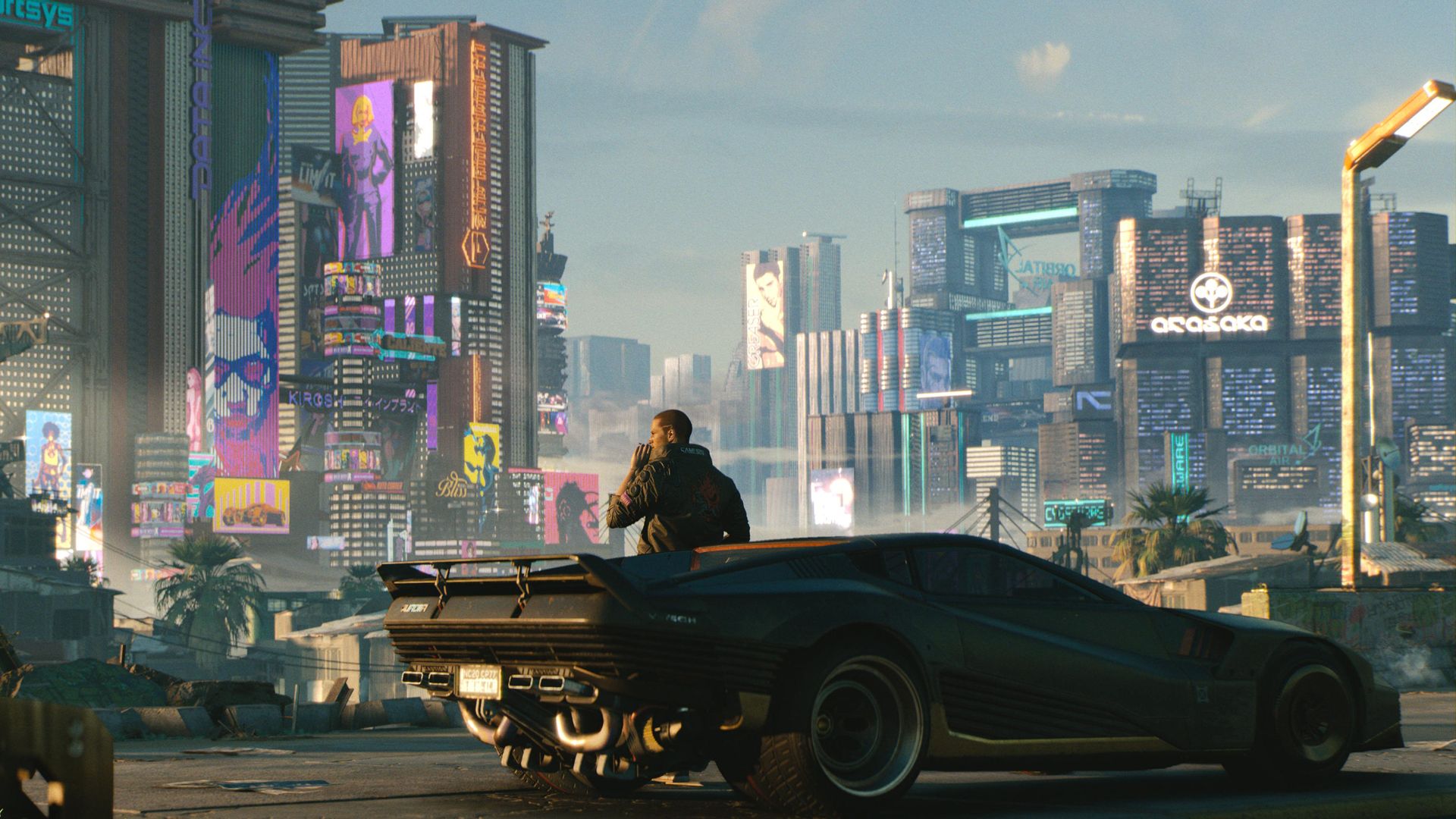
Night City is already a dangerous place, but one Cyberpunk 2077 mod has turned its traffic into a full-blown survival-horror threat. Streamer and modder Blurbs altered the game so every car travels at what he calls “super sonic” speeds, transforming routine walks through the city into frantic battles against runaway vehicles, exploding intersections, and physics-driven chaos.
The result is less a power fantasy and more a nightmare about crossing the street. Cars arrive with almost no warning, smash into buildings, ricochet off walls, and pile into one another before V has much chance to react. As Blurbs puts it, “It’s now a horror game,” and the footage makes a surprisingly convincing case.
Night City’s traffic becomes the monster
Cyberpunk 2077 normally treats vehicles as part of the city’s constant background motion. Traffic helps sell Night City as a functioning metropolis, filling its roads with taxis, private cars, police vehicles, and heavily customized rides. Blurbs’ experiment takes that familiar visual noise and turns it into an ever-present source of danger.
The most unsettling moments come when the cars are heard before they are seen. A distant engine suddenly becomes a violent crash, with a vehicle launching through the air after hitting an obstacle somewhere around the next corner. Intersections, already busy areas in the unmodded game, become death traps where several cars can collide at once.
That unpredictability gives the mod an unusual horror-game quality. There is no elaborate monster design or scripted jump scare. Instead, the tension comes from knowing that any quiet stretch of pavement could be interrupted by a car moving too quickly to avoid.
Driving is somehow even more dangerous
The chaos becomes more absurd when Blurbs tries to use the modified vehicles himself. Rather than offering a fast way around Night City, the car becomes a mechanical pinball. A small input on the accelerator sends it bouncing off walls and corners, while the confined space of a parking lot turns into a trap.
Getting out appears to be just as difficult as getting in. The excessive speed makes steering almost meaningless, leaving the vehicle to ricochet around the environment while every attempt to correct its movement creates another collision. It is a perfect example of how a single exaggerated modification can completely undermine a familiar system.
Cyberpunk 2077’s driving has always been more useful for transportation and spectacle than for precision racing, but this version pushes that distinction to the extreme. The mod does not simply make cars faster; it makes ordinary road layouts feel hostile. Parking areas, narrow streets, and building entrances become environments to escape rather than places to navigate.
A disaster movie hiding inside an RPG
For all the horror framing, the footage is also remarkably funny. Pileups spread across Night City with the exaggerated rhythm of a slapstick disaster movie. Cars slam into one another, launch over curbs, and create traffic jams that look less like urban congestion and more like the aftermath of a citywide emergency.
The spectacle recalls the appeal of driving a tank through Grand Theft Auto 3 while the wanted level climbs: the fun comes from watching a familiar world collapse under a deliberately ridiculous ruleset. Cyberpunk 2077’s detailed streets and dense vehicle traffic make the results especially entertaining because the city was built to appear busy and believable before the mod turns it into a demolition arena.
That contrast is what makes the experiment work. Night City is designed around excess, from its neon architecture to its corporate dystopia, but its traffic generally remains recognizable. By removing the expected limits on vehicle speed, Blurbs exposes how much of the city’s atmosphere depends on ordinary movement. Once every car becomes a projectile, the world’s carefully controlled rhythm disappears.
Why this kind of mod still matters
Mods like this are not intended to improve Cyberpunk 2077 in a conventional sense. They are closer to interactive experiments, using the game’s existing systems to reveal unexpected behavior. The appeal is not a new questline or a rebalanced combat system, but the chance to see what happens when one rule is pushed far beyond its intended boundaries.
That makes the experiment particularly suited to Cyberpunk 2077. CD Projekt Red’s RPG has a large, reactive open world with complex vehicle systems, dense environments, and plenty of opportunities for physics to produce unscripted comedy. A small alteration to traffic behavior can therefore create scenes that feel completely unlike the standard game without changing its story or missions.
The concept also highlights the difference between a game’s intended fantasy and its emergent one. Cyberpunk 2077 asks players to imagine themselves as an enhanced mercenary navigating a dangerous future city. Blurbs’ mod suggests a different fantasy entirely: surviving long enough to cross the street without being flattened by a sports car traveling at impossible speed.
There is no indication that this is an official feature or a planned gameplay mode, and the experiment is clearly designed for spectacle rather than practicality. Still, it demonstrates why Cyberpunk 2077 continues to provide fertile ground for strange community creations. Even after players have completed its major stories and explored Night City from every angle, a single chaotic tweak can make the city feel dangerous again.
Blurbs may be right that this version is a horror game. It is also a traffic simulator, a physics sandbox, and a comedy reel rolled into one. Most importantly, it is a reminder that sometimes the best way to rediscover a familiar open world is to break one of its rules as dramatically as possible.
Sources
gamesradar.com
cyberpunk.net