
Suburban horror works because the setting is so aggressively ordinary. The houses look familiar, the streets are neatly maintained, and the people behind the doors are supposed to be trustworthy. For collectors, that contrast makes these films especially rewarding: the best characters are instantly recognizable silhouettes, while the strongest scenes translate naturally into figures, dioramas, props, posters, and shelf-ready display pieces.
The following selection, adapted from Sideshow’s survey of suburban horror, focuses on movies where the neighborhood or community is more than a backdrop. These are stories about institutions failing, families hiding secrets, social expectations becoming prisons, and evil moving from one house to the next. They also represent some of the most collectible horror properties ever licensed for action figures and premium statues.
Foundational Icons of the Neighborhood Nightmare
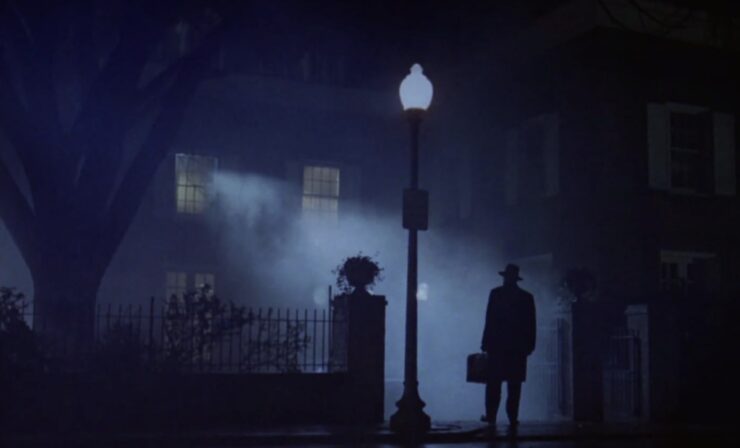
The Exorcist remains one of the most unsettling examples of supernatural horror invading an otherwise recognizable residential environment. William Friedkin’s 1973 classic places Regan MacNeil’s possession within Georgetown, where religion, medicine, family, and community all prove insufficient against the evil inside the house.
From a collectibles perspective, The Exorcist is a character-driven property built around one unforgettable transformation. Regan’s possessed appearance, Father Merrin’s priestly silhouette, and the film’s stark bedroom setting offer obvious possibilities for premium figures and diorama displays. The film is less about action than atmosphere, so a successful collectible needs strong portrait work, restrained paint, and a convincing sense of unease rather than an overloaded accessory count.
Halloween takes the opposite approach. John Carpenter’s 1978 film turns quiet streets, school routes, laundry rooms, and suburban porches into spaces of constant surveillance. Michael Myers is frightening partly because he does so little; his blank mask and rigid posture create a visual icon that has proven exceptionally adaptable across action figures, statues, busts, and prop replicas.
Michael is also one of the safest display choices for horror collectors. The character’s simple color palette reads well at almost any scale, while alternate masks, knives, hands, and scene-specific accessories allow manufacturers to revisit the same design without losing the core identity. NECA’s Halloween releases demonstrate how much mileage collectors can get from the franchise’s different eras, including seven-inch Ultimate figures, larger-scale releases, and character pairings featuring Laurie Strode and Dr. Loomis.
When a Stranger Calls is built around a single suburban fear: the person threatening you may already be inside. The film’s babysitter setup and infamous telephone menace are less visually elaborate than a masked killer or demonic creature, but that restraint is exactly the point. Its most effective collectible would likely be a scene piece—a telephone, staircase, or isolated babysitter pose—rather than a conventional monster figure.
A Nightmare on Elm Street expands the neighborhood threat into the dream world. Freddy Krueger can move from bedroom to bedroom and from house to house because sleep itself becomes communal territory. Wes Craven’s 1984 film therefore has enormous display potential: the boiler room, the claw glove, the striped sweater, the fedora, and the surreal dream imagery all give collectors strong visual hooks.
Freddy has also received some of the most elaborate horror action figures in the hobby. NECA’s officially documented releases include seven-inch figures with multiple heads, interchangeable hands, the glove, the tongue phone, and other film-specific accessories, along with larger one-quarter-scale versions. That range makes Freddy particularly appealing to both action-figure collectors and statue-focused fans who want a centerpiece with immediate shelf presence.
When the Community Is the Monster
The Stepford Wives is suburban horror without a traditional slasher villain. Bryan Forbes’ 1975 film turns domestic perfection into body horror and social control, with Joanna Eberhart discovering that Stepford’s polished image depends on the erasure of individuality. Its appeal to collectors is more conceptual than character-driven: the strongest display would emphasize uniformity, repetition, and the unsettling sameness of the town’s inhabitants.
Parents uses dark comedy to make the nuclear family itself suspicious. Bob Balaban’s 1989 film filters suburban anxiety through a child’s perspective, creating a world where the ideal family dinner may conceal something much worse. Alongside films such as Serial Mom and The ‘Burbs, it shows how humor can make domestic horror more uncomfortable rather than less.
These are difficult properties to represent with a single licensed figure, but that is also what makes them interesting for serious collectors. A diorama featuring a dinner table, vintage kitchen details, or an apparently normal family with carefully chosen expression changes could communicate the movie more effectively than a standard character release.
The Purge takes the neighborhood premise and scales it up into a social experiment. James DeMonaco’s 2013 film asks what happens when the laws that keep residential communities functioning are suspended for one night. Masks, improvised weapons, tactical clothing, and barricaded houses give the franchise a more obvious action-figure vocabulary than The Stepford Wives or Parents.
For collectors, The Purge sits in an interesting space between horror and military-style display. The masked antagonists can work in a modern sixth-scale environment, while the suburban architecture is essential to the identity of the film. Without the front door, windows, security system, and carefully maintained facade, the figures lose much of their narrative power.
Modern Suburban Horror and Hidden Histories
It makes the town of Derry, Maine a character in its own right. Pennywise is the headline attraction, but the deeper horror comes from the way racism, abuse, neglect, and institutional indifference remain embedded in the community. The 2017 adaptation gives collectors an unusually flexible centerpiece: Pennywise can be displayed as a colorful horror icon, a grotesque creature, or a sinister figure framed by the sewer and paper-boat imagery.
The character’s theatrical costume and highly readable silhouette have helped make Pennywise a natural fit for licensed collectibles. Sideshow has offered a sixth-scale Pennywise figure, while the broader horror-collectibles market has produced multiple versions across action-figure and statue formats. For a display, the most compelling approach is usually contrast: bright yellow rainwear, red balloon imagery, and a dark environmental base.
Get Out is perhaps the clearest example in this group of suburbia functioning as a social system rather than merely a location. Jordan Peele’s 2017 film places Chris Washington inside a wealthy family estate where politeness, hospitality, and liberal language conceal a deeply violent exploitation of Black bodies.
Get Out is not an obvious action-figure property, and that is part of its collector appeal. A conventional figure of Chris would need to rely on portrait likeness, posture, and a strong environmental base instead of weapons or interchangeable monster parts. The Sunken Place, the teacup, the deer imagery, and the Armitage estate all offer premium statue designers more interesting material than a simple character standing on a generic platform.
Weapons, directed by Zach Cregger and released in 2025, brings suburban helplessness into a contemporary setting. The disappearance of an entire classroom turns the community’s greatest responsibility—protecting children—into an impossible mystery. Rather than centering one instantly marketable villain, the film’s horror spreads through adults, schools, homes, and local institutions.
That makes Weapons a less obvious collectible license today, but potentially a compelling one if its imagery develops the same long-term recognition as earlier suburban horror. Its strongest future display possibilities would likely involve environmental storytelling: empty school spaces, missing-child notices, or a neighborhood scene that looks ordinary until the viewer understands what is absent.
The Collector Verdict
For action-figure collectors, Michael Myers, Freddy Krueger, and Pennywise offer the deepest selection of officially licensed releases and the clearest upgrade paths across scales. They also bring strong accessory ecosystems, making it easier to build a shelf around specific films rather than a single generic character.
Premium statue collectors may find more unusual opportunities in The Exorcist, Get Out, and It, where mood, composition, and environmental design matter as much as likeness. Gunpla builders and model-kit enthusiasts may not find traditional kits attached to these properties, but the films are excellent references for custom dioramas, suburban architecture, weathering, lighting, and small-scale storytelling.
The best suburban horror collectible is not necessarily the one with the most articulation or accessories. It is the one that preserves the tension between normality and dread: a familiar house, a harmless-looking family, a quiet street, or a figure that seems to be watching from the edge of the shelf.
Sources
- sideshow.com
- necaonline.com
- universalpictures.com
- apnews.com
- warnerbros.com