

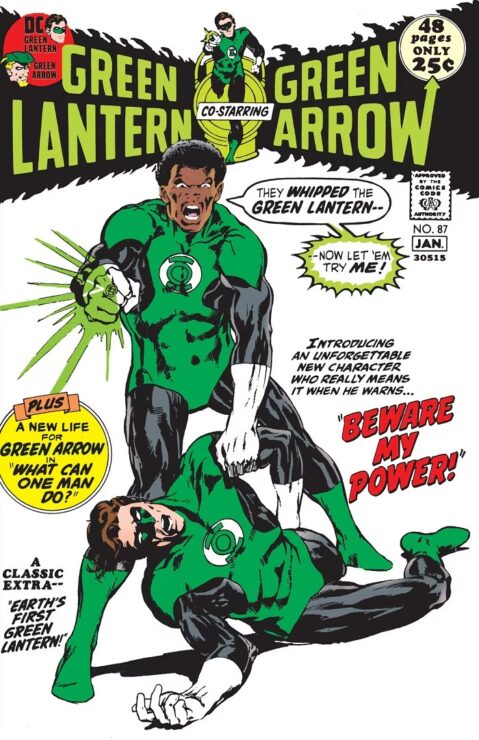
John Stewart has never been just another Green Lantern on the roster. Since his debut in Green Lantern #87 in 1971, Stewart has developed from Hal Jordan’s emergency replacement into one of DC’s most respected heroes, a Corps leader, a Justice League mainstay, and one of the company’s most important Black superheroes. That history gives collectors more to consider than simply choosing the latest figure with a green costume.
With Aaron Pierre bringing John Stewart to live action in Lanterns, scheduled to premiere on August 16, 2026, the character is entering another major visibility cycle. For collectors, that makes Stewart’s existing action figures, statues, and comic-inspired interpretations especially worth revisiting. He has a strong visual identity, several distinct costume eras, and a power set that gives sculptors and accessory designers plenty of room to work.
A Green Lantern Built on More Than Willpower
John Stewart first appeared during one of DC’s most socially conscious periods. Created by writer Dennis O’Neil, artist Neal Adams, and inker Dick Giordano, he was introduced as an alternate Green Lantern after Guy Gardner was injured. Hal Jordan is sent to recruit Stewart, who is encountered while playing dominoes and dealing with police harassment.
The story is undeniably rooted in the politics of its era, and some of its dialogue and framing feel dated today. Even so, Stewart’s introduction remains historically significant. He is direct, politically aware, and unwilling to perform respectability for people who have already decided to distrust him. His refusal to wear a mask is not a minor costume preference; it is a central statement about visibility and identity.
That quality also makes Stewart particularly compelling as a collectible. A masked hero can often be represented primarily through silhouette and costume. John’s appeal depends more heavily on the portrait sculpt, facial expression, and the character’s unmistakable presence. A good Stewart figure needs to look disciplined, confident, and observant rather than merely recreating a generic muscular superhero body.
Why Collectors Keep Returning to John Stewart
DC identifies Stewart as the third human to wield a Green Lantern ring, following Alan Scott and Hal Jordan. His background as a U.S. Marine and architect gives him a different visual and thematic profile from other Earth Lanterns. Hal is often portrayed as the instinctive test pilot, while Stewart brings military discipline, tactical thinking, and a structural approach to his ring constructs.
That architectural background is one of the character’s best recurring ideas. Official DC material describes Stewart’s constructs as being built from the inside out, complete with the internal structure needed to make them function. In practical collectible terms, this creates an opportunity for more imaginative accessories than the usual oversized fist, sword, or energy blast.
It also gives artists a clear way to distinguish Stewart from Hal Jordan in a crowded Green Lantern display. A John Stewart piece should communicate engineering and control. Geometric energy effects, military-inspired equipment, a power battery, and carefully designed hard-light weapons all feel more appropriate for Stewart than random translucent-green accessories.
His history across comics, animation, and film also gives collectors multiple display directions. Some fans will want the classic comic-book version, while others will gravitate toward his Justice League animated appearance, the Mosaic-inspired design, modern comic interpretations, or the upcoming live-action version. Unlike characters with one dominant costume, Stewart supports a genuinely varied shelf.
From Six-Inch Figures to Large-Scale Maquettes
John Stewart has received several notable collectible interpretations over the years, although his representation has sometimes lagged behind his importance within the DC Universe. Earlier Mattel releases offered more affordable ways to add him to a Justice League or Green Lantern display, while DC Collectibles’ DC Icons figure aimed at collectors looking for a more comic-focused 6-inch interpretation.
Reviews of the DC Icons release generally highlighted its sculpt, clean green-and-black paint scheme, and useful selection of interchangeable hands. The figure included a power battery and translucent construct attachments, giving it more display flexibility than a basic character release. Reviewers also noted limitations, including restricted torso movement, limited head articulation, and a height that could look slightly short beside taller 1:12-scale figures.
The DC Icons version is particularly interesting because it represents Stewart through a Mosaic-influenced design rather than treating him as a simple standard Green Lantern repaint. That makes it attractive to collectors who value comic specificity over broad mainstream recognition. Its slightly unusual scale and older articulation may matter less to fans who want a definitive John Stewart design on the shelf.
McFarlane Toys has offered Stewart in the 7-inch DC Multiverse format, including an Endless Winter version. That release features ultra articulation, a comic-based costume, two light-projection swords, a display base, and a Build-A-Figure component for Frost King. The larger scale gives the character a stronger presence next to McFarlane’s Justice League figures, though collectors should remember that the line’s proportions and scale do not match every competing DC series.
Reviews and collector discussions around McFarlane’s Stewart figures have frequently praised the sculpting, pose range, and translucent energy accessories. At the same time, some collectors have pointed out the lack of a classic power battery or a broader selection of constructs. That criticism is understandable: Green Lantern figures live or die by their accessories, and a character whose defining ability is creating hard-light objects benefits from more than one weapon or effect piece.
At the premium end, Tweeterhead’s 1:6-scale John Stewart maquette offers a substantially different approach. The polyresin statue stands approximately 20 inches tall with its alternate space-blaster piece attached and includes B’dg, the popular Lantern squirrel character. Its sculpted scene places Stewart beside a damaged Qwardian power battery, giving the statue a built-in narrative rather than presenting him as a figure simply standing on a logo base.
That environmental design is important for statue collectors. John Stewart is a character associated with duty, construction, and battlefield problem-solving, so a damaged alien battery and active repair-style composition feel more character-specific than a generic action pose. The trade-off is obvious: a statue of this size requires considerable shelf space and is aimed at collectors already committed to premium DC displays.
Another notable direction is the DC Direct 1:6-scale resin statue based on Jamal Campbell’s artwork. The piece presents Stewart in a more restrained, iconic pose with the power ring in one hand and the battery in the other. That kind of design may appeal more to collectors who prefer a clean centerpiece over a dynamic battle diorama.
The Lanterns Effect
The upcoming Lanterns series could change how John Stewart is perceived outside the existing comics and animation audience. DC has described the show as an Earth-based mystery pairing new recruit Stewart with veteran Lantern Hal Jordan, played by Kyle Chandler. That setup places Stewart in a mentor-and-successor dynamic while also giving the character a more grounded entry point into the new DCU.
For collectors, live-action visibility usually creates demand for screen-inspired figures, but Stewart’s broader appeal should not depend entirely on one costume. His strongest collectible history comes from the character’s accumulated identity: Marine, architect, leader, Justice League member, and one of the most disciplined wielders of a power ring.
Collector verdict: John Stewart is an essential Green Lantern for serious DC displays, and arguably the most rewarding Earth Lantern to collect across multiple styles. Action figure collectors should prioritize versions with strong portraits, useful construct effects, and compatibility with their preferred scale. Statue collectors have increasingly substantial options, especially if they want Stewart represented as a commanding centerpiece rather than a supporting character. Casual fans arriving through Lanterns will find plenty of accessible releases, while longtime collectors have enough costume and design variation to justify a dedicated Stewart shelf.
Sources
- sideshow.com
- dc.com
- press.wbd.com
- mcfarlanetoysstore.com
- tweeterhead.com
- theabahgeek.com
- blackactionfigure.com
- thefigureinquestion.com
- mwctoys.com