
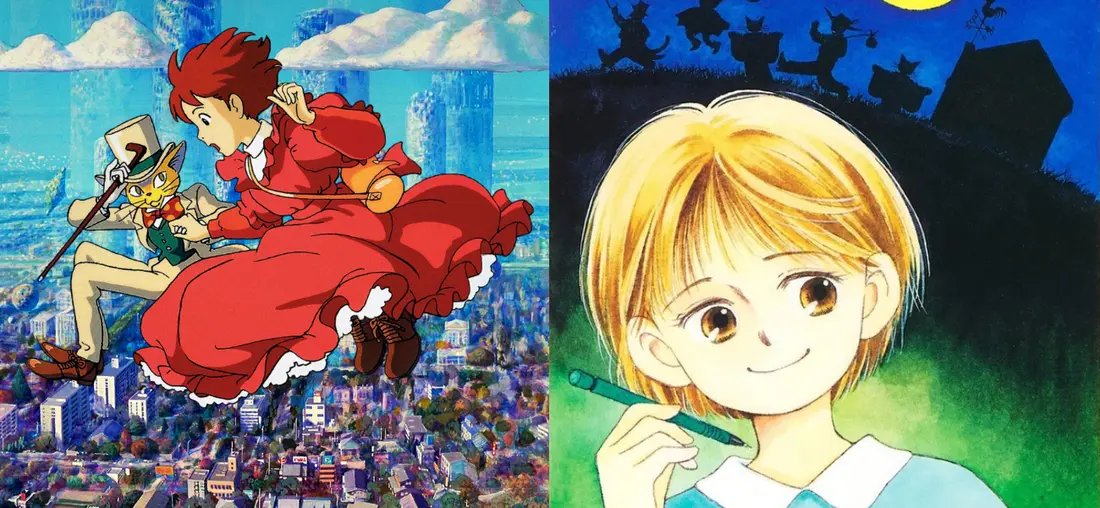
Whisper of the Heart is one of Studio Ghibli’s most beloved coming-of-age films, but its roots lie in a much shorter shoujo manga by Aoi Hiiragi. The 1995 animated adaptation keeps the manga’s youthful romance and love of imagination while reshaping the story into a more ambitious portrait of artistic ambition, family pressure, and the uncertainty of growing up.
For readers who know only the film, Hiiragi’s original Mimi wo Sumaseba offers a fascinating alternate version of Shizuku and Seiji’s relationship. It is lighter, more openly romantic, and considerably more expressive than the movie—while the Ghibli production expands the premise into something more grounded and emotionally searching.
A Short Shoujo Romance With a Big Imagination
The manga, published in 1989, presents Whisper of the Heart as a compact shoujo romance centered on Shizuku’s changing view of the world. She is imaginative, emotionally transparent, and deeply attached to fairy tales and fantasy. Her tendency to drift into daydreams gives the story much of its charm, but it also creates a contrast with the more complicated realities beginning to surround her.
Hiiragi’s artwork reinforces that youthful perspective. Shizuku’s expressions are often exaggerated, comedic, and wonderfully impulsive, making her feel like a real teenager rather than an idealized romance heroine. She reacts quickly to teasing, gets swept up in her own thoughts, and regularly has to confront the gap between the dramatic stories in her imagination and the ordinary people around her.
Seiji also comes across differently on the page. Rather than appearing primarily as a talented and determined figure, manga-Seiji feels more like an awkward teenage boy. He can be playful, embarrassing, and occasionally mean-spirited, especially when his own insecurities get in the way. That immaturity gives his exchanges with Shizuku a lively back-and-forth that is less prominent in the animated film.
The Manga Gives the Romance More Room to Develop
One of the most significant differences between the two versions is how Shizuku and Seiji move from irritation to affection. In the manga, their relationship develops through misunderstandings, bickering, and gradually shifting impressions. Shizuku’s early idea of Seiji is influenced by her imagination, and that image changes once she learns more about the person behind the name.
This shift matters because it becomes part of Shizuku’s emotional growth. She is forced to recognize that reality can be less glamorous than fantasy without being less meaningful. Seiji is not exactly the person she imagined, but he proves to be kinder and more sympathetic than she initially assumed.
The film includes some of this friction, but it establishes a bond between the characters more quickly. Their early interactions feel smoother, and the discovery of Seiji’s identity functions more as a humorous moment than as a major turning point in the romance. The adaptation also suggests that Seiji has been pursuing Shizuku’s attention in his own quiet way, particularly through the books he reads.
That change gives the film’s romance a more deliberate structure, but it also removes some of the manga’s charming awkwardness. The original feels like a classic shoujo story about two immature people discovering how much they have in common. The movie retains the affection between them while presenting Seiji as more composed, capable, and mature.
How Studio Ghibli Expands Shizuku’s Coming-of-Age Story
Studio Ghibli’s Whisper of the Heart, directed by Yoshifumi Kondō with a screenplay and story development associated with Hayao Miyazaki, takes the manga’s premise in a broader direction. The official Studio Ghibli listing identifies Aoi Hiiragi as the original creator, Kondō as director, and Miyazaki as producer, screenwriter, and storyboard artist. The film was released in Japan on July 15, 1995, and runs for approximately 111 minutes.
Rather than focusing mainly on romantic discovery, the film places greater weight on Shizuku’s anxiety about her own potential. Seiji’s dedication to violin-making becomes a source of inspiration, but it also creates pressure. Shizuku begins to wonder whether she has a passion or talent strong enough to stand beside his, and that uncertainty pushes her toward writing.
This version of Shizuku is less theatrically expressive than her manga counterpart, but she is no less imaginative. Her absent-minded behavior, sudden bursts of energy, and tendency to become lost in her own world remain essential to her personality. The difference is that the film frames her immaturity through responsibility and self-discovery rather than through exaggerated romantic comedy alone.
Family life also plays a much larger role in the adaptation. Shizuku’s relationship with her older sister and the expectations placed on her help create a stronger sense that childhood is ending. The film’s conflicts are not simply about whether Shizuku and Seiji like each other; they are also about whether the two teenagers can pursue their interests while dealing with school, family, and an uncertain future.
Seiji Becomes a Creative Counterpart
Both versions preserve an important part of Seiji’s character: he understands what it means to protect a passion that other people may not value. In the manga, his interest in fantasy and painting exists alongside pressure from his father, who wants him to pursue a more conventional future. That conflict helps explain his defensive attitude and his ability to empathize with Shizuku.
The film develops this idea through Seiji’s ambition to become a violin maker. His decision to study abroad makes his goals feel larger and more concrete, while also increasing Shizuku’s fear that she may be left behind. He becomes less of a teasing rival and more of a creative benchmark—someone whose determination encourages her to take her own abilities seriously.
From an adaptation perspective, this is where the movie becomes something more than a straightforward manga-to-screen translation. It transforms Seiji and Shizuku’s romance into a partnership between two young artists. Their relationship is still sweet, but it is also tied to questions about effort, identity, and the courage required to make something of your own.
Two Different Kinds of Whimsy
The manga’s whimsy comes primarily from Shizuku’s imagination, expressive reactions, fairy-tale interests, and the fast-moving energy of its shoujo storytelling. It feels intimate and playful, with the characters’ emotional immaturity always close to the surface.
The film creates its dreamlike atmosphere through animation, color, music, and richly detailed environments. Ordinary spaces—libraries, streets, shops, classrooms, and suburban neighborhoods—take on an almost magical quality. That visual approach allows the adaptation to preserve the manga’s love of fantasy even while making the story more realistic and serious.
The film’s use of music and creative work also gives Shizuku’s journey a stronger emotional framework. Her developing voice as a writer is not treated as a simple talent reveal; it becomes part of a difficult process of discovering what she wants and how much effort she is willing to invest in it.
Which Version Should You Experience?
Readers looking for a warm, compact shoujo romance will likely find the manga especially appealing. It offers more exaggerated character acting, more direct romantic development, and a charmingly youthful Shizuku-and-Seiji dynamic. Its brevity gives the story a fairy-tale quality, even as the characters begin to outgrow some of their childhood assumptions.
The animated film is the stronger choice for viewers drawn to artistic ambition, family relationships, atmosphere, and the emotional uncertainty of adolescence. It broadens the original concept without abandoning its central tenderness, turning a short romance into a richly textured coming-of-age film.
Ultimately, the manga and the Ghibli adaptation are not competing versions so much as complementary ones. Hiiragi’s work captures the exhilaration of first love and the imaginative intensity of being young. Kondō’s film carries those ideas into a more expansive story about creative identity, responsibility, and the frightening possibility of choosing a future for yourself.
Sources
- romancemangarecs.com
- ghibli.jp
- mangamillion.shueisha.co.jp
- japantimes.co.jp