
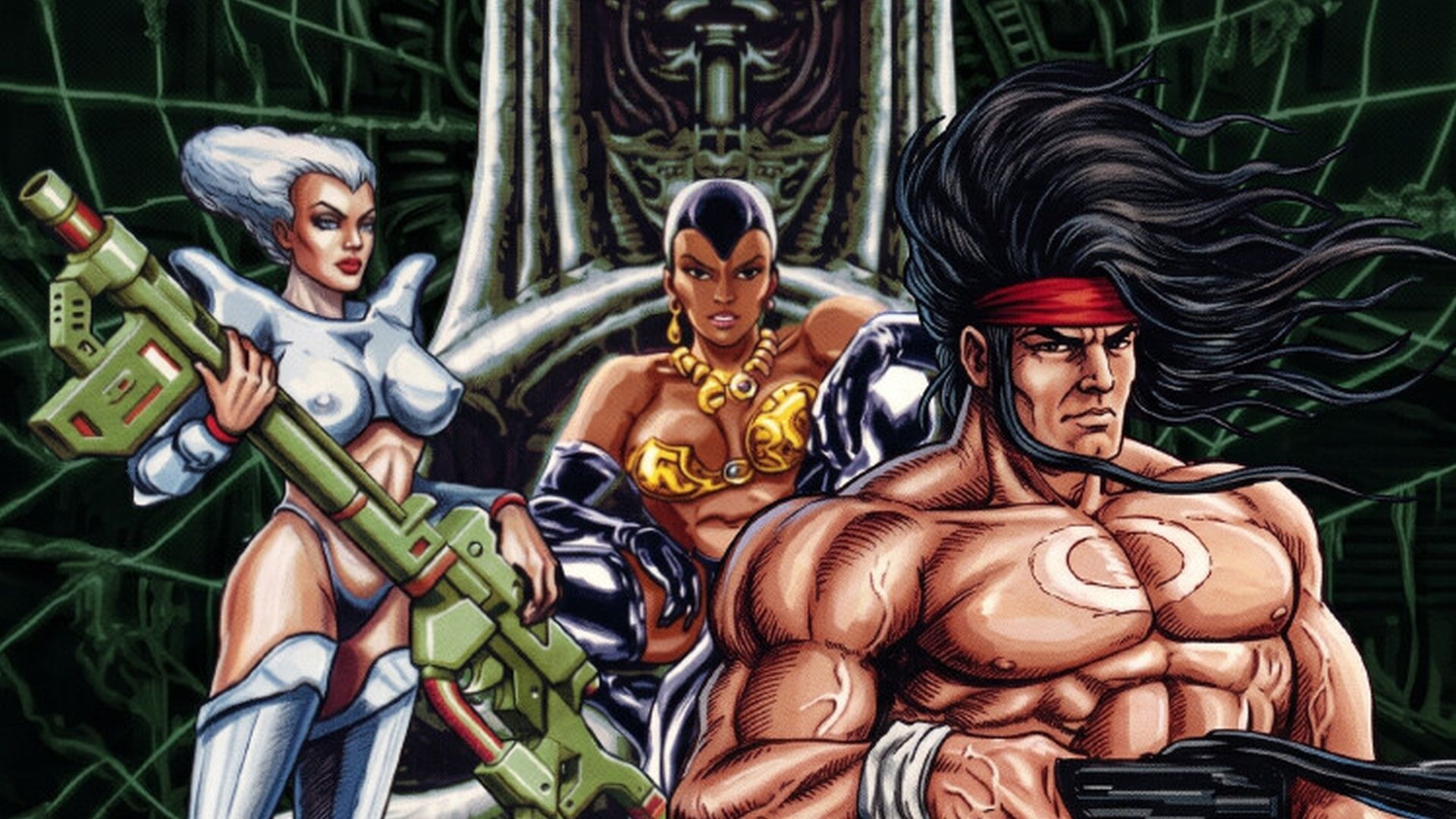
Two of Spain’s strangest arcade relics are getting a second life on PC. QUByte Interactive is bringing Gaelco’s Thunder Hoop and TH Strikes Back to Steam on October 8, 2026, giving modern players a chance to experience a pair of aggressively ’90s platform shooters where a Goku-like bio-engineered hero battles mutant armies, grotesque bosses, and an aesthetic that seems assembled from Dragon Ball, sci-fi horror, and arcade excess.
The Thunder Hoop Collection is more than a straightforward emulation release. It packages both Gaelco games with save states, rewind functionality, customizable CRT-style screen filters, Steam achievements, Steam Cloud support, and Remote Play Together. For a series that was designed to consume quarters rather than respect your evening, those additions could make a significant difference.
A forgotten corner of Spain’s arcade history
Gaelco was one of Spain’s most notable arcade developers, best known internationally for games such as World Rally. The company’s catalogue also included stranger and more experimental projects, and Thunder Hoop sits firmly in that category. The original arcade game was released in 1992, with TH Strikes Back following in 1994.
The first game introduces Thunder Hoop as a young, genetically engineered hero created to stop the bio-monsters unleashed by Dr. Genbreak. Its campaign moves through city environments, sewers, underwater stages, and other classic arcade backdrops, combining platforming with hand-fired attacks and boss encounters.
It is a remarkably direct premise, but the visual identity is difficult to ignore. Thunder Hoop’s spiky hair, energy blasts, and exaggerated action immediately recall the global popularity of Dragon Ball, while the enemies draw from a more unsettling strain of early-’90s science fiction. The result is not a polished licensed adaptation, but an unmistakably European arcade interpretation of the era’s biggest visual obsessions.
The sequel turns the chaos up several notches
TH Strikes Back does not simply continue the original’s formula. It ages Thunder Hoop into a much larger, more muscular action hero and shifts the emphasis toward faster run-and-gun combat. The sequel is more aggressive, more visually excessive, and considerably less interested in subtlety than its predecessor.
That escalation extends to the enemy designs. The game features mutant foes dressed in provocative latex-inspired outfits, along with a boss whose appearance includes exposed breasts. It is very much a product of the 1990s arcade market, when shock value, sexualized character design, and grotesque spectacle were often treated as selling points rather than liabilities.
The sequel also includes a transformation sequence that sends Thunder Hoop into a powered-up state before the action shifts into a spacebound, side-scrolling shooter segment. That sudden change of genre captures the collection’s appeal: these are not carefully restrained retro exercises, but games willing to throw another idea onto the screen whenever the previous one starts to run out of momentum.
Two games, two very different multiplayer approaches
Multiplayer support is one of the more important distinctions between the two titles. TH Strikes Back supports simultaneous local two-player co-op, allowing both players to fight through the mutant hordes together. The original Thunder Hoop, by contrast, uses alternating turns rather than simultaneous co-operative play.
That makes the sequel the more immediately attractive option for couch multiplayer, especially when combined with Steam’s Remote Play Together feature. The alternating-turn structure in the first game is more historically authentic to the arcade experience, but it may feel less satisfying to players expecting the collection to offer co-op throughout.
The contrast also reflects how quickly arcade design was changing in the early 1990s. Gaelco’s first game is rooted in platforming and deliberate stage navigation, while its follow-up leans into speed, enemy swarms, and the spectacle of having two players occupy the screen at once.
Modern conveniences for old-school difficulty
The collection’s save states and rewind function could be essential rather than ornamental. Contemporary commentary on the arcade originals frequently points to their uneven difficulty and quarter-munching design, particularly when attempting to play without continuing. Rewind will let players correct individual mistakes, while save states should make it easier to study later stages without repeatedly replaying the opening sections.
That accessibility may also reveal the difference between the games’ ambition and their execution. The sequel is often regarded as the more exciting of the pair because it moves faster and delivers more constant shooting, but that intensity can come with rough balance and chaotic stage design. The original has a stronger platforming identity, though its slower pace and arcade-style punishment may make it less immediately approachable.
Neither game should be mistaken for a lost rival to Contra or Metal Slug. Their appeal lies elsewhere: they are vivid snapshots of a regional arcade scene, full of unusual ideas, visual oddities, and the kind of unfiltered ’90s energy that modern games rarely attempt. For preservation-minded players, that eccentricity is precisely the point.
Release details and PC requirements
Thunder Hoop Collection launches on Steam on October 8, 2026. The collection is being developed and published by QUByte Interactive, with Bleem.net and Piko Interactive LCC also listed as publishers on the Steam page.
The PC requirements are modest by current standards, although the collection requires a 64-bit version of Windows 10 or later. The minimum specification lists 4GB of RAM, a 3.0GHz Intel i3 or AMD equivalent, DirectX 11, and 2GB of available storage. Recommended requirements rise to 16GB of RAM and a Core i5-9600K or Ryzen 5 3600-class processor.
There are currently no user reviews on Steam, so the collection’s emulation quality, input response, presentation, and overall value remain untested by the wider PC audience. Still, the package has a clear niche. Anyone interested in obscure arcade history, bizarre run-and-gun design, or games that look like a bootleg anime fever dream should keep an eye on this one when it arrives in October.
Sources
pcgamer.com
store.steampowered.com
arcade-museum.com
timeextension.com
seafoamgaming.com