
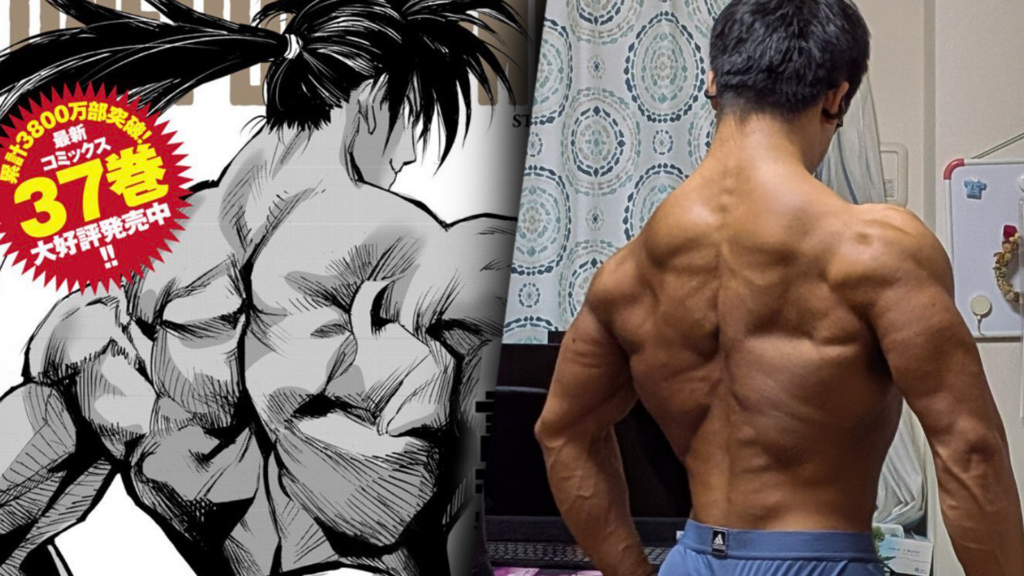
One-Punch Man artist Yusuke Murata has revealed an unexpectedly personal source behind the cover artwork for the manga’s latest chapter: his son, competitive bodybuilder Keisuke Murata. The real-life reference came to light after Chapter 283 appeared on Shueisha’s Tonari no Young Jump, connecting Murata’s famously detailed superhero artwork with his family’s own bodybuilding background.
Keisuke Murata Reveals the Cover’s Real-Life Model
After Chapter 283 was released, Keisuke shared a photograph of himself striking the same pose used in the new arc’s cover illustration. He confirmed that he served as both the model and reference material for the artwork, turning what might have seemed like a typical display of superhuman anatomy into a collaboration between father and son.
The reveal is especially fitting for One-Punch Man, a series known for treating physical power as both spectacle and comedy. Murata’s illustrations often emphasize dramatic proportions, tightly defined muscles, and carefully studied action poses. Having a competitive bodybuilder serve as a direct reference gives the cover an added layer of authenticity while preserving the exaggerated visual language that defines the manga.
A Family Connection Behind Murata’s Art
Keisuke Murata previously attracted attention in 2024 after placing second in the 170-centimeter-and-under category at Japan’s National High School Boys Bodybuilding Championship. Yusuke Murata publicly celebrated the result, while Keisuke acknowledged that he was disappointed not to take first place and expressed his intention to keep improving.
The artist has also shared glimpses of his children’s own creative interests over the years. In 2014, Murata posted an illustration drawn by his son when he was seven years old. He later shared artwork by his daughter, including illustrations connected to Toilet-bound Hanako-kun, when she was ten.
Those earlier posts offered a charming look at a family surrounded by drawing and visual creativity. Keisuke’s appearance as a reference for official One-Punch Man artwork takes that connection a step further: instead of simply showing a child’s drawing, Murata incorporated his son’s physical discipline and posing experience directly into the manga’s production process.
Why the Reference Works So Well for One-Punch Man
Murata’s art has always relied on the contrast between ordinary life and extraordinary physicality. Saitama may be bored by his overwhelming strength, but the surrounding heroes and monsters are frequently presented with the intensity of bodybuilding photography, martial-arts illustration, and superhero comics.
That approach makes a bodybuilder an unusually appropriate reference model. Competitive bodybuilding is built around posture, symmetry, muscle control, and presentation—all qualities that can help an artist capture a convincing heroic silhouette. The result is not realism in the strict sense; One-Punch Man remains a heightened action comedy. Instead, the real-life reference strengthens the believable foundation beneath Murata’s larger-than-life designs.
It also reflects one of the pleasures of serialized manga art. Readers often focus on the finished page, but striking images can emerge from a range of references, techniques, and personal experiences. In this case, the production detail became part of the story surrounding the chapter itself, giving fans another reason to examine the cover beyond its immediate visual impact.
One-Punch Man Continues Across Manga and Anime
One-Punch Man began as ONE’s original web manga before being remade as the serialized version written by ONE and illustrated by Yusuke Murata. The manga continues through Tonari no Young Jump, while VIZ Media publishes the series in English.
Murata is also widely recognized for his work on Eyeshield 21, another major sports-action manga. His connection to athletic movement is visible across both works, although One-Punch Man gives him a much broader canvas for combining explosive battles, grotesque monster designs, deadpan humor, and cinematic page composition.
The franchise’s anime side is continuing as well. The second part of the anime’s third season has been confirmed for production, keeping the series active across both its original manga format and its screen adaptation. For readers following the latest chapters, however, Chapter 283’s cover offers a more intimate reminder of the artist behind the spectacle—and the real-life inspiration that can sometimes stand just outside the panel.
Sources
- animecorner.me
- tonarinoyj.jp
- books.shueisha.co.jp