

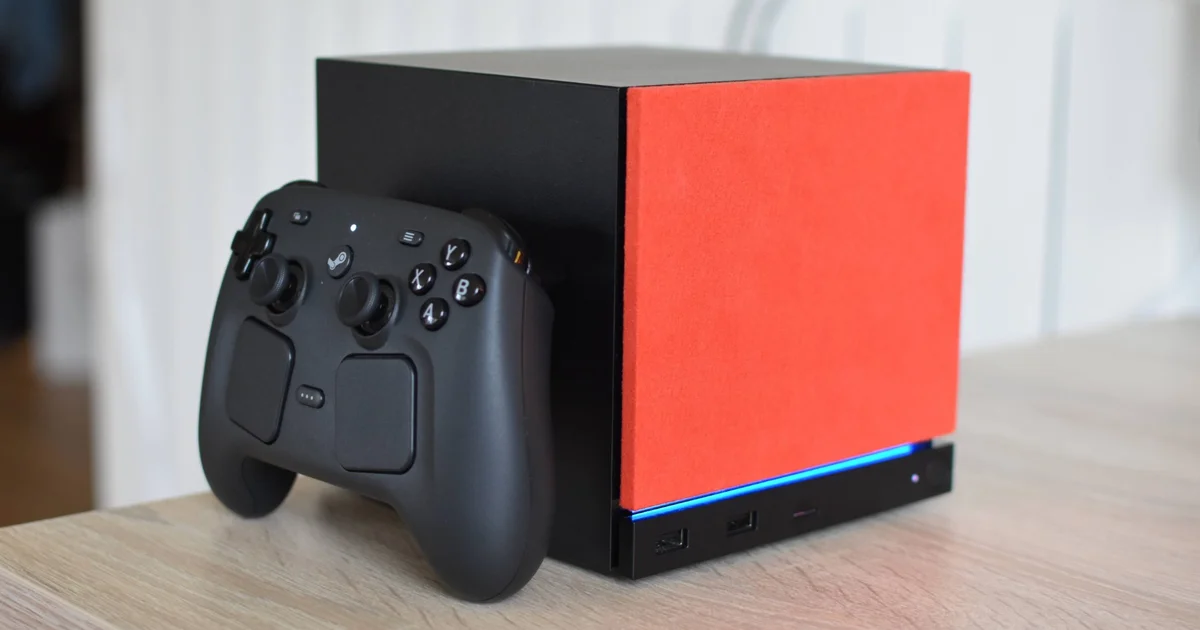
Valve has delivered a fresh dose of bad news for anyone hoping the Steam Machine might eventually become cheaper: the company believes the global memory shortage is still getting worse. Valve engineers Yazan Aldehayyat and Pierre-Loup Griffais offered the warning in an interview with Bloomberg’s Jason Schreier, arguing that the prices consumers see on retail shelves may not yet reflect the full impact of tightening bulk supply.
That matters even after the Steam Machine’s launch. Valve’s compact SteamOS PC went on sale in June with a starting price of $1,049 for the 512GB model without a controller, while the 2TB version costs $1,349 before adding the separately priced Steam Controller. Those figures already placed the machine in an uncomfortable position between traditional consoles and more flexible small-form-factor PCs. A prolonged memory crisis makes the possibility of future price cuts look increasingly remote.
The retail market may be behind the real problem
“Honestly, it’s still getting worse,” Aldehayyat said when discussing the memory shortage. His more worrying point was that retail pricing may lag behind bulk supply conditions by three to six months, meaning apparent stability at consumer retailers could be misleading rather than reassuring.
In practical terms, the RAM and storage market may not have reached its worst point yet. Prices for some DDR5 SO-DIMM modules and compact NVMe SSDs have shown periods of stability or even small declines, but that does not necessarily mean manufacturers are enjoying cheaper or more reliable access to components. If the retail market is reacting several months after suppliers, today’s prices could represent a temporary plateau before another increase.
Valve has stopped short of predicting where Steam Machine pricing goes next. That caution is understandable. Hardware costs are difficult enough to forecast under normal conditions, and the current market is being distorted by demand from enormous artificial intelligence data centers competing for memory, storage, and other high-performance components.
Why the Steam Machine was already expensive
The Steam Machine was designed around a very different assumption about PC hardware pricing. Valve’s engineers said the original design work and component sourcing were based on memory and storage costs from roughly two years earlier, when the company expected those parts to become cheaper over time.
Instead, the opposite happened. The final machine launched with a semi-custom AMD Zen 4 six-core processor, an RDNA 3-based GPU, 16GB of DDR5 system memory, 8GB of GDDR6 VRAM, and either 512GB or 2TB of storage. That combination is packaged inside a compact living-room enclosure with SteamOS integration, controller connectivity, HDMI-CEC support, and a quiet cooling solution.
Those features give the Steam Machine a distinct appeal, particularly for PC players who already own a substantial Steam library and want a console-like experience without abandoning PC storefronts, settings, mods, or hardware flexibility. Valve has also positioned it as a proper PC rather than a closed console, with users able to install other operating systems, including Windows.
The problem is that the machine’s physical design and software convenience do not make its components immune to market forces. A small, quiet PC is more difficult to build than a conventional desktop assembled from readily available retail parts, and Valve is not subsidizing the hardware in the same way console manufacturers sometimes do. That leaves the Steam Machine exposed to the full cost of memory and storage inflation.
Reviews like the design, but question the value
Early critical reaction has reflected that tension. PC Gamer praised the Steam Machine’s small form factor, cool and quiet operation, customizable faceplates, and generally strong SteamOS integration. However, the outlet criticized its price, setup quirks, and performance ceiling, arguing that the hardware can feel underpowered for the money.
The concern is not that the Steam Machine cannot run demanding games. Rather, reviewers found that buyers may need to rely heavily on upscaling, frame generation, and reduced graphical settings to achieve smooth performance in more intensive titles. That trade-off is easier to accept on a cheaper device, but becomes more difficult to justify when the machine costs more than several traditional console configurations.
For indie games, older titles, strategy games, and the enormous back catalog associated with Steam, the hardware can make much more sense. The Steam Machine’s appeal is strongest when its compact footprint and console-style interface are treated as the product’s core advantages. For players chasing maximum frame rates or high-end 4K performance, a conventional gaming PC remains the more convincing option.
Don’t expect a quick route to a cheaper model
Valve’s comments do not guarantee that the Steam Machine will become more expensive. They do, however, make a near-term price reduction look like the least likely outcome. If retail pricing is several months behind bulk supply conditions, even a period of stability may be a delayed response to worsening availability rather than the beginning of a recovery.
That creates an awkward situation for Valve. The company’s hardware is often associated with strong value, from the Steam Deck’s relatively accessible entry point to SteamOS’s ability to make PC gaming feel less intimidating from the sofa. The Steam Machine is trying to extend that philosophy into a more powerful living-room system, but the memory crisis has pushed it into a price category where buyers are far less forgiving.
The wider lesson is even more uncomfortable: the hardware market is no longer being shaped solely by gamers, PC builders, and console manufacturers. AI infrastructure projects are consuming resources at a scale that can influence the prices of everyday upgrades and complete systems. Until supply catches up with that demand, the best-case scenario for the Steam Machine may not be a cheaper price at all, but simply avoiding another increase.
For now, prospective buyers should view the Steam Machine as a niche living-room PC with a premium attached to its size, software integration, and convenience. Anyone hoping to wait a few months for a dramatic discount may be waiting a long time.
Sources
rockpapershotgun.com
steamcommunity.com
tomshardware.com
pcgamer.com