
Royal Caribbean has built something that comic-book fans rarely see outside a publisher’s office: an original superhero universe with no monthly issues, no direct-to-streaming adaptation and no familiar corporate mascot at its center. Instead, The Effectors exists as a live theatrical franchise, combining comic-book archetypes with lasers, projection mapping, aerial performance and indoor drone technology.
That makes the production more than a cruise-ship novelty. It is an unusual experiment in original-IP development—and one that gives Royal Caribbean complete control over its characters, mythology and future expansion.
A superhero team powered by creativity
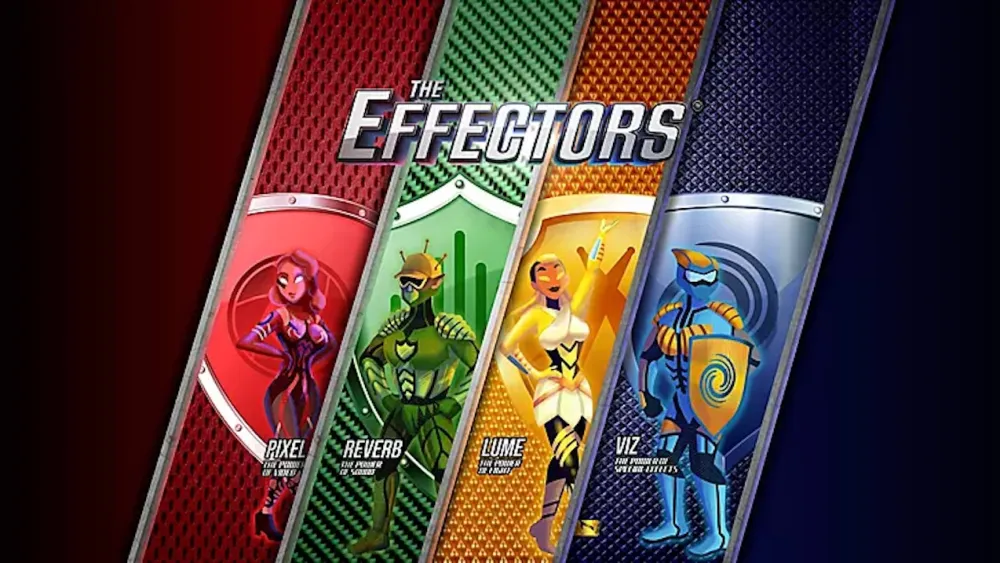
The premise is straightforward and deliberately oversized. Four heroes use artistic and technical abilities as superpowers, joining forces against the villain Crash and his forces of airborne drones and henchmen.
Viz serves as the team’s leader, bringing coordination and strategy to the group. Royal Caribbean’s earlier promotional material identified the character as Captain Coreo, making Viz one of the franchise’s more noticeable naming refinements over time. Pixel controls video, imagery and visual displays, while Reverb manipulates sound and music. Lume, described as the team’s dynamic powerhouse, specializes in light, lasers and color.
The concept is clever in its simplicity. Rather than giving the heroes the usual super-strength, super-speed or cosmic abilities, The Effectors turns the mechanics of live entertainment into its power system. A lighting cue becomes an attack. A projection becomes a duplicate. A sound effect becomes a weapon. The show’s technology is not merely decoration; it is the language of the fictional universe.
Tonally, the production occupies a space somewhere between a family-friendly Avengers-style team adventure and a Broadway spectacle. The dialogue and character types are intentionally broad, but that theatricality is part of the appeal. The Effectors is not trying to disguise its stage origins. It embraces them.
From origin story to “Crash ’n’ Burn”
Royal Caribbean has treated the property as a continuing saga rather than a one-off production. The original The Effectors introduced the team aboard the Odyssey and Spectrum of the Seas, establishing the heroes’ powers and their conflict with Crash.
The Effectors II: Crash ’n’ Burn expanded the formula aboard Wonder of the Seas. The sequel brought back Viz, Lume, Pixel and Reverb while adding Burn as Crash’s sidekick. Royal Caribbean positioned the production as a larger and more technologically ambitious follow-up, with the heroes again using their creative powers to save the day.
The franchise has also moved outside the traditional theater setting. The Effectors: Homecoming Parade, presented aboard Utopia of the Seas, shifts the action to the Royal Promenade. Rather than a conventional sit-down show, it is framed as a street-style celebration following Crash’s capture—with the expected suggestion that the villain may not remain safely imprisoned for long.
That distinction matters. The Royal Theater productions can function like traditional musical spectaculars, while Homecoming Parade turns the characters into a roaming, interactive presence within the ship. It is a small but meaningful step toward making the Effectors feel like a broader entertainment brand instead of a single stage show.
The technology is the real superpower
Even viewers unmoved by the story may find plenty to admire in the production design. Royal Caribbean describes the shows as using digital video effects, LED lighting, lasers, aerial acrobatics and drone technology alongside singers and dancers.
Verity Studios, which worked on the indoor drone elements, identifies the Effectors productions as a series built around 48 Lucie micro-drones aboard each participating ship. The drones are used as Crash’s airborne army, flying above the audience in coordinated formations. That is a striking technical achievement in a compact indoor theater, particularly because the sequence must be synchronized with performers, lighting, projections and the movement of the show itself.
One independent cruise review reached a similar conclusion: the production’s visual effects and stage mechanics were more impressive than its storytelling. The review highlighted character-specific effects, including apparent cloning and projection work for Pixel, laser choreography for Lume and elaborate transformations associated with Viz and Reverb.
That criticism is also a useful way to understand The Effectors. It is not primarily a character drama. The heroes have recognizable personalities, but the production’s biggest emotional beats are designed to support the spectacle. The central question is less “Will this story permanently change the Marvel Universe?” and more “How did they just do that on a moving ship?”
Why create an original superhero universe?
Royal Caribbean could have pursued a licensed Marvel or DC production, but an original property offers advantages that a famous superhero brand cannot. The company does not need to coordinate with a comic publisher, film studio or larger entertainment conglomerate to approve every costume, character decision or story development.
That creative independence gives Royal Caribbean room to build the franchise around its own strengths. The heroes are tied directly to performance, music, projection and spectacle—the same tools that make a cruise production distinctive. In business terms, the concept turns the company’s entertainment infrastructure into part of the mythology.
There is also a collector-minded appeal to the idea, even though The Effectors is not currently a conventional comic-book publishing line. The characters have distinct visual identities, named villains and sequel-style installments. They possess the basic building blocks of a transmedia franchise. If Royal Caribbean ever expanded the property into comics, animation, apparel or toys, the stage productions would already provide a foundation for that world.
For now, however, the franchise remains firmly rooted in live entertainment. That limitation is important. A cruise booking made solely to see The Effectors may be difficult to justify for someone who dislikes the cruise experience, and availability depends on the ship and its entertainment schedule. But for passengers who enjoy spectacle, the show offers something unusually ambitious: a homegrown superhero universe designed from the beginning around live performance.
The Effectors may never challenge Batman, Spider-Man or Superman for cultural dominance. It does not need to. Its significance is that it demonstrates how superhero world-building can emerge outside traditional comics, television and film. On Royal Caribbean’s ships, the medium is not the page or the screen. It is the stage—and the stage can fly.
Sources
- aiptcomics.com
- royalcaribbean.com
- royalcaribbeanpresscenter.com
- cruisehabit.com
- veritystudios.com