

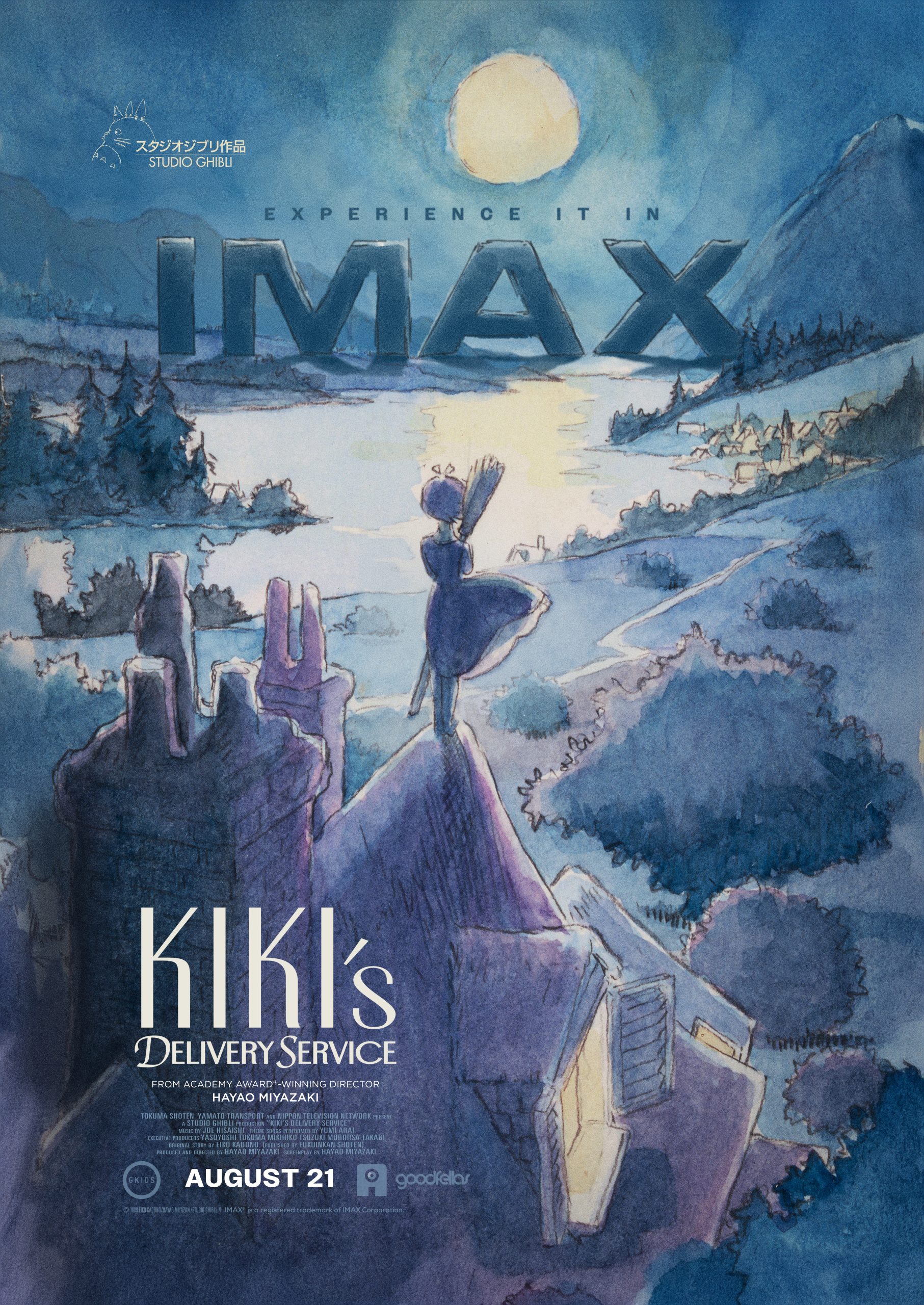
More than three decades after its Japanese debut, Kiki’s Delivery Service remains one of Studio Ghibli’s most inviting films. Hayao Miyazaki’s coming-of-age classic has now received a newly remastered 4K presentation from GKIDS, giving audiences another chance to experience Kiki’s seaside adventures on the big screen—including the film’s first IMAX engagement in North America, which began on March 13, 2026.
That renewed presentation is a fitting way to revisit a movie built around small details: laundry fluttering in the breeze, bicycle wheels rattling over cobblestones, a bakery waking up for the morning, and a young witch trying to figure out where she belongs. Kiki’s Delivery Service may feature broomsticks and talking cats, but its emotional core is remarkably grounded.
Our screener was provided by GKIDS.
A gentle story about finding your place
Kiki is a 13-year-old witch who leaves home with her black cat, Jiji, to spend a year living independently in a new town. Her magical abilities are limited to flying, so after arriving in the picturesque coastal city of Koriko, she turns that one skill into a business: a delivery service operated from the attic of a local bakery.
The setup gives Miyazaki plenty of room to explore the excitement of independence. Kiki has a new home, a new job, and the freedom to make her own decisions. She also meets Tombo, an enthusiastic aviation fan whose interest in flight mirrors her own, even if his eagerness initially gets on her nerves.
But the film is less interested in presenting independence as a simple wish-fulfillment fantasy than in showing what happens after the adventure begins. Kiki encounters unfriendly customers, awkward social situations, and the quiet pressure of having to prove herself. The town may be charming, but it is not always welcoming, and her confidence gradually begins to erode.
That emotional shift is the heart of the movie. When Kiki loses the ability to fly—and can no longer understand Jiji—the story turns a familiar magical premise into an affecting portrait of burnout, loneliness, and self-doubt. Miyazaki never treats these struggles as a melodramatic crisis. Instead, they arrive in the same understated way that real growing pains often do: gradually, and then all at once.
Why the animation still feels extraordinary
Released in Japan on July 29, 1989, Kiki’s Delivery Service was adapted from Eiko Kadono’s 1985 children’s novel. Miyazaki retained the basic idea of a young witch establishing herself in a new community, while reshaping the material into a more focused film about confidence and maturity.
The result is a world that feels lived in rather than simply decorated. Koriko is a fictional European-inspired city, but every street, shop, harbor, and rooftop seems to have a history beyond the edges of the frame. Kiki’s deliveries become an excuse to explore that environment, whether she is flying over red-tiled roofs or weaving through the bustle below.
The hand-drawn artwork benefits enormously from the 4K presentation. The remaster does not need flashy visual effects to make an impression; its appeal comes from the richness of the backgrounds and the expressive movement of ordinary life. A crowded market, a room full of baking supplies, or a gust of wind catching Kiki’s skirt can feel as carefully observed as the film’s more overtly magical moments.
Joe Hisaishi’s score is just as important to the atmosphere. The music gives Kiki’s flights a sense of exhilaration while also supporting the film’s quieter stretches. Alongside the songs associated with the movie, it helps create the warm, comforting tone that has made the film such a durable favorite.
The English dub remains a major draw
The English-language version brings together Kirsten Dunst as Kiki, Matthew Lawrence as Tombo, Tress MacNeille in multiple roles, and Phil Hartman as Jiji. Dunst gives Kiki a youthful but believable edge, capturing both her excitement and the frustration that comes when her carefully planned new life begins to feel overwhelming.
For longtime fans, the dub is also part of the film’s history in English-speaking territories. It reached those audiences in 1998, nearly a decade after the original Japanese release, and its cast helped introduce the movie to viewers who may not otherwise have encountered Studio Ghibli’s work.
There is a slower rhythm here than many contemporary animated films offer. At 102 minutes, the film is not especially long, but it allows scenes to breathe instead of rushing from one plot point to the next. Younger viewers accustomed to constant action may need a little patience, yet the payoff is a story that trusts its audience to notice mood, expression, and atmosphere.
Kiki’s Delivery Service is ultimately a film about recovering a sense of self—not by becoming more powerful, but by understanding that ability and identity are not the same thing. It is funny, beautiful, occasionally melancholy, and deeply reassuring without becoming sugary. Whether this is a first viewing or a return visit, the 4K presentation makes a strong case for seeing Kiki’s world on the biggest screen available.
For fans planning another trip to Koriko, the remastered theatrical presentation is well worth keeping an eye out for, while home releases remain an excellent way to revisit the film’s quieter details. More importantly, Miyazaki’s story still offers the same gentle reminder it did in 1989: growing up can be lonely, but losing your way does not mean you are lost forever.
Sources
gkids.com
studioghibli.jp
ghibli.jp