
Sideshow’s history with Frankenstein’s Monster begins not with a modern Premium Format™ Figure, but with an ambitious 1997 model kit based on Bernie Wrightson’s legendary interpretation of Mary Shelley’s creation. Long before pre-painted statues became the company’s specialty, this elaborate garage kit established a creative direction that would influence Sideshow’s approach to horror, licensed collectibles, and artist collaborations for decades.
For collectors, the kit remains important for more than its subject matter. It represents an early point in Sideshow’s evolution, when the company was still working primarily in prototyping, maquettes, special-effects fabrication, and model kits. It was also a rare meeting of several disciplines: Wrightson’s illustration, studio sculpting, diorama design, model engineering, painting, photography, and packaging were all treated as parts of a single collectible experience.
A Frankenstein Built for the Model-Kit Era
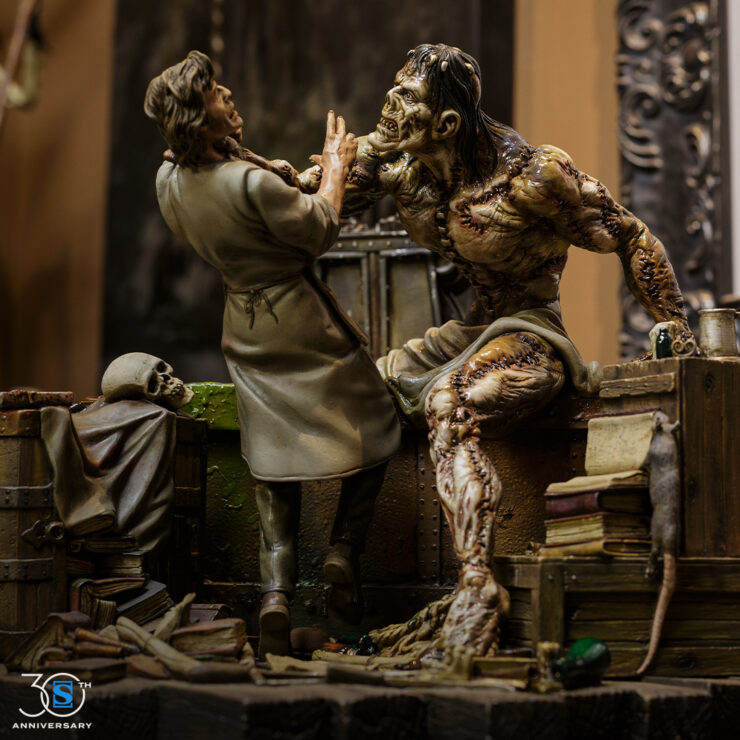
Released under the Sideshow Inc. name, Bernie Wrightson’s Frankenstein was advertised as a highly detailed, 1/8-scale vinyl model kit. Unlike a simple character bust or creature figure, the release presented an entire scene: Victor Frankenstein and his reanimated creation stood inside a cluttered nineteenth-century laboratory filled with atmospheric details, including skulls, rats, wooden structures, and a bio-electrical creation vat.
The kit arrived unassembled and unpainted, placing it firmly in the tradition of serious hobby projects. Collectors were expected to clean, fit, assemble, prime, and paint the parts themselves. That distinction is central to the kit’s appeal today. It was not merely a statue waiting to be removed from a box; it was a project intended to become a personal interpretation of Wrightson’s artwork.
At the time, resin dominated the collectible garage-kit market. Sideshow’s move into polyvinyl allowed the company to produce a large, intricate diorama while keeping the release suitable for distribution to hobbyists. The format was not without challenges. Later builder discussions have frequently pointed to the demanding nature of assembling older vinyl kits, particularly when large parts require careful fitting, reinforcement, and heat treatment. Even so, completed examples continue to attract attention because the underlying sculpt and composition have considerable display presence.
Bernie Wrightson’s Monster in Three Dimensions
Wrightson’s Frankenstein illustrations occupy a special place in horror art. Created for his celebrated illustrated edition of Mary Shelley’s novel, the images drew on the visual language of woodcuts and steel engravings, combining dense linework with an almost architectural command of shadow, texture, and anatomy.
His creature was neither a straightforward movie monster nor a generic undead brute. Wrightson’s design emphasized the physical consequences of being assembled from dead human parts, while still preserving the tragedy and emotional weight of Shelley’s character. Translating that vision into sculpture required more than simply reproducing a face. The kit needed to capture the creature’s posture, proportions, clothing, and sense of unease within a complete narrative environment.
Sideshow’s Tom Gilliland has explained that Wrightson supplied additional drawings during development to help establish details for the three-dimensional sculpture. That collaboration is one of the kit’s most significant features. Rather than treating the original illustrations as a fixed reference library, the production team worked with Wrightson to expand the visual language of the character and laboratory for a new medium.
Dan Platt sculpted Victor Frankenstein and the Monster, while Mat Falls handled the laboratory diorama. Ken Morgan served as art director and designer, Gilliland painted the finished prototype, David Bassett photographed it, and Robin Selvaggi designed the packaging. The kit also included an exclusive fine-art print based on the concept drawing that informed the sculpture.
Why the Painted Prototype Still Matters
For modern statue collectors, the most familiar version of the kit is usually the fully assembled and painted prototype shown in promotional photography. It is easy to forget how unusual that presentation was for a garage kit in the 1990s. Sideshow approached the product almost like a film production, commissioning professional photography and creating full-color packaging around the finished display piece.
That decision mattered. The painted prototype showed builders what the kit could become, but it also gave the release the kind of theatrical presentation normally associated with finished collectibles. The laboratory reads as a complete environment rather than a simple base, with the Monster and his creator locked into a moment of gothic melodrama.
From a collector’s perspective, the composition is arguably more important than any individual portrait. The two figures create a visual conversation, while the cluttered lab gives the eye plenty of smaller details to discover. It is the sort of piece that rewards a display position where viewers can examine it from multiple angles rather than treating it as a front-facing shelf ornament.
There are also practical considerations for anyone pursuing an original example. Because the kit was sold unpainted and intended for assembly, condition can vary dramatically between surviving pieces. Boxed, complete kits with instructions, the promotional print, and undamaged vinyl parts are naturally more desirable than partially built or incomplete examples. Finished builds, meanwhile, can differ widely depending on the painter’s skill and interpretation.
From Phone Orders to Finished Statues
In 1997, acquiring the kit required a very different kind of commitment than placing an online preorder. Sideshow promoted its releases through printed mailers, with collectors calling a direct phone line, completing an order slip, and mailing payment. The advertised retail price for the Frankenstein kit was $130, plus shipping and handling.
That figure may sound modest beside today’s premium statues, but the kit occupied a different part of the hobby market. The cost of entry was only the beginning. Builders also needed tools, paints, adhesives, workspace, and considerable time. The real value proposition was the opportunity to create a large-scale, display-worthy interpretation of Wrightson’s Frankenstein through hands-on craftsmanship.
That experience helped shape Sideshow’s later move toward pre-painted collectibles. The company recognized that many fans wanted the visual impact of a detailed sculpt without the considerable labor required to complete a garage kit. The result was a gradual shift toward finished products that could be unboxed and displayed immediately, eventually leading to formats such as the Premium Format™ Figure.
The connection remains visible in Sideshow’s modern Frankenstein releases. Its quarter-scale Universal Monsters statue, offered in fully sculpted and mixed-media editions, uses interchangeable portraits, a detailed castle-laboratory setting, and optional shackles to provide display flexibility. These newer pieces are based on Boris Karloff’s 1931 film portrayal rather than Wrightson’s specific design, but they reflect the same interest in environment, theatrical presentation, and multiple display options.
A Landmark for Horror Collectors
Bernie Wrightson’s Frankenstein is best understood as a landmark model kit rather than simply an old Sideshow release. It arrived at a moment when the company was still defining its identity and demonstrated that a licensed horror collectible could function as sculpture, diorama, art object, and hobby project all at once.
For dedicated model-kit builders, the appeal lies in the opportunity to assemble and paint a historically significant Sideshow piece. For Wrightson fans, it is one of the clearest physical translations of his Frankenstein imagery. For Sideshow collectors, it is an early expression of the collaborative design philosophy that would later become central to the company’s artist-driven statues and fine-art programs.
Collector verdict: This is a release for hobbyists and horror-art devotees who value provenance, craftsmanship, and historical importance as much as convenience. It is not the ideal choice for collectors seeking a modern, factory-finished display piece, but for those who appreciate the garage-kit era, Bernie Wrightson’s visual legacy, and Sideshow’s early creative ambitions, the Frankenstein model kit remains one of the company’s most meaningful releases.
The original painted prototype reportedly remains on display at Sideshow’s studio, a fitting reminder of how much the company’s collectible philosophy has changed since the 1990s—and how much of that philosophy was already present in this ambitious laboratory scene.
Sources
- sideshow.com
- collectorfreaks.com
- amazingstories.com