
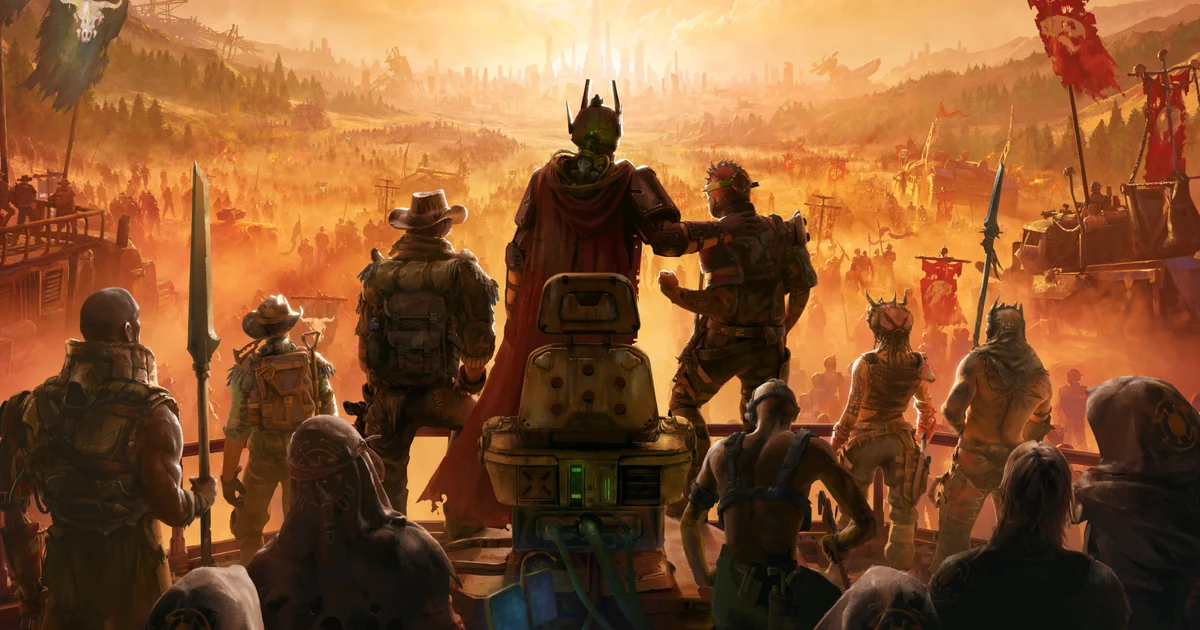
Paradox Interactive is leaving behind its familiar historical map for something far more dangerous. The publisher has announced Afterworld, a post-apocalyptic grand strategy game set in a procedurally generated North America, where players will guide a small band of survivors from desperate scavengers to the founders of a new empire.
The project is a notable change of direction for Paradox Development Studio. After years of returning to established historical series, Afterworld is being positioned as the studio’s first grand strategy game built around an original setting in more than a decade. It is also an ambitious attempt to combine Paradox’s political and military simulations with survival systems, settlement management, exploration, and generational storytelling.
A new world for Paradox’s grand strategy formula
Afterworld begins at the smallest possible scale. Rather than taking control of an established nation, players start with a handful of survivors struggling to secure food, water, fuel, and shelter in the ruins of the old world. From there, the goal is to establish settlements, expand into new territories, and eventually build a continent-spanning power.
The setting is a ruined North America whose geography remains recognizable, but whose resources, factions, threats, and opportunities change from one playthrough to the next. That procedural structure should give each campaign a different strategic texture, particularly when a promising region turns out to be dangerously short on supplies or surrounded by hostile groups.
Paradox is describing the game as approachable at the beginning before developing into the deeper, more complex experience associated with its grand strategy catalogue. That progression could be one of Afterworld’s most important design features. The early game appears focused on immediate survival, while later stages will involve logistics, diplomacy, laws, ideology, technological rediscovery, and war.
Origins, ideologies, and the cost of rebuilding
Players will choose from several origins for their survivor group, with examples including shelterfolk escaping a failing nuclear bunker and religious zealots searching for their goddess in the dustlands. These starting identities are more than cosmetic framing: they are intended to shape the character of a new society and influence how its people respond to the world around them.
Technology will not be unlocked through a conventional, predetermined research ladder. Instead, Afterworld features a dynamic Ideas Tree that responds to what players encounter during exploration. Finding a river may encourage the development of irrigation, while contact with another tribe could lead to organized religion. In theory, the civilization players build will reflect the discoveries and crises that define their particular campaign.
That approach gives Afterworld an appealing thematic foundation. Rebuilding civilization is not simply a matter of gathering enough resources to unlock the next tier of buildings. It is also about deciding what knowledge survives, which traditions return, and what kind of society emerges from the ruins.
Paradox has also teased moral dilemmas that can echo through generations. Players may need to ration scarce supplies, decide who receives political representation, navigate the rise of new religions, and determine how their society treats mutated and augmented people. These choices suggest that the game’s central conflict will not always be between rival armies. Sometimes the harder decision may be determining what a successful civilization is willing to sacrifice.
Convoys, rival tribes, and the threat of a second collapse
Survival will eventually require players to look beyond their first settlement. Afterworld includes convoys and supply lines, and players may need to migrate their entire group when a region becomes exhausted. A starting settlement is not necessarily destined to remain the capital, which could make expansion feel less like painting the map and more like managing a fragile network of communities.
Other survivor groups will be central to that process. Players can trade, negotiate, absorb wandering tribes, form alliances, or take what they need by force. The Steam listing also identifies cultists, raider warlords, and the mysterious Ancients as major forces in the setting.
The Ancients appear to be one of Afterworld’s clearest story hooks. These immortal leaders survived the Fall through forgotten technology and still believe they have the right to rule. Their presence gives the game a conflict that goes beyond the usual struggle between newly formed factions: players will also be confronting living remnants of the civilization that came before.
That combination of exploration and political friction could help Afterworld stand apart from more traditional post-apocalyptic strategy games. Its premise is not only about restoring the past, but about deciding whether the past deserves to be restored at all.
Multiplayer is confirmed, but the bigger questions remain
Afterworld is confirmed for PC through Steam, with both online co-op and competitive multiplayer listed among its features. The multiplayer possibilities are significant. Cooperative campaigns could allow players to divide responsibility across settlements and supply networks, while competitive games may turn the struggle for resources and territory into a tense contest between emerging civilizations.
However, Paradox has not yet detailed how multiplayer campaigns will work, how many players will be supported, or whether the co-op and competitive modes will use the same rules as the single-player experience. Those details will matter, particularly for a game that combines long-term empire management with procedural worlds and story events.
There is also no announced release date. Steam currently lists the launch timing as “to be announced,” and system requirements remain to be confirmed for Windows, macOS, and SteamOS/Linux. No console version has been announced, so PlayStation, Xbox, and Nintendo players should not assume the game is headed to those platforms.
With no release version available, there are no critic reviews or meaningful performance assessments to consider yet. For now, Afterworld is best viewed as a promising design pitch rather than a proven successor to Paradox’s historical catalogue.
Still, the concept has obvious appeal. It offers Paradox veterans a fresh setting without abandoning the diplomacy, warfare, logistics, and political decision-making that define the studio’s games. At the same time, its survival-focused opening could make the genre less intimidating for players who have always admired grand strategy from a distance.
The challenge will be balance. Afterworld needs to make its early survival systems meaningful without allowing the opening hours to become a repetitive resource hunt, and it must ensure that procedural generation supports memorable stories rather than producing interchangeable wastelands. If Paradox can connect its systems into a world where every settlement, alliance, famine, and war feels like the consequence of a player’s choices, Afterworld could become one of the company’s most interesting experiments in years.
Sources
eurogamer.net
paradoxinteractive.com
steampowered.com
gematsu.com
pcgamer.com
gamesradar.com