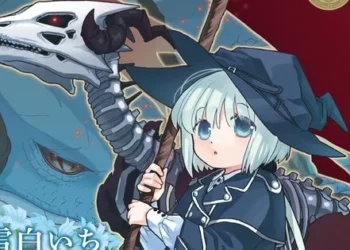


Flower and Asura is approaching the final page of its five-year run. Written by Ayano Takeda and illustrated by Musshu, the coming-of-age manga will conclude in Ultra Jump on August 19, 2026, giving readers a confirmed ending date for the story that also inspired Studio Bind’s 2025 anime adaptation.
The announcement matters beyond a routine serialization update. Flower and Asura, also known by its Japanese title Hana wa Saku, Shura no Gotoku, has built its identity around reading, performance, and the complicated process of finding one’s voice. For fans who discovered the series through its anime, the manga’s conclusion offers a chance to see how Hana Haruyama’s journey ultimately comes together.
A quiet story about the power of reading
The manga debuted in Shueisha’s Ultra Jump in June 2021. Takeda, best known internationally for Sound! Euphonium, provides the story, while Musshu handles the artwork. Shueisha has published ten tankōbon volumes so far.
At the center of the series is Hana Haruyama, a high school student who loves books and regularly holds reading sessions for children on her island. Her gift for recitation catches the attention of Mizuki Usurai, the president of the school’s broadcasting club, who invites Hana to join.
That invitation becomes the starting point for a broader story about artistic confidence and personal growth. Hana’s arrival does not simply give her a new club to belong to; her enthusiasm for reading also changes the atmosphere around the other members. As the group works together, each character is pushed to confront their own ambitions, insecurities, and understanding of performance.
Why the broadcasting club makes the premise distinctive
School-club manga often use competition as their main engine, but Flower and Asura places communication at the heart of its drama. The characters are not only trying to improve technically. They are learning how voice, timing, interpretation, and emotional honesty can affect an audience.
That focus gives the series a different rhythm from a conventional sports or performance story. A reading may appear simple from the outside, yet the act of delivering someone else’s words becomes a way for Hana and her classmates to express feelings they cannot easily articulate in ordinary conversation.
For digital-comics readers, the concept also has natural appeal. A serialized story built around spoken words invites attention to pauses, reactions, and the emotional space between lines of dialogue. Although the original is a print manga rather than a vertical-scroll webtoon, its emphasis on atmosphere and performance offers a similarly intimate reading experience, particularly for fans of character-driven drama.
The anime brought Hana’s voice to the screen
Studio Bind adapted Flower and Asura into a television anime during the winter 2025 season. Ayumu Uwano directed the series, which introduced the broadcasting club to a wider anime audience while preserving the manga’s focus on high school relationships and the emotional force of storytelling.
HIDIVE streamed the anime with subtitles and an English dub in the United States, Canada, Ireland, and Oceania. The central cast included Minori Fujidera as Hana Haruyama, Miyuri Shimabukuro as Mizuki Usurai, Fuuka Izumi as An Natsue, Chiba Shouya as Shuudai Toga, and Seiichirou Yamashita as Matsuyuki Akiyama.
Kiyono Yasuno voiced Ryouko Totonoi, while Taito Ban played Sentarou Hakoyama and Kouji Yusa played Hiromi Kichikouji. The adaptation’s casting reflects the ensemble nature of the story: Hana may be the entry point, but the broadcasting club functions as a collective, with every member contributing to the series’ emotional texture.
What the August conclusion means for readers
The manga’s final chapter is scheduled for August 19, 2026, in Ultra Jump. That date marks the end of the ongoing serialization, although the final collected-volume schedule has not been specified in the announcement covered here.
Because the story is built around gradual personal development rather than a single mystery or villain, the conclusion carries a particular kind of anticipation. Readers will be looking not only for plot resolution, but also for a sense of completion in Hana’s growth, her relationship with Mizuki, and the club’s shared understanding of what it means to be heard.
The ending may also encourage anime viewers to revisit the manga. Adaptations can make a series easier to discover, but the original format allows readers to move through Takeda and Musshu’s story at their own pace and spend more time with the quieter character beats. For fans who prefer reflective school drama, ensemble storytelling, and creative pursuits over high-stakes action, the manga is well suited to a focused binge once the final chapter arrives.
Flower and Asura has always treated expression as something active rather than decorative. Its characters read, speak, listen, and perform in order to understand themselves and one another. With the manga ending on August 19, the series is preparing to give that idea its final reading.
Sources
- animecorner.me
- ultra.shueisha.co.jp
- hanashura-anime.com
- crunchyroll.com