
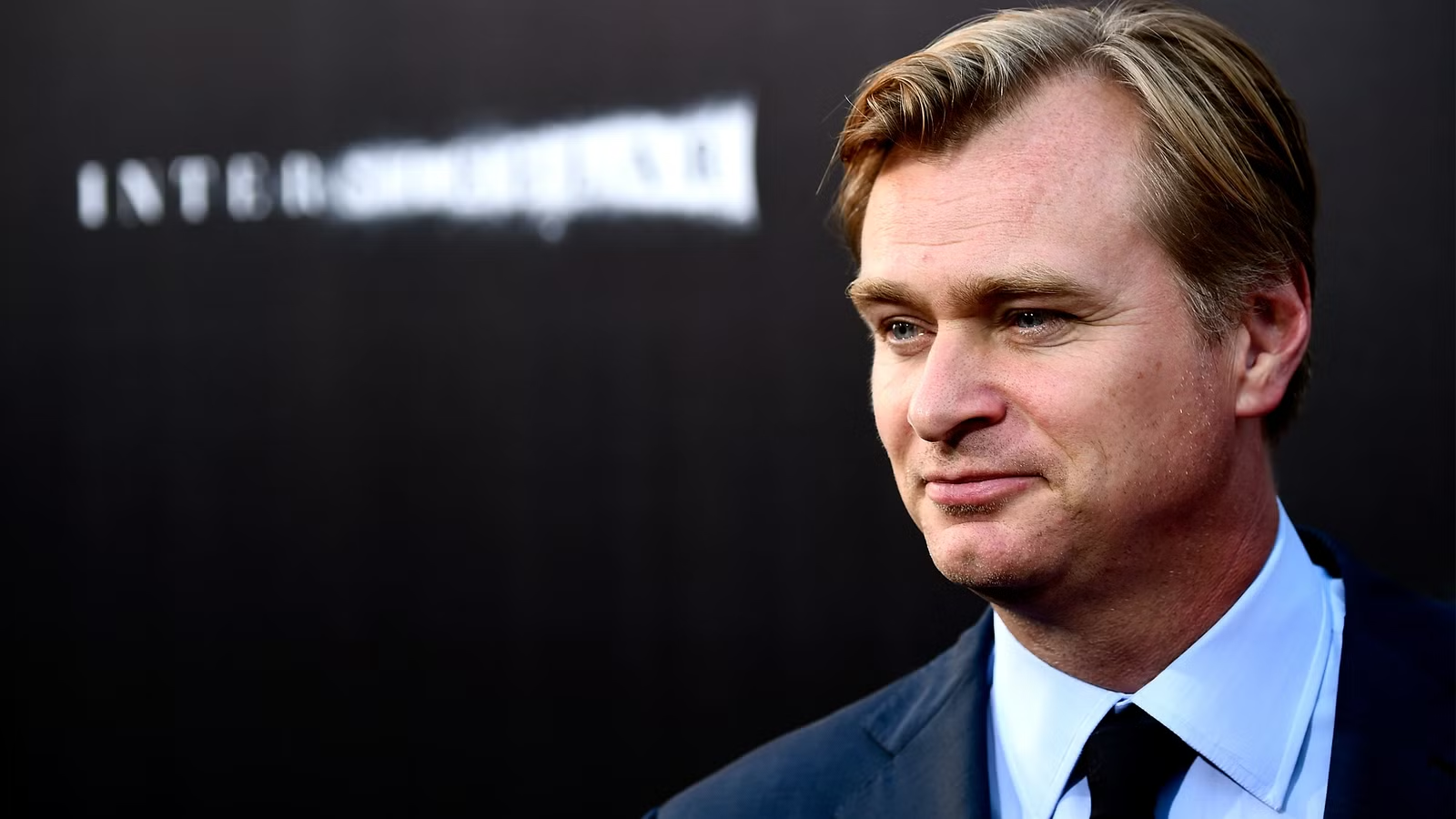
Christopher Nolan has turned a release schedule into a superpower. With The Odyssey now in theaters following its July 17, 2026 release, the director has once again transformed an original film into a global event—without relying on a preexisting superhero universe, a decades-old game franchise, or a constant stream of spin-offs. ([universalpictures.ca](https://universalpictures.ca/movie/the-odyssey/?utm_source=openai))
That should interest anyone who follows games. Nolan may work in movies, but his career offers one of the clearest demonstrations of how scarcity, consistency, and creative identity can make a single person feel like a franchise. In an industry increasingly obsessed with recognizable intellectual property, Nolan himself has become the recognizable intellectual property.
The three-year release cycle is the real trick
Since Interstellar in 2014, Nolan has generally maintained a near-metronomic rhythm: one major film, followed by roughly three years of anticipation. The pattern survived the pandemic, the director’s highly publicized departure from Warner Bros., and the shift toward streaming-first entertainment. His next project is rarely just another film on a release calendar. It is the next Nolan movie.
That distinction matters. A yearly release can keep a franchise visible, but it can also make the audience feel as if they are doing maintenance work. The excitement becomes obligation. Nolan’s films arrive often enough to remain culturally present, yet rarely enough to preserve a sense of occasion.
The same principle applies to games, particularly expensive blockbuster games. A new Grand Theft Auto, The Legend of Zelda, or God of War can dominate conversation precisely because audiences are not receiving a dozen smaller updates between major entries. Scarcity gives players time to speculate, revisit older games, and build expectations. It also gives developers room to make each release feel distinct rather than merely larger.
Nolan is selling authorship, not just spectacle
The Odyssey is based on one of the foundational stories of Western literature, but the selling point is not simply Homer. Universal’s campaign has emphasized Nolan’s authorship, his use of newly developed IMAX film technology, and the scale of the production. The film is being positioned as a theatrical experience that could only come from this particular filmmaker. ([universalpictures.ca](https://universalpictures.ca/movie/the-odyssey/?utm_source=openai))
That is a remarkable achievement. Nolan’s movies can be wildly different in genre and subject: science fiction, war drama, psychological thriller, historical drama, superhero cinema, and now mythic fantasy. Yet the connective tissue is obvious. His stories repeatedly return to time, memory, sacrifice, obsession, fate, and people attempting to impose order on forces too immense to control.
In gaming terms, he has built something closer to a premium auteur label than a conventional franchise. Players know a FromSoftware game will probably demand patience and experimentation. They know a Nintendo-developed adventure will likely prioritize tactile interaction and discovery. Nolan has created a similarly powerful expectation around his name: practical spectacle, dense structure, large-format presentation, and a serious commitment to making the project feel like an event.
The Batman boost helped—but it was not the whole strategy
Nolan’s Batman films gave him the commercial platform to operate at enormous scale. Batman Begins, The Dark Knight, and The Dark Knight Rises established him as a director capable of handling valuable intellectual property while imposing a distinctive creative identity on it.
But the important part of his career came afterward. Inception, Dunkirk, Tenet, and Oppenheimer demonstrated that audiences would show up for projects that did not have a familiar character or pre-sold fictional universe at the center. Oppenheimer in particular proved that a three-hour historical drama could become a mainstream event when the filmmaker’s identity was strong enough. Universal’s partnership with Nolan continued into The Odyssey, his second feature with the studio after Oppenheimer. ([apnews.com](https://apnews.com/article/6a6287d4714817dad985d88ad557e4af?utm_source=openai))
This is where the comparison with games becomes especially revealing. The industry often treats an established brand as the only reliable route to mass attention. Nolan’s career suggests another possibility: build such a strong creative reputation that the creator becomes the brand.
What game publishers should learn from the Nolan model
The lesson is not that every game should take three years to make, or that publishers should abandon ongoing support. Live-service games, seasonal content, expansions, and multiplayer communities all serve different purposes. The larger lesson is that audiences need breathing room and a reason to believe the next release will matter.
Imagine a major franchise with a genuinely deliberate cadence: a new entry every three or four years, fewer filler projects, less dependence on annualized content, and a clearer distinction between installments. The result would not automatically be better games, but it could make each launch feel less disposable.
There is also a lesson in creative continuity. Nolan’s films are not sequels to one another, yet they belong to a recognizable body of work. Game studios can pursue the same approach through new intellectual properties that share design values rather than characters, timelines, or monetization systems. A studio’s identity can become a reason to buy a game before its marketing campaign explains every feature.
The danger, of course, is that auteur branding can become its own form of hype. Nolan’s work has critics, and recurring habits—exposition-heavy dialogue, emotionally distant characters, and structural complexity—can feel like signatures pushed past their natural limits. Early reviews for The Odyssey have been overwhelmingly positive, with praise for its scale, craft, and ensemble, while some critics have questioned its pacing and the way it modernizes Homer’s material. ([rottentomatoes.com](https://www.rottentomatoes.com/m/the_odyssey_2026?utm_source=openai))
That tension is healthy. A recognizable creator should not receive automatic approval. The value of the Nolan model is that it creates enough trust for audiences to take a chance, while still leaving room for disagreement once the work arrives.
The future of “IP” may be the person making it
Franchises are usually thought of as characters, worlds, logos, and fictional histories. Nolan complicates that definition. His name now carries genre expectations, technical promises, and a particular relationship with theaters. Audiences do not just ask what his next film is about. They ask what Nolan will do with it.
That is the rarest kind of brand loyalty because it is attached to a creative voice rather than an endlessly expandable universe. For games, where production cycles are growing longer and audiences are tiring of repetition, that distinction could become increasingly important.
The strongest studios of the future may not be the ones that release the most content. They may be the ones that know when to disappear, return with something unmistakably their own, and make the wait feel like part of the experience. Nolan’s three-year clock is not a gimmick. It is a reminder that anticipation is a resource—and that the best intellectual property may be the promise of a creator who still has something new to say.
Sources
polygon.com
universalpictures.ca
nbcuniversal.com
apnews.com
rottentomatoes.com
theguardian.com
rogerebert.com