
The Lucas Museum of Narrative Art will open to the public in Los Angeles on Tuesday, September 22, 2026, giving collectors an unusually ambitious new destination where fine art, illustration, comics, cinema, and production design share the same spotlight. For hobby fans, the headline attraction is “Star Wars in Motion,” an inaugural Cinema exhibition built around vehicles, props, costumes, and concept work from the first six films of George Lucas’s saga.
That Star Wars display is likely to draw the biggest opening-day attention, but it represents only one part of a much broader institution. The museum’s collection and inaugural programming are designed around visual storytelling as a whole, making this less of a traditional franchise museum and more of a massive, collector-minded survey of how images create worlds, characters, myths, and memories.
A Museum Built Around the Art of Storytelling
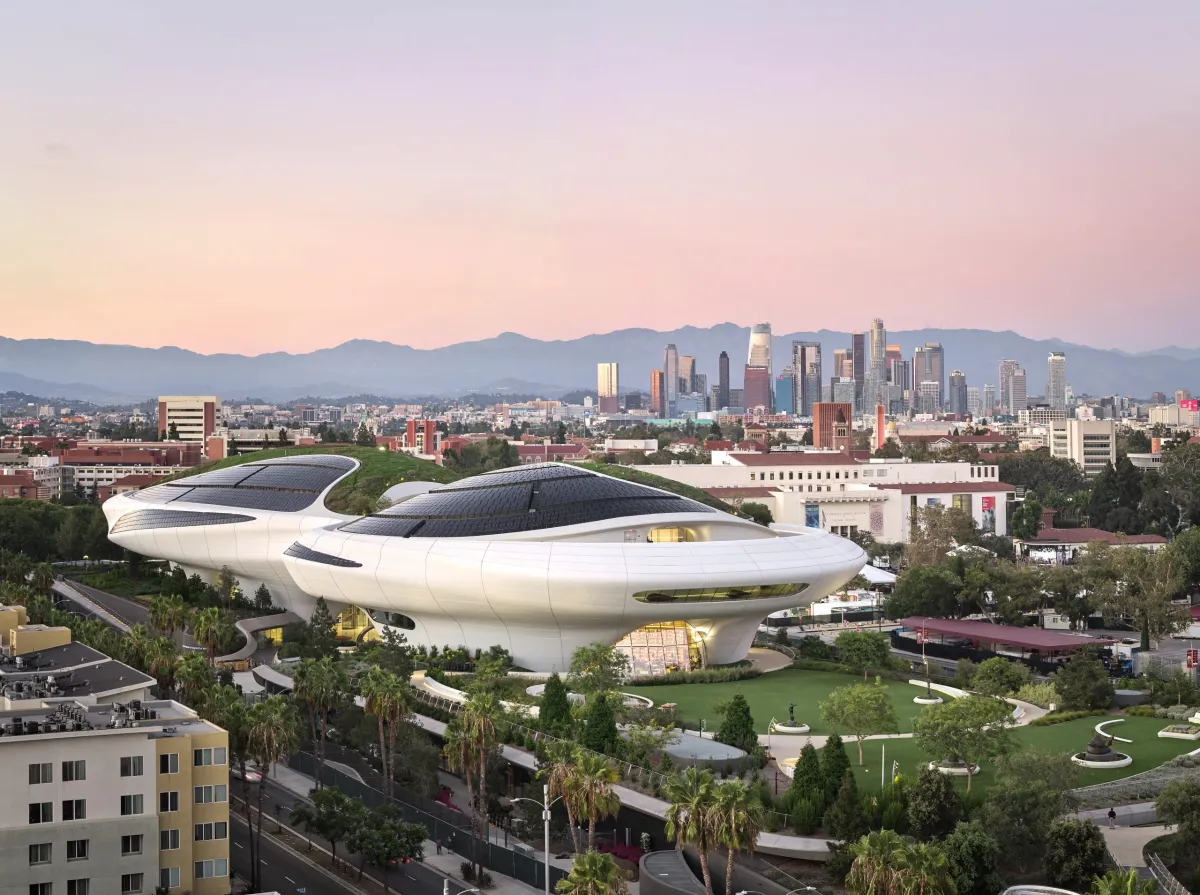
Located in Los Angeles’s Exposition Park, the Lucas Museum occupies a 300,000-square-foot building designed by Ma Yansong of MAD with Stantec. More than 100,000 square feet are devoted to gallery space, arranged across more than 30 galleries and filled with over 1,300 works from the museum’s collection.
The scale is significant even by major museum standards, but the more interesting point for collectors is the range of material being placed together. Paintings, comic strips, children’s book illustrations, manga, graphic novels, photography, murals, animation, and film artifacts are being treated as parts of a continuous visual tradition rather than separate categories with different cultural value.
That approach should feel familiar to collectors who move freely between original comic art, premium statues, model kits, art books, and screen-used props. The museum’s thesis is essentially that the image itself is the common language, whether it appears on a gallery wall, a comic-book page, a storyboard, or the side of a vehicle designed for a science-fiction film.
“Star Wars in Motion” Puts Production Design Front and Center
The inaugural Cinema installation, “Star Wars in Motion,” focuses on motion and vehicle design across Episodes I through VI. Officially announced examples include Luke Skywalker’s X-34 Landspeeder from A New Hope and the first physical build of General Grievous’s Wheel Bike from Revenge of the Sith.
The exhibition will also include concept designs, props, costumes, and illustrations connected to the saga’s racers, transports, and flying vessels. Recent preview coverage has additionally identified production versions of the Landspeeder and the speeder bikes from Return of the Jedi, while a bright yellow Naboo N-1 Starfighter from The Phantom Menace is suspended above the entrance to the museum’s Education Lobby.
For collectors, the appeal is obvious. These are not simply recognizable vehicles presented as static movie memorabilia. They represent the design decisions, physical construction techniques, and visual problem-solving that turned Ralph McQuarrie-era concepts and production sketches into objects audiences could believe existed in a galaxy far, far away.
The first six films also offer a particularly rich range of design languages. The original trilogy’s used-future machinery, the prequels’ polished Naboo forms, the industrial bulk of Imperial hardware, and the exaggerated silhouettes of podracers and Separatist technology all show how vehicle design can communicate culture and character before a pilot ever climbs aboard.
That makes “Star Wars in Motion” relevant well beyond Star Wars collecting. Gunpla builders, vehicle modelers, garage-kit fans, and customizers should find plenty to study in the way shapes, surface details, weathering, color, and scale work together to create believable fictional machinery.
More Than a Star Wars Museum
The museum’s first-floor exhibition, The History of Narrative Art: Heroes • Myths • The Sacred, looks across tens of thousands of years of visual storytelling. Alongside pieces from the permanent collection, the gallery uses high-resolution imagery and 3-D scans to create faithful reproductions of artworks and archaeological sites that cannot realistically be moved.
Collaborations include the Vatican Museums for the Sistine Chapel ceiling, the Louvre for the Winged Human-Headed Bulls from the Palace of Sargon II, the National Museum and Research Center of Altamira in Spain for ancient cave paintings, and Mexico’s Instituto Nacional de Antropología e Historia for the Aztec Sun Stone. The museum says the resulting digital assets have also been donated to its collaborating partners.
For hobbyists, this is an especially interesting curatorial choice. Collectors already understand the value of a faithful reproduction, whether it is a licensed prop replica, a museum-quality statue, or a meticulously engineered model kit. Here, reproduction technology becomes a way to place otherwise disconnected monuments into a single visual conversation.
Upper-floor galleries expand into themes such as love, family, community, labor, sport, fantasy, romance, and adventure. The artists represented include Vincent van Gogh, George Bellows, Jacob Lawrence, Beatrix Potter, Charles White, Ernie Barnes, George Méliès, Boris Vallejo, Julie Bell, and Ken Kelly.
Medium-specific installations will spotlight comic books, manga, graphic novels, photography, and murals, with names including George Herriman, Charles Schulz, Jim Lee, Frank Miller, Takashi Murakami, Robert Capa, Gordon Parks, Diego Rivera, and Judith F. Baca. Individual galleries will also honor major illustrators such as Norman Rockwell, N.C. Wyeth, Jessie Willcox Smith, Maxfield Parrish, Frank Frazetta, and Thomas Hart Benton.
That lineup helps explain why the Lucas Museum may become a particularly valuable stop for collectors who have long felt that illustration and popular art receive less institutional attention than painting or sculpture. A Frank Frazetta original, a Charles Schulz drawing, a comic-book page, and a film maquette can all be judged through different technical standards, but they can also be appreciated for the same fundamental achievement: making a story visible.
A Destination for Collectors and Film Fans
The museum experience extends beyond the galleries. Its campus includes a free research library, two theaters with continuous drop-in film programs, education spaces, a museum shop, a café, and Skywalker Grill. The surrounding 13-acre park and gardens, designed by Mia Lehrer and Studio-MLA, add another public component to the project.
The theater program is also worth noting. The Robert Flaherty Theater examines cinema’s ability to capture reality and document the world, while the Slavko Vorkapich Theater explores the mechanics of motion, light, sound, color, and editing. For anyone interested in the craft behind visual media, that programming could make a museum visit feel less like a passive display tour and more like a study of how images are made to move an audience.
General admission is listed at $25 for adults and $21 for seniors aged 65 and over. Visitors ages 17 and under, active-duty military personnel with valid identification, and several other qualifying groups are admitted free. Timed-entry tickets are required, and tickets for the initial public period beginning September 22 went on sale July 21.
From a collector’s perspective, the most important detail is that the museum should reward repeat visits. A first trip may be dominated by the Star Wars vehicles, but the combination of original art, production material, murals, film screenings, and changing interpretations of narrative art gives the institution a much wider footprint than a one-room franchise exhibit.
Collector verdict: Dedicated Star Wars fans will have the clearest immediate reason to visit, especially those interested in original trilogy vehicles, prequel-era design, concept art, and physical production artifacts. However, the museum’s real strength may be its broader argument that comics, illustration, cinema, and popular visual culture belong in the same serious collecting conversation as traditional fine art. For hobby collectors, it promises to be both a major Star Wars destination and a useful reminder of where the objects in our collections come from: artists, designers, builders, and storytellers solving visual problems one image at a time.
Sources
- actionfigureinsider.com
- lucasmuseum.org
- apnews.com