
Content warning: This review discusses homophobia, transphobia, bullying, assault of a minor, sexual abuse, and mentions of suicide.
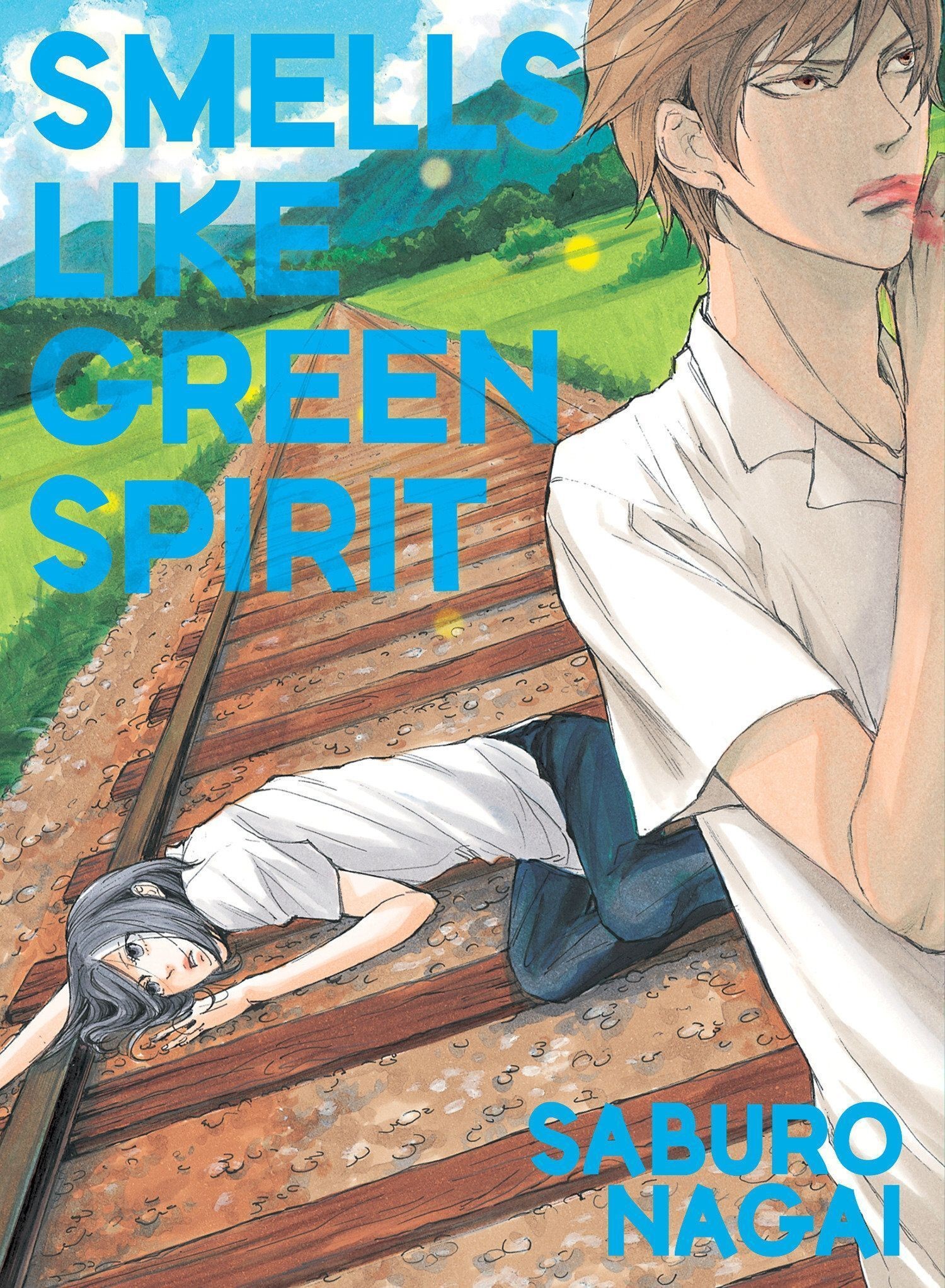
Saburo Nagai’s Smells Like Green Spirit is now available in English as a complete one-volume omnibus from Kodansha, collecting a difficult, emotionally raw coming-of-age story about queer identity in rural Japan. It is also the manga that inspired a live-action television drama broadcast in Japan in 2024, making this long-awaited English edition an especially timely opportunity to revisit Nagai’s most widely known work.
The book follows Futoshi Mishima, a junior high school student living with his widowed mother in an isolated village. Bullied for his long hair, delicate features, and presumed sexuality, Mishima finds a private escape in experimenting with his mother’s pink lipstick. His secret life takes an unexpected turn when he discovers Kirino, a popular soccer player and one of his tormentors, applying the missing lipstick on the school roof.
That discovery becomes the first crack in the boys’ carefully maintained public identities. Kirino admits that he has always felt different, and the two begin to recognize something familiar in each other. Their connection is repeatedly tested by violence, gossip, family pressure, and the dangerous attention of a teacher whose behavior escalates from inappropriate punishment into predatory abuse.
A coming-of-age story without easy answers
What makes the manga so powerful is that it refuses to turn its central relationships into a simple story of bullying followed by instant acceptance. Mishima, Kirino, and Yumeno are all shaped by the hostile environment around them, and their prejudices do not disappear overnight. Yumeno’s cruelty toward Mishima is particularly uncomfortable, but the story gradually explores how fear, confusion, and learned homophobia can distort feelings that the characters do not yet know how to express.
That does not excuse the harm done to Mishima. Nagai is clear about the damage caused by both peer harassment and adult abuse. The village’s gossiping residents create an atmosphere in which the boys are constantly watched and judged, while the adults who should protect them often become another source of danger. The result is a story that can be painful to read, but rarely feels emotionally dishonest.
Mishima’s relationship with gender expression is also handled with more nuance than the basic premise might suggest. He enjoys presenting a feminine side of himself, but that does not automatically define his entire identity. At one point, he makes clear that being gay and wanting to dress up are not the same thing as wanting to become a girl. Kirino, meanwhile, expresses a softer and more feminine self when he and Mishima are alone. Their differences matter, and the manga allows both boys to be more complicated than the labels imposed on them.
Beautiful artwork, unsettling shadows
Nagai’s artwork shifts dramatically depending on the emotional temperature of a scene. Mishima, Kirino, and Yumeno are often drawn with an almost angelic beauty, a striking contrast to the ugliness of the world surrounding them. The boys’ conversations on the school roof can feel delicate and dreamlike, particularly when they fantasize about escaping to Thailand or Tokyo’s Ni-Chome district in search of somewhere they might live openly.
Those moments of beauty are balanced by genuinely disturbing imagery. Scenes involving the teacher Yanagida become increasingly nightmarish as his fixation on Mishima intensifies. The visual contrast makes the abuse feel even more intrusive: tenderness and danger occupy the same pages, often without warning.
The manga also finds room for dry, sometimes cruel humor. The village gossips are rendered as grotesque caricatures, and their exaggerated presence captures how suffocating small-community judgment can become. These flashes of dark comedy do not soften the serious material, but they prevent the book from collapsing into unrelenting misery.
A substantial English edition
Kodansha lists the English release as a complete 346-page omnibus for readers aged 16 and up. The edition includes ten color pages and a comic afterword from Nagai, whose visual avatar offers a playful final note after such a heavy story. Jo Lumley handles the translation, with lettering by Carolina Hernandez Mendoza.
The publisher positions the book for older teens and adults who enjoy seinen and LGBTQ+ manga, citing works such as Welcome Back, Alice, The Flowers of Evil, and Boys Run the Riot. That comparison is useful, although this manga has its own distinctly uncomfortable rhythm. It is less interested in offering a polished fantasy of acceptance than in showing how young people attempt to build an identity in a place that gives them very little room to breathe.
The material is undeniably grim, and some readers may find the abuse plot difficult or even overwhelming. Still, the story’s outlook is not hopeless. Mishima’s mother offers a rare example of unconditional support, while other adults reveal that their attitudes are more complicated than the village rumors suggest. By the final pages, the manga has earned its moments of hope rather than simply declaring them.
The 2024 live-action adaptation, broadcast through MBS’s Dramaphile programming block, starred Hiwa Araki as Mishima, Shunta Sono as Kirino, and Kodai Fujimoto as Yumeno, with Ikuko Sawada directing and Yuuka Arai writing the script. For readers discovering the manga through that adaptation—or approaching the story before seeking it out—the omnibus provides the fullest way to experience Nagai’s unsettling, compassionate vision.
Thought-provoking, disturbing, and ultimately more hopeful than its darkest chapters suggest, this is an important addition to the English-language LGBTQ+ manga shelf. Readers should go in prepared for difficult subject matter, but those who can handle its intensity will find a beautifully drawn story about identity, survival, and the possibility of finding one person with whom it is safe to be honest.
Sources
kodansha.us
mbs.jp
ebidan.jp