
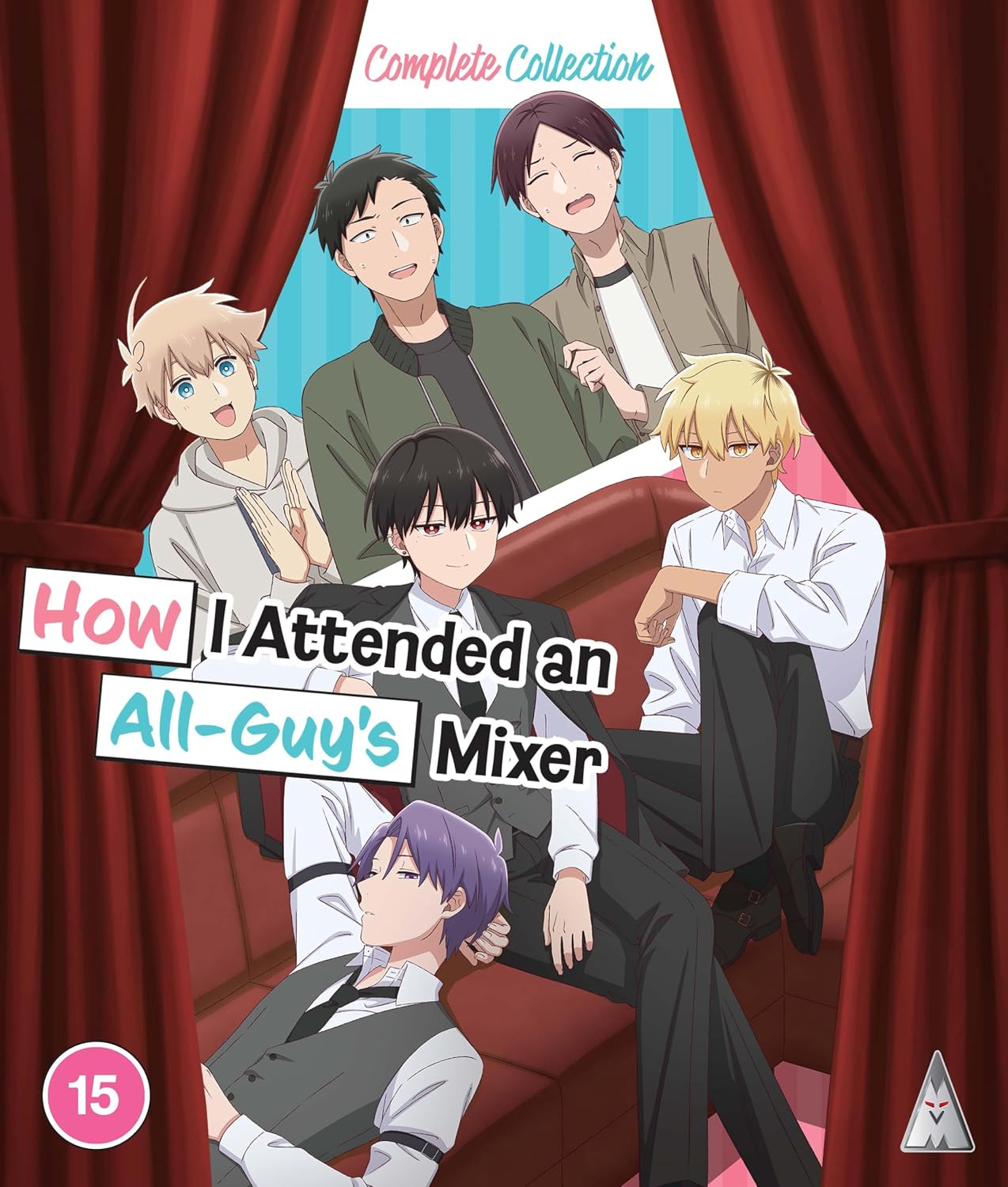
MVM’s complete collection of How I Attended an All-Guy’s Mixer brings all 12 episodes of Nana Aokawa’s unusual romantic comedy to home video, complete with English and Japanese audio options. The series has an immediately eye-catching premise: three university students arrive at a mixer expecting to meet women, only to find themselves sitting across from three handsome men who turn out to be women working at a dansou bar.
Produced by Ashi Productions and directed by Kazuomi Koga, the anime originally aired as part of the 2024 television season. Its central cast includes Mikako Komatsu as Suo, Aoi Yuki as Fuji, Nao Toyama as Kohaku, Shunsuke Takeuchi as Tokiwa, Gakuto Kajiwara as Hagi and Shun Horie as Asagi.
That unusual setup gives the show plenty of room to explore attraction, presentation and the expectations attached to gender. Unfortunately, the complete series frequently feels more interested in repeating its central joke than examining what makes the idea so distinctive.
A promising mixer that quickly becomes familiar
Tokiwa, Hagi and Asagi are invited to a group date by Suo, one of Tokiwa’s classmates. When they arrive, Suo and her colleagues Fuji and Kohaku are dressed in sharp suits and performing their “ikemen” personas for customers at the dansou bar where they work.
The women move comfortably between their polished male-presenting identities and their everyday selves, and those changes often reveal more about their personalities than the men’s dialogue does. Suo is confident and proactive, Fuji is an enthusiastic doujin artist with a secretive side, and Kohaku combines her handsome bar persona with a fondness for sweet things.
The male trio is less successful. Tokiwa spends most of the series acting as the group’s passive centre, rarely pushing events forward or displaying much personal growth. Hagi is defined largely by insecurity and nervous overthinking, while Asagi is positioned as the lovable fool. Their contrasting reactions to the women are meant to fuel the comedy, but the character balance makes the girls feel like the true protagonists.
There is also a recurring gag built around the men finding themselves attracted to the women while they are dressed as men. The resulting panic about whether this makes them gay is framed as playful confusion, but the joke becomes repetitive and increasingly dated. Rather than using the situation to explore identity with much nuance, the series often settles for BL-coded teasing and exaggerated embarrassment.
Rom-com routines without enough spark
Across its 12 episodes, the anime moves through familiar slice-of-life scenarios: karaoke outings, festivals, camping trips, beach visits and casual gatherings. Each storyline generally introduces a misunderstanding or awkward situation between one of the pairs before resolving it with the characters slightly closer than before.
That structure is perfectly workable for a romantic comedy, but the execution rarely gives these episodes a memorable hook. The relationships progress in small steps, yet the show does not always make those developments feel earned. Suo’s pursuit of Tokiwa is particularly one-sided, with Tokiwa more often being carried along by her plans than actively participating in the romance.
The stronger material arrives when the anime focuses on the women’s lives away from the bar. One of the most entertaining episodes sees Asagi helping Fuji at her Comiket doujin stall, creating a far more distinctive comic situation than the usual misunderstandings. There are also welcome moments where the show pushes back against rigid ideas about masculinity, including the simple point that a man should be able to enjoy something like ice cream without being judged for it.
Those scenes hint at a more thoughtful series hiding beneath the formula. How I Attended an All-Guy’s Mixer could have used the dansou setting to say more about performance, social expectations and the difference between how someone is perceived and who they are. Instead, those ideas are usually left at the edges of the story.
A pleasant production with an excellent female cast
The animation does what it needs to for a character-driven romantic comedy. The designs for Suo, Fuji and Kohaku are especially effective because their male and female presentations feel distinct without making them seem like completely different people. The male characters are visually less memorable, and the frequent switches into chibi artwork can feel abrupt rather than like a carefully controlled stylistic choice.
The soundtrack is a highlight. TECHNOBOYS PULCRAFT GREEN-FUND provide a light electronic score that suits the show’s breezy atmosphere, while Nasuo☆ performs the opening theme “Merry Go Round Time.” ASOBI Doumei’s ending theme, “Ōsama Da-reda,” accompanies a playful King’s Game sequence set in the bar.
In Japanese, the women’s voice performances are consistently enjoyable. Mikako Komatsu, Aoi Yuki and Nao Toyama each bring plenty of energy to their characters’ contrasting public and private personas. The English dub has a little more naturalistic warmth in places, although Hagi and Asagi remain difficult to enjoy when their louder traits take over.
MVM’s collection includes the full 12-episode season in English, English with subtitles for the hearing impaired, and Japanese with English subtitles. The extras are limited to clean opening and closing animations. The terminology surrounding dansou bars is also a tricky translation challenge, since the Japanese setting does not map neatly onto Western drag culture; some choices work better than others, with the use of “chad” for “ikemen” feeling particularly imprecise.
There is a good anime hidden inside this premise, and the complete collection makes it easy to see both the potential and the missed opportunity. Viewers looking for a light, unconventional campus rom-com may still find a few charming character moments, but anyone hoping for sharp commentary on gender or a consistently strong romance should keep expectations modest. For longtime fans of Nana Aokawa’s manga, the home-video release is worth keeping an eye on; for everyone else, the first episode may be enough to determine whether the series’ central gag has staying power.
Sources
anici.co.jp
sentaifilmworks.com
bbfc.co.uk