
Big Walk’s most memorable puzzle may be the one that asks players to do absolutely nothing. Around six hours into House House’s cooperative adventure, a seemingly harmless room traps three players behind a locked door and starts a five-minute countdown. There are no monsters, no collapsing platforms, and no obvious trick to uncover. The solution is simply to wait.
That sounds easy until a game built around movement, experimentation, and constant communication forces a group of restless players to sit still. In Big Walk, five minutes of inactivity becomes a psychological endurance test—and a strangely effective demonstration of what the game is really about.
The puzzle that turns patience into a challenge
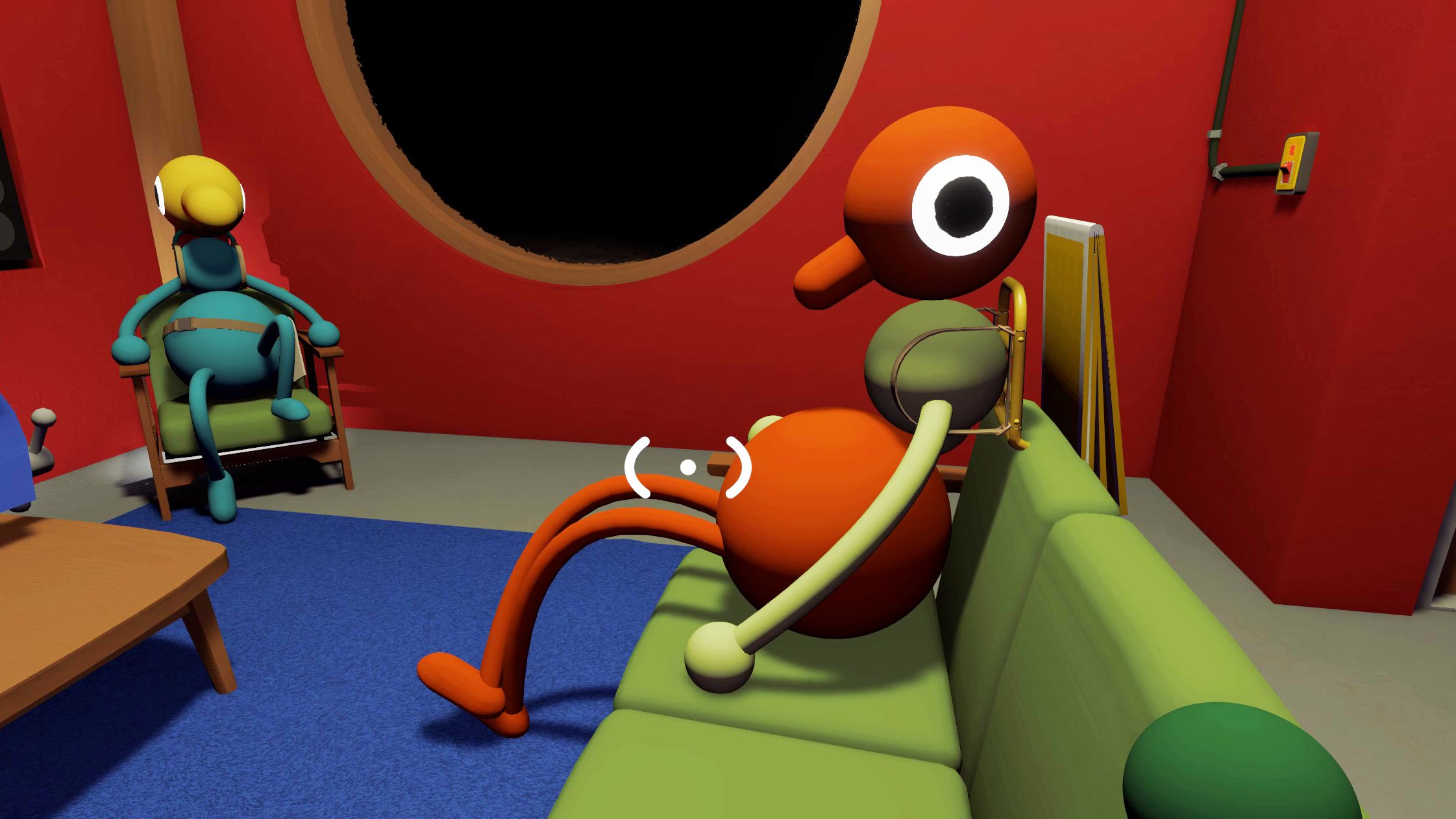
The room appears almost aggressively ordinary. There is a door, a pair of windows, a couch, a chair, a table, and a prize sitting in plain sight. On the wall hangs what looks like a digital clock displaying 00:00. Once three players press the room’s buttons together, the door closes and the display changes to a five-minute timer.
The immediate reaction is panic. Big Walk is full of puzzles that require players to coordinate actions, relay information, manipulate objects, or find unusual ways to communicate. A locked room naturally suggests another mechanical solution waiting to be discovered. The players search for hidden switches, test the buttons again, and inspect the room for clues.
Pressing the buttons a second time only resets the countdown. The door remains shut. Eventually, the group arrives at the answer: sit down and wait for the timer to reach zero.
That is the entire puzzle. There is no secret sequence, no environmental revelation, and no last-second interaction. The prize is released only after the players spend five uninterrupted minutes together in the room.
Doing nothing is harder than it sounds
The comedy comes from how quickly the group fails to remain still. One player changes seats. Another begins flicking the lightswitch. A flashlight is stolen, reclaimed, kicked across the room, and eventually stranded on a high ledge. The three players pick each other up, bounce around the walls, and invent increasingly pointless objectives to make the timer move faster.
At one point, the group discusses everyone’s different sitting poses. It is a tiny detail, but it becomes important because Big Walk gives players a physical presence that goes beyond simply standing next to one another. Characters can sit, gesture, point, carry objects, and interfere with each other in ways that make even a static room feel alive.
The room’s real trick is not that the solution is obscure. It is that the game convinces players they must continue solving something. Every previous puzzle has trained them to inspect, communicate, experiment, and act. When the correct answer is patience, that instinct becomes the obstacle.
The result is an unusual kind of co-op challenge. Instead of testing reflexes or logic, the room tests whether a group can resist its own impulse to meddle. The answer is obvious well before the timer ends, yet accepting it feels almost impossible.
Big Walk makes conversation part of the mechanics
This room also captures why Big Walk is more than a conventional puzzle game with multiplayer added on top. House House has designed the experience around communication itself. Its proximity voice chat changes depending on where players are standing, with voices fading over distance, echoing through corridors, and becoming muffled through walls. In other situations, players may need to use tools such as walkie-talkies, binoculars, megaphones, flares, or whiteboards.
Big Walk also supports in-game text chat with similar restrictions. Players can communicate without microphones, but distance and obstacles still matter. That design makes communication part of the world rather than an external layer running through Discord or a console party chat.
The five-minute room is therefore a perfect inversion of the game’s usual rhythm. Instead of using communication to solve a problem, the players use it to cope with the absence of a problem. Dinner plans, sitting poses, increasingly desperate jokes, and complaints about the timer become the content of the scene.
It is easy to imagine this moment being annoying for some groups. Big Walk is built for players who enjoy the social experience as much as the objective, and that makes its lack of matchmaking significant. The game is designed to be played with people you know across multiple sessions, rather than placing strangers together and expecting instant chemistry.
A co-op game that understands boredom
Big Walk launches on August 4, 2026, for PC and Mac, PlayStation 5, and Nintendo Switch 2. It supports groups of two to twelve players, with the world adapting somewhat depending on whether a session is built for two, three, or four or more participants. Crossplay allows friends on different systems to join the same adventure, while the host’s save file carries the group’s progress forward.
Those details matter because the game’s appeal depends heavily on the people playing it. With two players, the experience can be focused and deliberate. With a larger group, the same puzzles are likely to become louder, messier, and more improvisational. The room described here might be a minor pause for one group and a full-scale comedy routine for another.
House House has previously shown a talent for turning simple interactions into memorable comedy, and Big Walk appears to extend that approach into a much larger cooperative space. The game’s puzzles are not only about reaching the correct answer. They are excuses to see how a group thinks, argues, gets distracted, and eventually celebrates.
That is why the five-minute waiting room works so well. It transforms inactivity into a shared event. The players are not progressing, collecting loot, or uncovering lore, but they are still creating a story together—one involving a flashlight, an uncomfortable couch, and the dawning realization that quiet reflection may be more frightening than any trap.
When the timer finally reaches zero, the door opens and the prize is released. The group is free to continue exploring the island, but the puzzle has already made its point. Big Walk’s greatest challenge may not be figuring out what to do next. It may be learning when to stop doing anything at all.
Sources
pcgamer.com
bigwalk.game
gamespot.com
gameinformer.com
blog.playstation.com