

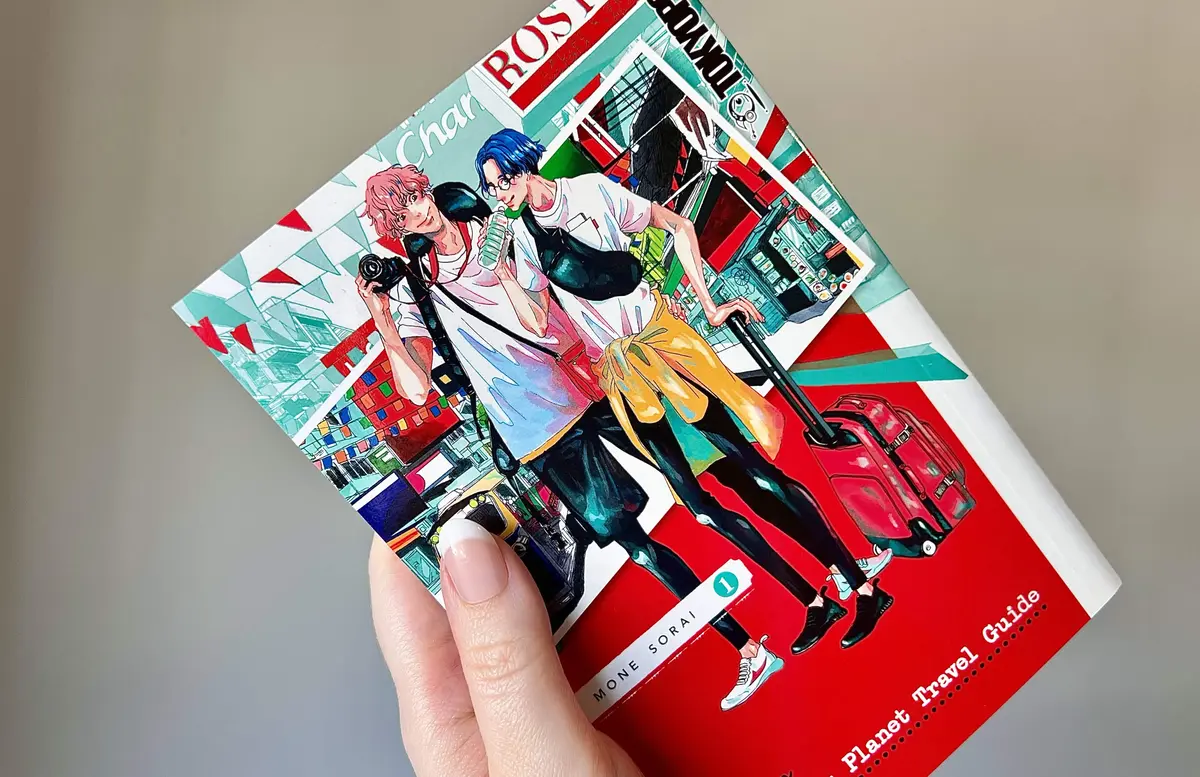
Our Not-So-Lonely Planet Travel Guide turns a round-the-world vacation into an unusually grounded BL romance. Created by Mone Sorai and published in English by TOKYOPOP, the manga follows an established couple whose relationship is tested not by elaborate melodrama, but by travel stress, personal insecurity, cultural difference, and the question of what it really means to build a future together.
That focus makes Sorai’s series stand out in a crowded romance field. Mitsuki Sayama and Asahi Suzumura are not waiting to confess their feelings or discover whether they are attracted to each other. They are already partners, already traveling together, and already planning to marry—provided they are still together when the journey ends.
A romance that begins after the confession
Both men are 29, but they approach their relationship from very different emotional positions. Mitsuki is outgoing, energetic, food-loving, and comfortable expressing affection. Asahi is more reserved, anxious, serious, and inclined to worry about what could go wrong. Their contrasting personalities create much of the manga’s humor, but the differences also reveal the emotional work required to maintain a healthy relationship.
The central arrangement is simple: Mitsuki and Asahi will travel around the world together, then get married when they return to Japan if their relationship survives the trip. It is a romantic promise, but also a practical challenge. Traveling with a partner means sharing unfamiliar spaces, making decisions under pressure, managing money and schedules, and confronting habits that might remain hidden during ordinary daily life.
Rather than treating those difficulties as excuses for endless misunderstandings, Our Not-So-Lonely Planet Travel Guide uses them to develop its leads. The couple bickers, gets frustrated, and occasionally struggles to understand one another, but their conflicts generally feel proportionate to the situation. Communication matters here, and the manga’s emotional payoff often comes from watching Mitsuki and Asahi become more honest instead of waiting for a dramatic plot twist to force a breakthrough.
Travel is part of the character development
The travel premise is more than decorative scenery. New countries, unfamiliar customs, local food, and unexpected encounters constantly push the couple outside their comfort zone. Early sections of the journey take them through destinations including Thailand, India, and Georgia, with each location offering a different combination of excitement, confusion, hospitality, and inconvenience.
Several published reviews have praised the manga for capturing both the pleasure and the strain of international travel. The characters are allowed to admire beautiful places and enjoy memorable meals, but they also face schedule problems, health concerns, exhaustion, and moments when being far from home becomes emotionally difficult. That balance keeps the story from feeling like a glossy tourism brochure.
For readers who enjoy food manga, the meals are a particularly appealing part of the experience. Sorai gives the characters room to react to new dishes and eating customs, allowing food to become a way of expressing curiosity, discomfort, generosity, and connection. The same is true of the series’ scenery: locations are not merely backdrops, but environments that influence how Mitsuki and Asahi behave and what they learn about themselves.
Editorially, the manga’s strongest idea is that travel changes a relationship by changing the people inside it. Mitsuki and Asahi do not simply collect memories from different countries. They are forced to reconsider assumptions about identity, privacy, family, and what kind of life they want after returning home.
Mitsuki and Asahi’s different relationships with visibility
The couple’s personalities are not their only point of contrast. Mitsuki is comparatively open about being in a relationship with a man, while Asahi is much more cautious. He worries about being judged and is reluctant to disclose their relationship to family members or strangers. That difference creates some of the manga’s most meaningful emotional tension without reducing either character to a simple stereotype.
Asahi’s guardedness is especially important because the story treats it as something shaped by lived experience rather than a personality defect. His reluctance to be open does not disappear overnight, and the series takes time to show how trust, travel, and supportive encounters gradually affect him. Mitsuki, meanwhile, is not presented as a perfect solution to Asahi’s anxiety. His confidence can be comforting, but it can also make him impatient with Asahi’s fears.
The people they meet along the way broaden the story beyond the central romance. Side characters introduce different perspectives on queer identity, family acceptance, cultural expectations, and partnership. These encounters help Mitsuki and Asahi see that there is no single way to live openly, privately, cautiously, or proudly—and that their own choices still have consequences.
The supplied review also notes brief homophobic dialogue and a short depiction of self-injury, alongside illness and surgery-related material. Readers who prefer to avoid those subjects should approach the series with that context in mind.
A distinctive visual style for a gentle story
Sorai’s artwork is one of the manga’s clearest strengths. The character designs are expressive without feeling overly polished, and the linework has a lively, slightly rough quality that gives the pages personality. Facial expressions do a great deal of storytelling, particularly during moments when Asahi is overwhelmed or Mitsuki is being playful.
The environments receive considerable attention as well. Travel manga depends on a sense of place, and Sorai’s detailed treatment of streets, food, interiors, and landmarks helps each destination feel different. The art can be warm and comedic in one scene, then turn quietly vulnerable when the characters confront fear, illness, or uncertainty.
Reviews from The Wonder of Anime, ComicBookYeti, and But Why Tho? similarly highlighted the series’ combination of expressive artwork, grounded humor, romance, and travel detail. Some commentary has also suggested that the manga’s calm, everyday structure may feel too subdued for readers seeking intense plot twists or constant romantic escalation. That is a fair limitation: the story is more interested in gradual emotional movement than explosive drama.
Who should read Our Not-So-Lonely Planet Travel Guide?
This is a strong recommendation for readers who want BL romance built around an established couple rather than a prolonged first confession. It should appeal to fans of slice-of-life stories, travel narratives, food-focused manga, queer relationship drama, and romances where emotional intimacy matters as much as physical affection.
Readers looking for frequent sensual scenes may find the series restrained. Mitsuki and Asahi share affection and romantic chemistry, but the manga’s emphasis is on conversation, companionship, personal growth, and the small negotiations of life together. Its sweetness comes from watching two people learn how to support one another across unfamiliar places—not from constant romantic spectacle.
With TOKYOPOP’s English catalog now listing seven volumes, the series offers a substantial journey for readers who connect with its patient pacing and character-focused approach. Our Not-So-Lonely Planet Travel Guide is at its best when it treats romance as an ongoing practice: showing up, paying attention, apologizing, trying something new, and choosing the same person again after the day has become complicated.
Sources
- romancemangarecs.com
- tokyopop.com
- thewonderofanime.com
- comicbookyeti.com
- butwhytho.net
- scorpiobooks.co.nz