
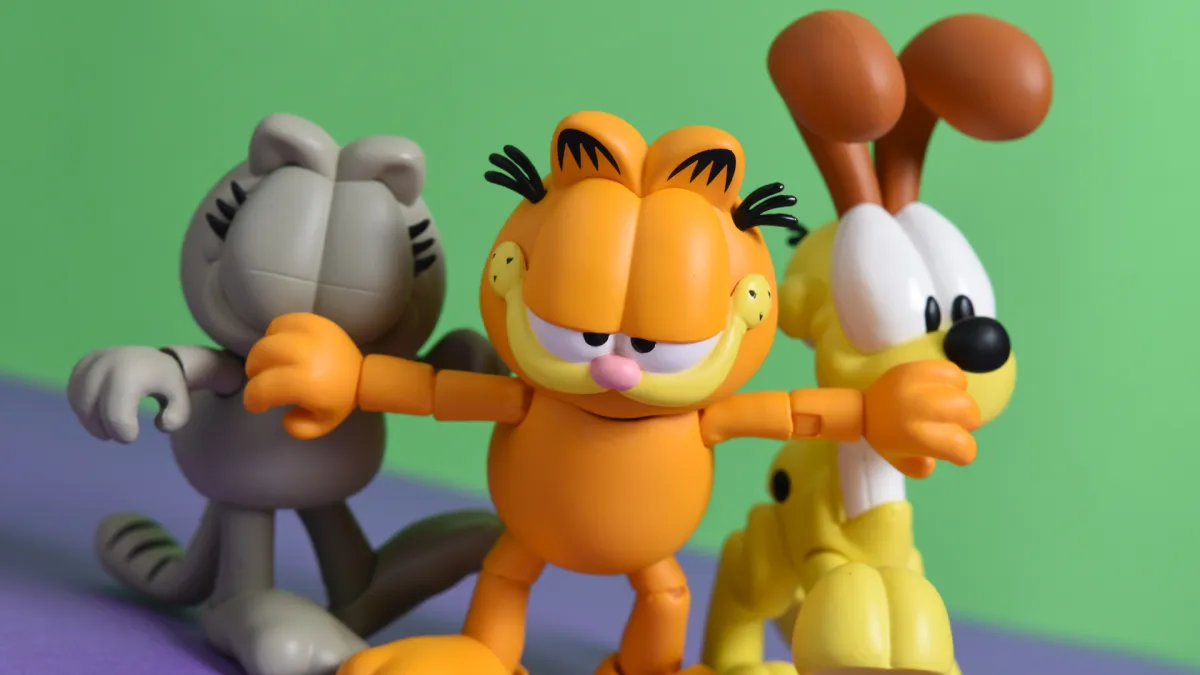
Boss Fight Studio’s first Garfield action-figure wave brings the classic comic-strip trio of Garfield, Odie, and Nermal into a fully articulated format. That alone makes the release notable: despite Garfield’s decades of television specials, merchandise, and feature-film appearances, the character has rarely been treated as a proper collector-oriented action-figure line. These 4-inch-scale figures are designed to capture the exaggerated proportions and expressive poses of the original strip while adding enough articulation and accessories to make them more than static desk ornaments.
The wave is especially appealing because Boss Fight Studio did not stop at Garfield. Odie and Nermal give collectors the essential character dynamic immediately, creating a compact display with recognizable personalities rather than three disconnected character releases. The result is a line aimed at both longtime Garfield fans and collectors who appreciate stylized cartoon properties such as Popeye, Fraggle Rock, or cereal mascots.
A Faithful Translation of the Comic-Strip Style
The strongest feature of the line is the sculpting. Translating a two-dimensional comic character into a three-dimensional action figure is not as straightforward as it may appear. Garfield’s proportions can shift from panel to panel, while his expressions and body language often rely on extreme exaggeration. Boss Fight Studio’s designs lean into that flexibility rather than trying to force the characters into realistic anatomy.
Garfield has the broad, rounded body, oversized head, and short limbs associated with his classic strip appearance. Odie is even more dependent on silhouette and facial expression, and his sculpt successfully preserves the dog’s simple, almost rubber-hose cartoon construction. Nermal’s smaller proportions and oversized eyes give the kitten an appropriately cute presentation without making the figure appear too delicate for the line.
The packaging also supports the vintage comic-strip appeal. The carded presentation uses character artwork and a large blister that clearly displays the figure and accessories. For collectors who keep cartoon figures carded, the packaging has a suitably nostalgic look; for those who open their toys, the broad bubble makes it relatively easy to see exactly what each character includes before purchase.
Accessories Built Around Character Gags
Garfield’s accessory selection is the centerpiece of the wave. The figure includes a tray of lasagna with a removable piece that can be held in his hand, along with Pooky, Garfield’s teddy bear. These are not generic extras added to fill out the package. They are key pieces of Garfield’s identity, and they immediately communicate the character even when the figure is displayed without a background or diorama.
The swappable facial expression adds further personality. Garfield’s appeal has always depended on his ability to move between bored indifference, smug satisfaction, and exaggerated food-driven enthusiasm, so an alternate face is a practical choice for a figure of this size. A more extreme expression showing Garfield swallowing an entire plate of lasagna would have been a natural future upgrade, but the existing selection still gives the figure useful display variety.
Nermal comes with a ball of yarn, an alternate closed-eye expression, and a small shipping box referencing Garfield’s familiar attempts to send the “cutest kitten in the world” away to Abu Dhabi. The box opens and can store the spare eye piece, making it both a character-specific prop and a convenient accessory container. It is exactly the kind of visual joke that rewards collectors who know the strip.
Odie has fewer accessories, but his options are more mechanically distinctive. In addition to a food dish, he includes a tongue-out lower mouth piece and a translucent wagging-tail effect. The replacement tail uses sculpted motion lines to suggest movement, giving Odie a playful action pose without requiring a stand or complicated gimmick. It is a clever solution that makes the accessory feel integrated with the character rather than simply added to the package.
Articulation and Display Potential
According to Boss Fight Studio’s specifications, Garfield features 25 points of articulation, while Odie and Nermal each feature 17. The cats use ball-and-socket joints at the neck and hips, with additional swivel-and-hinge articulation through the shoulders, elbows, wrists, ankles, and tails. Garfield also includes knee articulation, while Nermal’s shorter limbs understandably result in a simpler joint layout.
Odie’s engineering is more limited around the head. The central portion of the head connects to the body with a ball-and-socket joint, although the range of motion is not especially broad, while the upper portion of the head uses a more stationary connection. That is a reasonable compromise for preserving Odie’s unusual head shape, but collectors should view these figures as expressive display pieces rather than highly articulated posing platforms.
The relatively small scale is an important part of the line’s identity. Published previews place Garfield at roughly 4 inches tall, Odie at approximately 4 1/2 inches, and Nermal just over 3 inches. They will not blend naturally with standard 6-inch superhero or anime figure collections, but that is less of a problem than it might initially seem. Garfield and friends are better suited to a dedicated cartoon shelf, office display, kitchen vignette, or mixed shelf of mascot-style figures. Their size also makes it easier to create a compact three-character scene.
In particular, the figures should work well with other stylized releases that prioritize strong silhouettes over strict scale accuracy. The Fwoosh noted that the trio displayed effectively alongside Jada’s cereal mascots, an observation that makes sense from a collector standpoint: both lines occupy a similar novelty-cartoon space where shelf presence matters more than shared measurement charts.
Paint, Finish, and Early Collector Concerns
The paint applications are intentionally straightforward, matching the clean visual language of the comic strip. Orange, black, white, and gray provide most of the palette, with the sculpt doing much of the work. Garfield’s stripes are the one area where presentation can vary noticeably depending on the viewing angle. Early review coverage observed that the front-facing portrait can appear especially orange, while a three-quarter pose reveals more of the facial striping and gives the character a more natural comic-strip attitude.
The Fwoosh’s preview was broadly positive about the sculpt, character likeness, accessory choices, and overall desk-display appeal. Its main criticism was less about the concept than about the limitations inherent in translating these designs into articulated plastic. A seated, four-legged cat body would be a logical future addition, since that pose appears frequently in the strip and would offer a more relaxed alternative to the standing figures.
Collector feedback after release has been more mixed. Some owners have reported loose leg joints, limbs separating during posing or shipping, and paint wear or flaking around articulated areas. These reports come from individual collectors rather than a controlled review sample, so they should not automatically be treated as universal defects. However, they are significant enough that buyers may want to inspect joints carefully, avoid forcing stiff hinges, and consider purchasing from a retailer with a clear replacement policy.
That quality-control discussion is particularly relevant because the figures occupy a price range where collectors reasonably expect dependable construction. Boss Fight Studio’s current direct listing places each figure at $36, making the trio a $108 purchase before shipping or tax. The sculpt and character-specific accessories provide strong appeal, but the value proposition becomes less convincing if a figure requires extensive joint repair or must be treated as a “pose once and display” collectible.
Current Line Direction and Collector Verdict
Boss Fight Studio has continued expanding the Garfield concept beyond the initial trio. The company has announced additional versions, including Garfield V.2, Arlene, and a Deluxe Jon Arbuckle, along with themed two-packs based on Garfield’s Halloween Adventure and the Garfield and Teenage Mutant Ninja Turtles crossover. That broader range gives the original Garfield, Odie, and Nermal releases more importance: they function as the foundation of a potential character-based display rather than a one-off novelty wave.
For Garfield fans, the character selection is nearly perfect. Garfield provides the central star, Odie supplies the physical comedy, and Nermal adds the recurring rivalry that makes the trio feel connected. The accessories are thoughtfully chosen, and the sculpting captures the printed artwork better than a more generic “cartoon animal” approach would have.
Collector verdict: these figures are best suited to fans of classic newspaper comics, cartoon merchandise, and compact character displays. The sculpt work and accessories make them unusually appealing for Garfield collectors, while the reported joint and paint concerns suggest that articulation-focused buyers should approach with some caution. Their greatest strength is not extreme posing range, but the ability to turn a small shelf space into a recognizable three-dimensional comic strip.
As of July 18, 2026, Boss Fight Studio lists the original Garfield, Odie, and Nermal figures as available through its website, with each character priced at $36. The line has developed beyond the preview stage, but these first releases remain the essential starting point for anyone interested in building the Boss Fight Studio Garfield display.
Sources
- thefwoosh.com
- bossfightstudio.com
- toyark.com
- reddit.com