
Kyoto Animation’s Sparks of Tomorrow made its world premiere at Anime Expo 2026, where the first two episodes earned steady laughter, strong applause, and an attentive response from the packed Platinum Ballroom at the JW Marriott. The screening offered fans an early look at the studio’s smoke-filled alternate-history Kyoto—and a promising new adventure built around lost dreams, steam technology, and the possibility of starting over.
Fans began lining up well before the doors opened, creating one of the morning’s longest queues. The ballroom ultimately reached roughly 70% capacity, but the audience stayed engaged throughout the presentation, reacting warmly to the series’ comedic timing and applauding as the credits rolled.
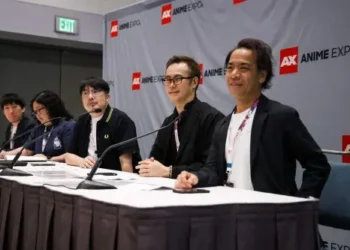
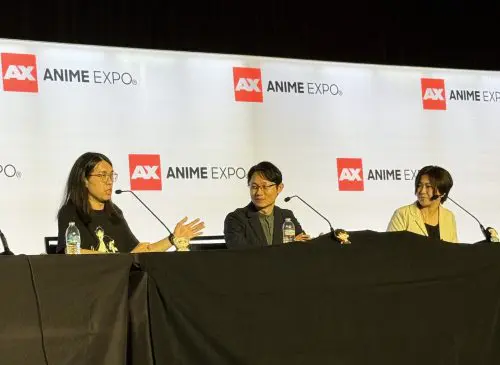
Following the screening, first-time director Minoru Ota and producer Satori Senami discussed the production alongside Ginger Root, who created the ending theme and also served as the panel’s moderator and interpreter. The guests answered questions submitted in advance by MyAnimeList users, offering a closer look at the anime’s visual direction, characters, themes, and creative challenges.
Sparks of Tomorrow began streaming worldwide on Netflix on July 5, 2026. The series is based on Hiro Yuki’s novel published under Kyoto Animation’s KA Esuma Bunko label, and its Japanese title is Nijusseiki Denki Mokuroku.
A Steam-Powered Kyoto With Its Own Identity
The story takes place in an alternate version of early 20th-century Kyoto, where steam technology has advanced while other forms of progress have stalled. The result is a city wrapped in industrial smoke, with familiar Japanese locations and customs reshaped by machinery, pollution, and a society that has lost faith in the future.
At the center of the story is Kihachi Sakamoto, a young man who once dreamed of an “Age of Electricity” alongside his older brother, Seiroku. After Seiroku disappears while carrying the mysterious 20th Century Electrical Catalog, Kihachi loses sight of those ambitions. His life changes when he meets Inako Momokawa, the daughter of a sake brewer, and the missing catalog resurfaces.
The official staff list identifies Yuma Uchida as Kihachi and Sora Amamiya as Inako, with Koki Uchiyama voicing Yosuke Mizoe and Daisuke Ono playing Seiroku Sakamoto. Minoru Ota directs the series, with Tatsuhiko Urahata handling series composition, Kohei Okamura serving as character designer and chief animation director, and Hitomi Koto composing the music.
Rather than leaning into a familiar steampunk formula, Ota said the team wanted the setting to feel like a lived-in Kyoto first. Steam pipes, machinery, and environmental damage support the atmosphere, but the characters’ everyday lives remain the foundation of the world.
Kyoto Animation Pushes Into a New Visual Frontier
The premiere’s biggest immediate impression was its artwork. Detailed backgrounds, expressive character animation, fluid movement, and carefully controlled lighting gave the first two episodes a cinematic quality that benefited from the big-screen presentation.
Ota explained that the background team developed a large library of digital brush textures inspired by the appearance of Impressionist paintings. Approximately 80% of the backgrounds were created digitally, while traditional analog methods remain part of Kyoto Animation’s artist training before staff members move into digital production.
That visual approach was not simply a decorative choice. Ota described the series as a completely new challenge for the studio, since previous projects offered little guidance for maintaining the same look across an entire season. Episode 1 underwent extensive revisions to establish the production’s artistic direction, and the various departments ultimately refined their workflows to preserve the style throughout the series.
The premiere also made the cast’s contrasting personalities clear. Kihachi represents doubt, while Inako embodies belief. Yosuke’s refusal to surrender his ambitions places him in direct contrast with Kihachi’s resignation, while Seiroku’s charisma continues to influence Yosuke’s choices even in his absence.
Ginger Root’s Ending Theme Gets a Futuristic Spark
Ginger Root said his involvement began with a straightforward email from Bandai asking whether he would create the ending theme for Kyoto Animation’s newest series. As a longtime fan of the studio, he accepted immediately.
Director Ota provided a painting and a piece of writing as creative references, then encouraged Ginger Root to pursue a more futuristic sound using electronic instruments and guitar. The artist joked that the song was approved after a single take, while the opening theme reportedly went through around 15 rounds of revisions.
Ota remained cautious about revealing too much of what lies ahead, but he encouraged viewers to keep watching as the series digs deeper into its colorful ensemble. Senami specifically pointed to the show’s balance of comedy and drama, adding that Ota’s distinctive sensibility becomes even more apparent after Episode 3.
For longtime Kyoto Animation fans, the world premiere offered a strong first impression: a visually ambitious story with an unusual setting, an emotionally divided cast, and a central mystery tied to the dream of electricity. Ota also teased that the story becomes especially exciting around Episode 11, while Senami noted that Yosuke’s role will continue to grow. With all episodes available on Netflix, those developments are now within reach.
Sources
netflix.com
denkimokuroku.jp
kyotoanimation.co.jp