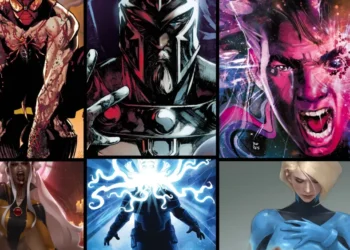

San Diego Comic-Con 2026 generated plenty of headlines across the comics industry, and the latest AIPT Comics Podcast takes a wide-angle look at the weekend’s biggest announcements. The episode covers DC’s Next Level slate, Marvel’s Predator vs. Punisher, Christian Ward’s newly announced Pandemonium, and Ryan Gosling’s unexpected connection to Ghost Rider.
The centerpiece, however, is Ward’s conversation about The Forever Home, his ambitious new Oni Press limited series with artist Sami Kivelä. Built around a simple but deeply unsettling idea—a house where 20 minutes inside equals one year outside—the series blends science fiction, horror, family drama, and climate anxiety into one of the more intriguing creator-owned projects arriving this fall.
DC, Marvel, and the biggest SDCC talking points
The podcast opens with a breakdown of DC’s latest Next Level announcements, including new ongoing series centered on Vixen, Static, Batman, The Demon, and Jonah Hex. For readers, the significance is less about a single crossover and more about the breadth of the lineup: established heroes, legacy characters, supernatural figures, and Western antiheroes all receiving renewed attention.
That mix gives DC’s publishing plans a deliberately expansive feel. Static and Vixen offer opportunities to spotlight characters whose importance has often exceeded their page count, while The Demon and Jonah Hex point toward the publisher’s continued interest in darker and more genre-specific corners of its universe. Batman, meanwhile, remains the company’s most dependable anchor, even as the surrounding slate reaches into stranger territory.
Marvel’s Predator vs. Punisher also receives attention during the episode. The pairing is immediately legible: Frank Castle’s methodical warfare colliding with an alien hunter built around ritual, trophies, and superior technology. Whether approached as a brutal action story or a clash between two radically different codes of violence, the concept fits comfortably within the tradition of Marvel’s licensed Predator projects.
The episode also touches on Ward’s newly announced Pandemonium and the surprising Ghost Rider reveal involving Ryan Gosling. Those stories help establish the broader SDCC atmosphere before the discussion turns to a much more intimate project—one focused not on superheroes, but on a family trying to outlast the end of the world.
A house outside of time
Published by Oni Press, The Forever Home is a six-issue limited series written by Christian Ward and drawn by Sami Kivelä. The first issue is scheduled for September 9, 2026, at $4.99 for 32 full-color pages.
The story follows Henry D’mour, an infamous billionaire scientist who builds an insulated luxury home for himself, his wife, and their two children as the planet collapses around them. The house is designed to withstand climate catastrophe, but its most extraordinary feature is something its creators did not anticipate: it is seemingly immune to time.
Inside the structure, only 20 minutes pass for every year outside. That imbalance transforms the home into more than a bunker. It becomes a sealed experiment in family, privilege, and isolation, allowing the D’mours to watch the world end—and eventually begin again—while remaining physically protected from the passage of history.
The premise carries obvious climate-fiction overtones, but Ward’s comments suggest that the book is equally concerned with generational communication. A family may share the same walls, resources, and survival plan, yet still be separated by radically different ideas about responsibility and the future. The time distortion turns that emotional distance into a literal one.
The situation becomes even more dangerous when a child’s mistake breaks the barrier protecting the house. What waits outside is not simply the ruined world the family expected. Something has had eons to approach the home, and it now has a reason to get inside.
Christian Ward and Sami Kivelä reunite
The Forever Home reunites Ward and Kivelä after their earlier collaboration on Machine Gun Wizards. Ward’s enthusiasm for Kivelä’s work is one of the clearest through-lines in the discussion surrounding the series. The writer has described the artist as a collaborator who consistently adds unexpected visual ideas, inventive page layouts, and heightened emotional detail to the script.
That relationship appears especially important for a book built around a single architectural space. The house must feel desirable enough to justify its enormous cost, functional enough to suggest genuine survival, and unsettling enough to become a character in its own right. Oni’s promotional material emphasizes a retro-futuristic environment filled with advanced technology, robots, and familiar domestic details, creating a setting where comfort and menace exist side by side.
The visual contrast is central to the book’s appeal. A luxury bunker can be sleek, spacious, and filled with conveniences while still representing a moral failure: the decision to preserve one family rather than confront a catastrophe affecting everyone else. Kivelä’s combination of futuristic machinery and recognizable household design gives that contradiction a concrete form.
For collectors, the first issue also arrives with a substantial assortment of covers. Ward, Kivelä, Frany, David Rubín, and Miguel Mercado contribute to the opening issue’s cover lineup, which includes standard, foil, full-art, incentive, and blank sketch editions. That range makes the debut notable both as a new science-fiction series and as a potential cover-collecting target.
Why the podcast conversation matters
Ward’s comments frame The Forever Home as one of his most personal creator-owned projects. Its climate anxiety is connected to his concerns as a parent, while its critique of billionaire escape bunkers gives the horror a recognizable real-world foundation. The result is a story that does not need to rely on a familiar superhero universe to feel immediate.
The book also reflects Ward’s growing role as a writer working closely with other artists. Although he has extensive experience as a visual creator, he has explained that writing for Kivelä means leaving room for the artist to reinterpret, expand, and improve the material. That collaborative approach is particularly promising for a series whose core tension depends on the relationship between a controlled environment and everything that cannot be controlled beyond it.
The episode’s weekly recommendations round out the conversation. Dave selects Doomquest #3 and Queen in Black #1, while Alex highlights Is Ted Ok? #6 and The Patron #1. The standout KAPOW pick is Horror of Godzilla #1, with Queen in Black: Hela receiving Dave’s nod. The “Judging by the Cover” segment focuses on Tyler Boss’ Deadman #3 cover, Alexander Lozano’s ’80s Storm variant for Uncanny X-Men #33, and KyuYong Eom’s cover for Batgirl #22.
For readers looking beyond the SDCC headlines, the Ward interview offers the strongest reason to tune in. The Forever Home has the kind of high-concept hook that invites immediate curiosity, but its real promise lies in the questions beneath it: Who gets to survive? What does protection cost? And if a family can escape time, can it escape the consequences of its choices?
Sources
aiptcomics.com
onipress.com
publishersweekly.com
fanbasepress.com
smashpages.net