
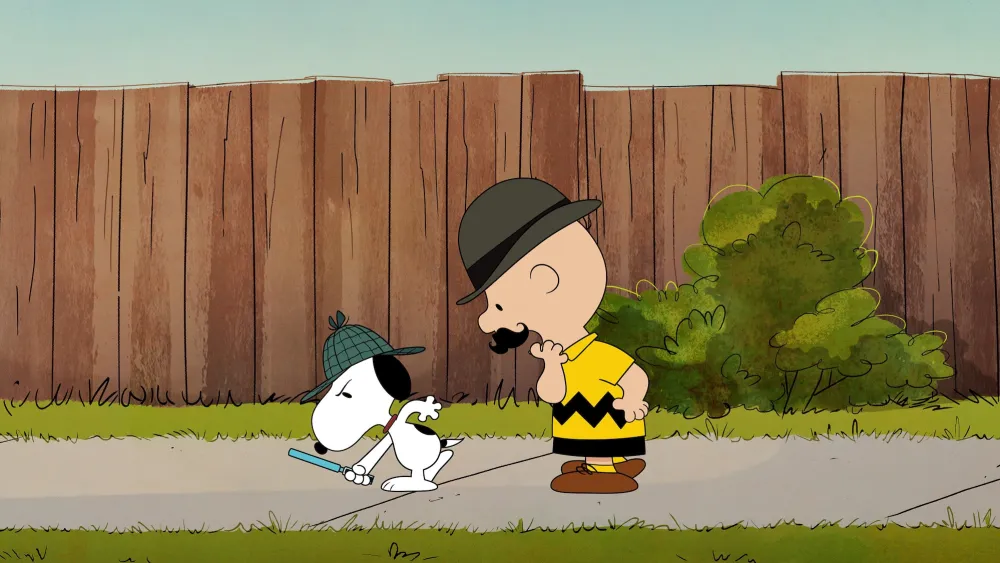
Snoopy’s most famous piece of real estate is at the center of a new Peanuts adventure. In Snoopy Presents: There’s No Place Like Home, Snoopy, the beloved beagle loses his doghouse after it is accidentally sold at a yard sale, sending Charlie Brown and Snoopy on a search that explores what makes a place feel like home.
The new animated special premieres Friday, July 31, 2026, exclusively on Apple TV. For comic readers and longtime Peanuts fans, its importance goes beyond another streaming-era cartoon: the special is part of an ongoing effort to expand Charles M. Schulz’s world while keeping its characters, humor and visual identity rooted in the original strip.
A story that began in the shorter format
Executive producer Mark Evestaff explained that the production team’s first step is always a return to Schulz’s comic strip. That approach guided the development of The Snoopy Show, and it became the foundation for this new special as well.
According to Evestaff, the doghouse story was originally considered during work on The Snoopy Show. The idea had promise, but the team ultimately felt it was too large to fit comfortably into one of that series’ seven-minute segments. Rather than discard it, they kept the concept available for a format that could give the premise more room to develop.
That opportunity arrived when Apple and WildBrain approached the team about a new Snoopy Presents special. The resulting story gives Charlie Brown and Snoopy a more substantial journey while preserving the simple emotional premise that has always made Peanuts work: an everyday problem becomes an opportunity to explore friendship, disappointment and hope.
Snoopy’s doghouse is more than a recognizable visual gag. It is a symbol of his private world, the place where his imagination takes flight and where he keeps the things that matter to him. Losing it creates an immediate emotional problem, but the search also allows the special to ask whether “home” is defined by a physical object or by the people and memories connected to it.
Honoring Schulz without freezing Peanuts in time
One of the central challenges in producing new Peanuts material is maintaining the balance between familiarity and renewal. The characters have been part of popular culture for generations, but a new animated project still needs to connect with younger viewers encountering Charlie Brown, Snoopy and the gang for the first time.
Evestaff said the team works to preserve the characters’ original foundation, including how they look, move and sound. At the same time, the production may update certain elements when necessary. The goal is not to modernize Peanuts into something unrecognizable, but to create enough space for the characters to function naturally in a contemporary animated special.
That philosophy is especially important for collectors and longtime fans. Peanuts has an instantly identifiable visual language: Schulz’s economical line work, expressive poses and deceptively simple settings. Any new adaptation carries the risk of becoming overly polished or detached from the strip. The comments from Evestaff suggest that the team understands the value of restraint, preserving the small gestures and visual clarity that make the property feel like Peanuts.
For newer viewers, meanwhile, the premise offers a direct entry point. No extensive knowledge of the strip is required to understand Snoopy’s attachment to his doghouse or Charlie Brown’s determination to help his friend. The story begins with a concrete problem and uses it to introduce the emotional logic of the neighborhood.
Deep-cut characters step into the spotlight
The special also makes room for less frequently used Peanuts characters, including Milo and the Goose Eggs. Their involvement gives the production an opportunity to look beyond the most familiar members of the cast while drawing on the broader legacy of Schulz’s comic strip.
Evestaff noted that the Goose Eggs’ younger age makes them an interesting reflection of the audience. Their losing records also create a parallel with Charlie Brown, whose struggles are a defining part of his characterization. That connection provides additional story possibilities without changing who Charlie Brown is.
For fans who enjoy tracking the deeper corners of the Peanuts cast, appearances by characters such as Milo and the Goose Eggs are a welcome reminder that the franchise is larger than its most recognizable icons. Their presence can reward longtime readers while remaining accessible to viewers who simply recognize them as part of Snoopy and Charlie Brown’s world.
Allen Stone’s song adds another emotional layer
Music has always played a major role in Peanuts animation, from Vince Guaraldi’s unmistakable jazz compositions to the songs that have helped define later specials. There’s No Place Like Home, Snoopy continues that tradition with “Home, Where Your Heart Found Me,” an original song performed by Allen Stone.
Evestaff described the song as an immediate fit for the special. The team connected with its emotional tone so strongly that they revisited several sequences and adjusted the animation to better accommodate the music.
That kind of revision is significant. Rather than treating the song as an element added after the story was complete, the production reshaped portions of the special so the music and visuals could work together. In a story about belonging, memory and the meaning of home, the song appears designed to reinforce the central theme rather than simply provide a closing-credit moment.
A familiar neighborhood with something new to say
Evestaff hopes viewers take away a message of resilience. The special recognizes that physical things can be lost, but memories, friendships, families and communities can remain sources of support when life changes unexpectedly.
That idea fits comfortably within the long-running emotional tradition of Peanuts. Schulz’s strip often found meaning in disappointment without pretending disappointment could always be avoided. Charlie Brown might lose the game, Snoopy might see a plan go wrong, and the neighborhood might not behave as expected—but the characters continue to return to one another.
That makes this special a natural extension of the franchise rather than a departure from it. Snoopy’s doghouse may be the object everyone is trying to recover, but the larger story is about the relationships that make the search worthwhile. For a property built on the power of small moments, that is a fitting way to bring the Peanuts gang back for another generation.
Snoopy Presents: There’s No Place Like Home, Snoopy premieres July 31, 2026, on Apple TV.
Sources
aiptcomics.com
apple.com