
Image Comics’ If Destruction Be Our Lot reaches its third issue with Lincoln still caught between a dangerous factory, suspicious authorities, and a mystery that could rewrite everything he believes about his world. Written by Matthew Rosenberg and Mark Elijah Rosenberg, with art by Andy MacDonald, colors by Francesco Segala, and lettering by Hassan Otsmane-Elhaou, the sci-fi series continues to stand out through its strange premise and carefully layered world-building.
Issue #3, released July 15, 2026, pushes Lincoln’s escape story forward while adding new questions about identity, humanity, and the purpose of a machine-built society. It is also the kind of comic where a background gag, an unusual robot design, or a throwaway bit of dialogue can make the setting feel significantly larger than the immediate story.
A dangerous escape opens the world wider
The central situation remains sharply defined: Lincoln needs to escape the factory before he is turned into scrap, while also trying to track down a mysterious thief connected to the world beyond the wall. That basic chase gives the issue momentum, but the larger appeal comes from how the creative team uses the escape to reveal more about the society surrounding him.
The factory is not simply a location for an action sequence. It reflects the series’ broader ideas about how machines are treated, categorized, processed, and stripped of individuality. The dangers inside the facility range from imposing security units to smaller, more unsettling threats, reinforcing the sense that Lincoln is moving through a system designed to make personal identity irrelevant.
The issue also follows up on the previous chapter’s cliffhanger with the introduction of a human girl. Her appearance immediately complicates the assumptions Lincoln and the other machines have been forced to accept about the fate of humanity. The revelation does not simply provide an answer; it creates another layer of uncertainty, giving the series a new emotional and philosophical center.
Small details make the dystopia feel lived in
One of the strongest elements in If Destruction Be Our Lot #3 is its attention to the everyday life of this robot society. The comic is filled with machines that have developed their own habits, vices, social rituals, and forms of commerce. These details make the setting feel less like a generic post-apocalyptic backdrop and more like a functioning civilization built on the remains of a vanished one.
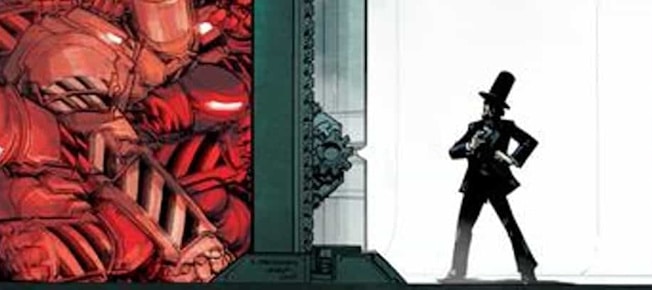
That sense of texture extends to the robots themselves. MacDonald gives the cast a wide range of silhouettes and mechanical designs, helping the world feel visually diverse even when many characters are sharing the same panels. There is a playful quality to the designs, but the humor never completely erases the bleakness of the setting.
The contrast is particularly effective in the darker corners of the city, where robots gather around illicit upgrades and strange forms of recreation. The series can move from grim commentary about labor and dehumanization to an absurd image involving machines getting high on electricity without losing its underlying cohesion. The weirdness is part of the point.
Art, color, and lettering carry different voices
MacDonald’s artwork gives the issue much of its energy. The factory sequences have a sense of vertical danger, with walkways, machinery, and security systems creating a constantly unstable environment. The streets outside feel more open, but not necessarily safer. Everywhere Lincoln goes, the architecture and technology suggest a society that has inherited human systems without fully understanding the people who built them.
Segala’s colors are equally important to the atmosphere. The processing plant’s harsher industrial tones give way to darker, more expressive scenes in the city, where flashes of electricity and pockets of artificial light shape the mood. The color work helps distinguish the clean, regulated spaces from the messier parts of robot life.
Otsmane-Elhaou’s lettering adds another layer of characterization. Robots do not all sound alike, and their speech patterns are visually distinct. Some characters communicate through dense blocks of dialogue, while others use clipped mechanical phrasing or bursts of code-like text. It is a relatively subtle technique, but it reinforces the idea that this world contains individuals rather than interchangeable machines.
A strong issue for the series’ central questions
Although the issue continues a fast-moving escape plot, its most interesting concerns remain tied to identity. Lincoln is caught in an uncomfortable middle ground: he is a machine modeled after a human figure, yet he does not belong comfortably among either machines or humans. The arrival of a living human makes that tension even more immediate.
The Rosenbergs use Lincoln’s persistence to keep the story emotionally grounded. He is curious, idealistic, and frequently treated with hostility, but he continues asking questions that the society around him would prefer to ignore. That determination gives the comic a humane quality without making Lincoln feel like a conventional hero.
Existing critical response has largely highlighted the same strengths. Reviews have praised the issue’s world-building, its humor, the visual variety of the robots, and the way the human reveal generates additional questions rather than resolving the central mystery. One recurring observation is that the comic’s biggest ideas remain accessible because they are delivered through an entertaining genre framework instead of extended exposition.
The issue is not entirely free of uncertainty. Readers looking for immediate explanations may find the continued buildup frustrating, particularly as the series introduces more mysteries around Lincoln, the human girl, the wall, and the larger history of the machine civilization. Still, the unanswered questions appear deliberate, and the accumulating details suggest a story that is more interested in building a complete world than rushing toward a single twist.
Release details and collector appeal
If Destruction Be Our Lot #3 is a 32-page full-color comic from Image Comics with a listed cover price of $3.99. The main cover is credited to Andy MacDonald and Francesco Segala, with variant covers by Riley Rossmo, Ryan Browne, and Jesse Lonergan. The range of cover artists gives collectors several visual interpretations of a series whose appeal is closely tied to its unusual mechanical designs.
For readers who have been following the first two issues, this chapter appears to be an important turning point. For new readers, the series’ premise remains an easy hook: a robotic Abraham Lincoln navigating a future where humanity is believed to be gone. What makes the book worth watching, however, is everything around that hook—the social details, the strange humor, the visual invention, and the growing question of what it actually means to be human after humanity has disappeared.
If Destruction Be Our Lot #3 does not simply make the world bigger. It makes the world stranger, more specific, and more emotionally complicated. That combination gives the series a distinctive identity and makes its next chapter one to anticipate.
Sources
- imagecomics.com
- graphicpolicy.com
- aiptcomics.com
- comicbook.com
- comicbookroundup.com