
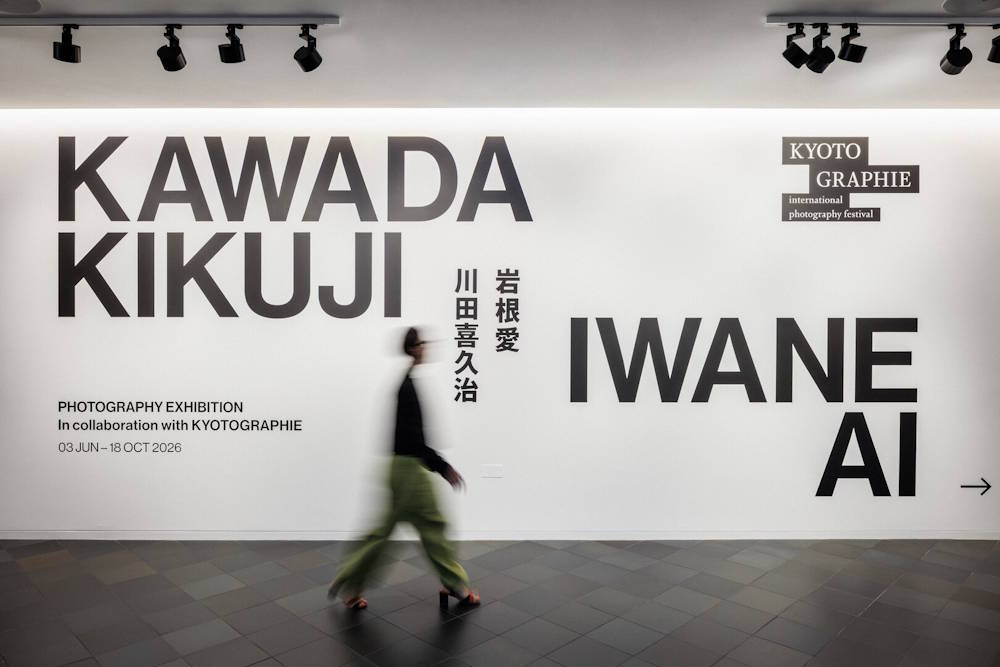
Japan House London has opened Kyotographie: Kawada Kikuji x Iwane Ai, a major photography exhibition bringing together two generations of Japanese artists for the venue’s first photography showcase. Running until October 18, 2026, the free exhibition explores memory, identity, migration, war and cultural tradition through striking images from Japan, Hiroshima, Tōhoku and Hawaii.
Presented in partnership with the team behind KYOTOGRAPHIE International Photography Festival, the exhibition offers UK visitors a rare chance to see Kawada Kikuji and Iwane Ai in the same space. The show was previously announced under the title Invisible, before taking its current name for the London presentation.
Japan House London’s Gallery has been arranged to let each photographer’s work occupy its own distinct half of the space. The result is a natural visual conversation between Kawada’s long examination of postwar Japan and Iwane’s atmospheric photographs of community, folklore and displacement.
Kawada Kikuji’s photographic map of postwar Japan
For longtime fans of Japanese photography, Kawada’s inclusion is a major draw. Born in 1933, the photographer has spent more than eight decades pushing at the boundaries of the medium, with a career that has continually returned to questions about Japan’s changing identity.
The exhibition includes works from Chizu (The Map), his landmark 1965 photobook. Rather than presenting a straightforward documentary record, the series approaches the scars of postwar Hiroshima through fragmented, abstract and often unsettling imagery. Its reputation as one of the most important Japanese photobooks of the 20th century gives the London exhibition a powerful historical centre.
Visitors can also encounter selections from Los Caprichos, created between 1968 and 1981, as well as works from The Last Cosmology and more recent projects. Together, the pieces show how Kawada’s visual language has continued to change while remaining focused on memory, destruction and the difficult process of interpreting the past.
Kawada rose to prominence in the 1960s and was a founding member of the VIVO collective, an influential group of Japanese photographers. His work was exhibited at The Museum of Modern Art in New York in 1974, and he received a lifetime achievement award from the Photographic Society of Japan in 2011. The selection for this exhibition has been curated by Sayaka Takahashi of PGI Gallery in Tokyo.
Iwane Ai connects Tōhoku, Hawaii and Japanese folklore
Iwane Ai’s work provides a striking contrast. Born in Tokyo and educated partly in the United States, she often approaches photography through a transnational lens, looking at how Japanese communities preserve identity across oceans and generations.
Her Kipuka series, from 2018, documents Japanese immigrant communities in Hawaii, including people with roots in Fukushima. The photographs look beyond simple ideas of heritage, focusing instead on the ways culture survives, changes and becomes part of a new landscape.
The exhibition also features A New River, created in Japan’s Tōhoku region during the COVID-19 pandemic. Cherry blossoms photographed at night appear alongside figures drawn from Japanese folk traditions, creating images that feel dreamlike but are rooted in isolation, grief, memory and hope.
It is this meeting of contemporary reality and supernatural folklore that gives Iwane’s work its distinctive atmosphere. Her photographs do not treat tradition as something frozen in the past; instead, folklore becomes a way to process events still affecting communities in the present.
Free admission, gallery talks and visitor information
Kyotographie: Kawada Kikuji x Iwane Ai is on display at The Gallery inside Japan House London, located at 101–111 Kensington High Street. Admission is free, although booking is encouraged, particularly during busy periods. The exhibition is scheduled to continue through Sunday, October 18, 2026.
The venue has also arranged related programming, including spotlight talks focused on individual works and series. Upcoming sessions are set to examine Kawada’s The Map on August 11, Iwane’s Kipuka on September 15, and Kawada’s The Last Cosmology on October 13. These talks are designed to offer more context before visitors explore the wider exhibition at their own pace.
Visitors should also be aware that the installation includes low lighting, limited space and fast-moving slide projections. Some of the displayed photographs address war, natural disasters, self-harm and death, while others contain nudity. Japan House London recommends checking the visitor information before making a booking.
For anime, manga and Japanese pop-culture fans accustomed to seeing Japan through animation, games and character design, this exhibition offers a different kind of visual journey. Worth keeping an eye on next are the remaining gallery talks and the exhibition’s final months, when the free show will give London audiences one more chance to experience these two very different photographic visions side by side.
Sources
japanhouselondon.uk
kyotographie.jp
japansociety.org.uk
uk.emb-japan.go.jp