
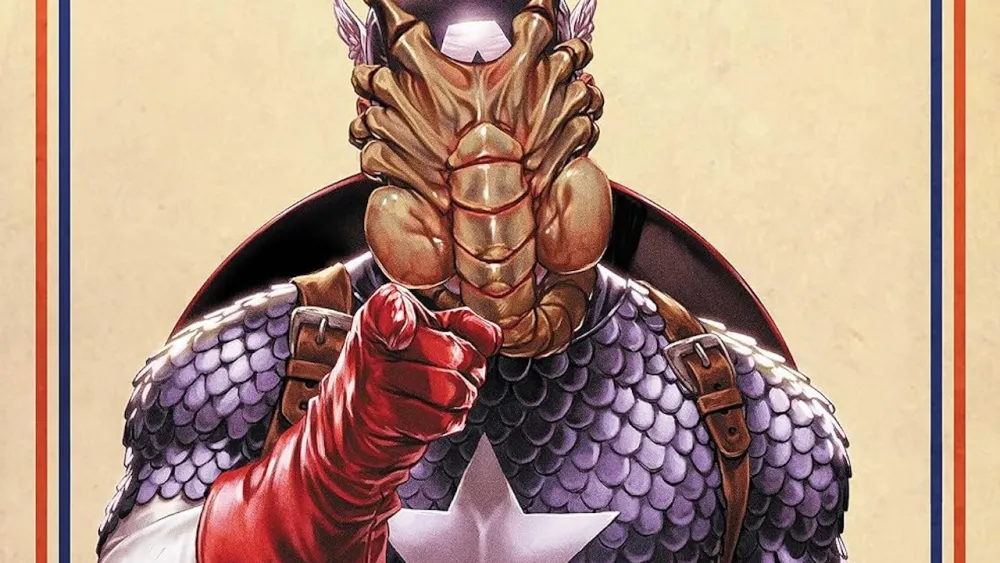
Marvel’s Alien vs. Captain America has arrived as a four-issue limited series, bringing Steve Rogers and the Howling Commandos into a World War II nightmare engineered by Hydra. Written by Frank Tieri and illustrated by Stefano Raffaele, the crossover matters because it takes a different route from the earlier Alien vs. Avengers: instead of centering the story on the mythology of the Xenomorphs, it builds its foundation from Marvel history.
The result, according to a review from AIPT Comics, is a story that feels less like a conventional superhero team-up and more like a horror tale unfolding inside an alternate version of the Marvel Universe.
A World War II Mission Opens the Door to Attilan
The premise begins with Hydra searching for a weapon capable of turning the tide of the war. Red Skull sends Baron Strucker into the Himalayas in search of the fabled city of Attilan, home of the Inhumans. What Strucker discovers, however, is not the secret knowledge he expects.
Instead, the expedition uncovers the remains of a civilization destroyed by Xenomorphs. The creatures are not introduced through an elaborate explanation of how they reached the Marvel Universe. They are simply there, waiting in the ruins, much like the unknown horror discovered aboard the derelict spacecraft in the original Alien film.
That choice gives the series an unsettling sense of inevitability. The infestation is not beginning when Hydra arrives; the destruction has already happened. The danger is ancient, buried, and only now being disturbed by people arrogant enough to believe they can control it.
It also allows the comic to avoid spending too much time on crossover logistics. Rather than pausing to explain every detail of the Xenomorphs’ arrival, the story moves quickly toward the consequences of their discovery.
Marvel Mythology Takes Center Stage
Where Alien vs. Avengers drew heavily from the film franchise’s expanded mythology, including elements associated with Prometheus and Alien: Covenant, Alien vs. Captain America is much more invested in Marvel’s cosmic and superhero traditions.
Inhumans, Kree, Skrulls, the Red Skull, Arnim Zola, and Captain Marvel all become part of the story’s larger design. The Xenomorphs are still the source of the body horror, but the framework around them is unmistakably Marvel. The crossover treats the Alien creatures as an invasive force moving through familiar superhero systems rather than as the sole focus of the mythology.
Captain America’s position in the story is particularly important. Steve Rogers does not serve as the cause of the central disaster, nor does he arrive early enough to prevent the initial catastrophe. By the time he encounters the Aliens, they have already been unleashed.
That makes Cap less of a traditional action-movie engine and more of a survivor caught in circumstances far beyond his control. The distinction helps preserve the horror. Even a hero as capable and symbolically powerful as Captain America is forced to respond to an enemy that does not care about patriotism, strategy, or moral certainty.
When Hydra Science Meets Xenomorph Biology
The comic does not avoid the larger-than-life spectacle expected from a Marvel crossover. Hydra’s experiments lead to a gruesome fusion involving the Red Skull and an Alien Queen, with the story suggesting that Arnim Zola’s scientific interference is responsible for the monstrous result.
It is an extravagant idea, but it fits the collision of these properties. The Alien franchise supplies the biological horror, while Marvel contributes the mad science, supervillain escalation, and willingness to make an already dangerous threat even more extreme.
The series expands its scope further with the arrival of Mar-Vell and the Kree Empire. Their involvement shifts the story beyond the European battlefront and into the wider cosmic side of Marvel. The Xenomorph threat is no longer limited to Hydra’s wartime ambitions; it becomes a problem capable of destabilizing alien civilizations.
One of the more imaginative concepts explored in the series involves the potential results of Xenomorphs breeding with Skrulls. The resulting creatures combine the Aliens’ destructive biology with the Skrulls’ shape-shifting abilities, creating an enemy that is both physically dangerous and difficult to identify or contain.
Stefano Raffaele’s Shadowy, Brutal Visuals
Stefano Raffaele’s artwork provides the connective tissue between the two franchises. The pages are dark, oppressive, and filled with heavy shadow, giving the Xenomorph sequences the atmosphere expected from Alien. At the same time, Raffaele gives Captain America and the surrounding Marvel characters the scale and visual clarity of a superhero adventure.
That balance is essential. The series needs to sell the claustrophobia and gore of an Alien story while still allowing Captain America to look like Captain America. Raffaele’s work reportedly handles both sides effectively, moving from war-torn European landscapes to blood-soaked killing grounds without making either setting feel out of place.
The artwork also gives the human characters enough dramatic weight to make the horror matter. The Xenomorphs are not merely presented as action figures for Cap to punch. Their presence changes the mood of every scene, turning familiar wartime heroics into something more desperate and uncertain.
A Strong Addition to Marvel’s Alien Crossovers
Alien vs. Captain America is ultimately most successful when it understands that the two franchises do not need equal representation in every scene. The Alien elements provide the threat, atmosphere, and physical horror. Marvel supplies the mythology, villains, cosmic history, and heightened spectacle.
That division gives the crossover its own identity. It is not simply Captain America fighting Xenomorphs in a series of disconnected set pieces. The story uses Attilan, Hydra, the Kree, the Skrulls, and Marvel’s wartime history to create a world in which the Aliens feel disturbingly natural.
The series was released by Marvel as a four-issue limited series beginning in November 2025. The collected trade paperback gathers Alien vs. Captain America #1–4 and was listed for release on August 26, 2026, making it an accessible option for readers who prefer to experience the complete crossover in one volume.
For Marvel fans, Alien readers, and collectors drawn to unusual franchise collisions, the series offers a clever variation on the crossover formula. Its biggest strength is also its simplest idea: the Xenomorphs do not need to be explained before they become terrifying. They only need to be discovered.
Sources
aiptcomics.com
marvel.com
graphicpolicy.com
midtowncomics.com