
Marvel’s Venom #261 puts Reed Richards back in the path of one of his most consequential scientific mistakes. Written by Al Ewing with art by Carlos Gómez, the issue revisits the alien symbiote’s early days in Fantastic Four custody—and turns an old containment procedure into the source of a dangerous new alliance.
Scheduled for release on September 2, 2026, the 32-page, $4.99 issue promises a story built around unfinished business. Reed may need the symbiote’s help to save the world, but Venom has not forgotten what happened when Mister Fantastic treated a living alien like a laboratory specimen.
Reed Richards’ Old Mistake Returns
The central conflict reaches back to the classic black-suit era. After Spider-Man’s alien costume proved impossible to remove, Reed Richards used a sonic weapon to separate it from its host and placed the symbiote in containment for study. Marvel’s own retrospective material identifies The Amazing Spider-Man #258 as the key chapter in that story, with the Fantastic Four discovering that the costume was alive and vulnerable to sound.
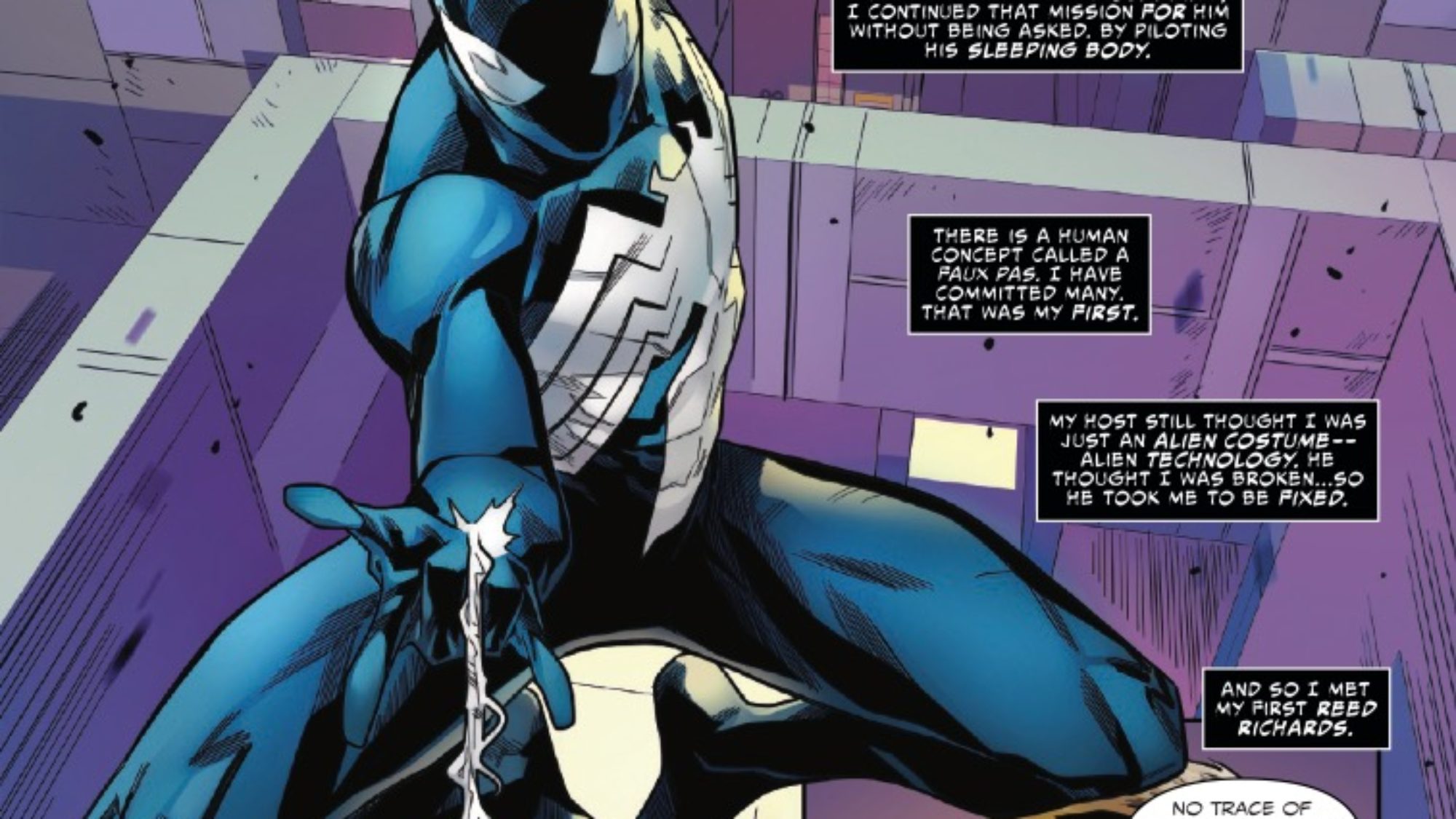
Venom #261 now reframes that familiar sequence from the symbiote’s perspective. The preview presents Reed and Johnny Storm examining the creature inside a Fantastic Four facility while the symbiote’s narration casts Richards not as a concerned hero, but as another human being tormenting and imprisoning an intelligent lifeform.
That viewpoint gives the issue an appealing twist. Readers have seen the black suit’s escape and eventual bonding with Eddie Brock many times, but Ewing’s setup asks what the symbiote remembers about the experience—and whether those memories have shaped its relationship with Venom ever since.
An Uneasy Alliance with Venom’s Oldest Enemy
Marvel’s solicitation makes the stakes clear: Reed must work alongside the alien organism to save the world, even as Venom carries a deep grudge. The details of the larger threat remain under wraps, but the premise creates immediate tension between necessity and trust.
Reed is one of Marvel’s most celebrated scientific minds, yet his brilliance has often come with serious ethical blind spots. His decision to imprison the symbiote was understandable from a security standpoint, especially after it endangered Spider-Man, but the preview emphasizes the cost of reducing a sentient being to a research subject. That tension could make the issue more than a straightforward superhero team-up.
Johnny Storm’s presence adds another layer to the flashback. The Human Torch’s powers fail to drive the symbiote away, forcing Reed to escalate with sonic technology. The sequence reinforces how little the Fantastic Four understood about the organism at the time—and how easily a controlled experiment became a personal trauma for the creature.
Why the Symbiote’s History Still Matters
The alien costume’s journey from Secret Wars relic to Spider-Man’s black suit and, eventually, Venom is one of Marvel’s most durable pieces of character history. The symbiote’s first major host was Peter Parker, but its union with Eddie Brock in The Amazing Spider-Man #300 transformed it into one of Marvel’s defining antiheroes.
That history has continued to evolve through new hosts, changing symbiote mythology, and stories that have explored the organisms as individuals rather than simple monsters. Recent Venom comics have also leaned into the character’s cosmic mythology and complicated family structure. By returning to the Fantastic Four’s early handling of the symbiote, Venom #261 appears poised to connect that larger mythology to a very personal grievance.
For longtime readers, the appeal is obvious: this is a chance to revisit a foundational moment while adding emotional context to an event that originally played as horror and science fiction. Newer readers do not necessarily need to know every detail of the black-suit saga, either. The basic conflict—Reed imprisoned a sentient alien, and now he needs its cooperation—is enough to establish the issue’s dramatic stakes.
What to Expect from Ewing and Gómez
Al Ewing and Carlos Gómez continue the creative partnership that has defined Marvel’s current Venom era. Existing coverage of their work has frequently highlighted Gómez’s clean layouts, expressive characters, and energetic superhero action, while Ewing’s scripts tend to expand familiar concepts through unusual points of view and deeper mythology.
That combination seems particularly well suited to this story. Gómez’s character-driven approach can give the symbiote’s memories a distinct visual identity, while Ewing has room to explore the moral discomfort beneath Reed’s scientific procedure. The issue’s premise also leaves space for the kind of uneasy humor that often emerges when the Fantastic Four are forced to confront the consequences of their own experiments.
Collectors can also look for multiple variant editions, including covers by Ben Su, Geoff Shaw, and Ito, alongside the Carlos Gómez cover. For readers following the current run, the issue should be an important chapter in Venom’s ongoing relationship with Marvel’s wider superhero community.
Venom #261 arrives in comic shops on September 2, 2026. Reed Richards may have believed he was containing a threat decades ago, but this preview suggests the symbiote remembers the experience very differently—and it may finally be ready to make him answer for it.
Sources
- bleedingcool.com
- marvel.com
- comicbookroundup.com
- keycollectorcomics.com