
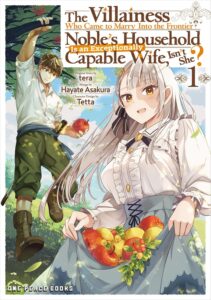
The villainess genre is getting a clever change of perspective with The Villainess Who Came to Marry Into the Frontier Noble’s Household Is an Exceptionally Capable Wife, Isn’t She? One Peace Books will release the first English-language manga volume on September 15, 2026, bringing Tetta’s adaptation of the fantasy romantic comedy to North American readers.
Rather than following a doomed noblewoman who awakens inside her own story, the series shifts attention to a supposedly ordinary “mob” nobleman. Ragna Brave is a reincarnated young man trying to survive the harsh realities of frontier life when an arranged marriage places him face-to-face with Alicia, a duke’s daughter branded as an otome game villainess.
The setup sounds familiar, but the angle is notably different. Alicia is not secretly cruel or scheming; according to the book’s premise, her villainous reputation exists largely because the game’s plot needs someone to occupy that role. Ragna’s challenge is therefore less about defeating a feared antagonist and more about understanding the woman behind the label while protecting her from the consequences of a story that has already decided her fate.
A villainess story from the “background character’s” point of view
Reincarnated villainess stories have become one of the most recognizable corners of modern fantasy romance. Titles such as My Next Life as a Villainess: All Routes Lead to Doom, Villainess Level 99, and The Most Heretical Last Boss Queen typically focus on characters attempting to escape a predetermined downfall.
This manga takes a more unusual route by centering a character who was never part of the original romantic conflict. Ragna is not the hero pursuing Alicia, nor is he the rival who helped bring about her downfall. He is a frontier nobleman with territory to manage, monsters to repel, and neighboring countries to worry about—until the game’s villainess becomes his future bride.
That contrast gives the story room to blend domestic comedy with fantasy adventure. Ragna expects a proud and difficult aristocrat, while Alicia turns out to be remarkably kind and capable. The central relationship grows out of that mismatch between reputation and reality, with the couple forced to deal with lingering hostility directed at Alicia even after her original social defeat.
Tetta’s art gives the adaptation extra weight
One of the first-volume’s biggest strengths is its visual presentation. Light novel manga adaptations can sometimes feel rushed, especially when their primary purpose is to direct readers back toward the prose series. Tetta’s work, however, is described as unusually polished for the format.
The character designs remain accessible and conventional, but the artwork benefits from clean linework, careful detailing, and a stronger-than-usual commitment to backgrounds. Frontier estates, rural surroundings, and fantasy environments receive meaningful visual attention instead of disappearing behind empty panels. That additional detail helps the setting feel like a real place rather than a generic backdrop for the romance.
The action is also handled with restraint. The story includes moments of serious violence, but the manga presents them in a controlled, largely bloodless manner. The result is a fantasy adventure that can create danger without abandoning the light, approachable tone promised by its romantic comedy premise.
A quiet, character-driven opening
The first volume favors understatement over dramatic speeches. Its humor comes from small reactions, awkward exchanges, deadpan physical comedy, and the gradual discovery that Ragna and Alicia are not quite what the other expected. Ragna’s habit of keeping his sword at his side—even when the situation hardly calls for it—becomes one of the little character details that adds personality to the otherwise practical frontier lord.
There are also hints that shared scars and past hardships will become important to the pair’s growing connection. At the same time, the volume takes its time. Ragna and Alicia spend months living together across the opening chapters, yet their relationship develops more like that of cautious housemates than an immediately intimate married couple.
That slow burn may frustrate readers looking for rapid romantic progress, but it also fits the manga’s preference for implication. Some revelations arrive with less preparation than they might need, and several supporting characters remain lightly sketched. Still, the opening volume functions effectively as an introduction to the household, the frontier, and the threats gathering around Alicia.
The English edition runs 168 pages and includes the first four chapters, creator afterwords, translated sound effects, and the opening color pages reproduced in monochrome. The paperback is listed at $13.95, giving readers a compact entry point into a series that combines reincarnation, arranged marriage, territory management, and villainess-story revision.
For longtime fans of otome-game fantasy, the appeal is clear: this is another story about escaping a bad ending, but one told from outside the usual spotlight. Whether Ragna and Alicia’s cautious partnership develops into a deeper romance—and whether the frontier can survive the pressures closing in—will be worth keeping an eye on when Volume 1 arrives this September.
Sources
ipgbook.com
theouterhaven.net