
Goldin’s Summer TCG Auction has closed with more than $18 million in reported sales, reinforcing the continuing strength of the high-end trading card market. The auction, which ended August 9, 2026, brought together vintage Pokémon rarities, modern One Piece championship cards, sealed video game collectibles, and several pieces that established new public sales records.
For collectors accustomed to tracking limited-run figures, premium statues, or rare Gunpla kits, the appeal is familiar: scarcity, condition, provenance, and franchise importance all combine to create a market well beyond the original retail price. In this case, six auction items surpassed half a million dollars, with several iconic Pokémon characters and a One Piece trophy card leading the results.
Pokémon’s Original-Era Rarities Continue to Command the Spotlight
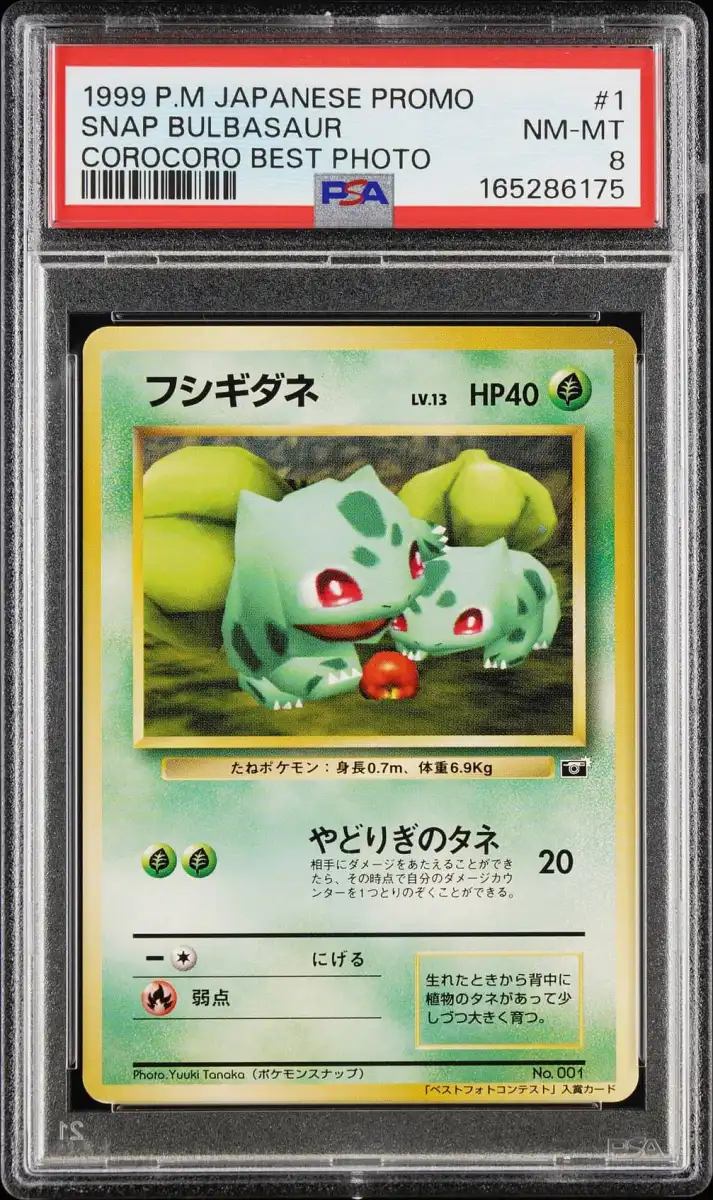
The auction’s highest-selling Pokémon item was a 1999 Japanese CoroCoro Best Photo #1 Snap Bulbasaur, graded PSA NM-MT 8. It sold for $809,943, setting what Goldin identified as an all-time public sales record for a Bulbasaur card.
Snap cards occupy an especially distinctive corner of Pokémon collecting. They are tied to the early Japanese Pokémon Snap promotion and feature photographic imagery rather than the more familiar artwork associated with standard trading cards. Their importance is driven not only by age, but also by the unusual presentation, limited availability, and difficulty of finding high-grade examples.
A 1999 Japanese Promo 64 Mario Stadium Best Photo #4 Snap Charmander reached $640,500, also establishing a reported record for the character. Its companion Mario Stadium Snap Squirtle brought $555,100, while a Snap Articuno from the same promotional family sold for $231,800. Together, the results demonstrate how collectors are increasingly treating obscure regional promos as major franchise artifacts rather than secondary curiosities.
Another major Pokémon result came from a 1999 Base Set Prerelease Holo Raichu graded PSA EX-MT 6. Identified as having a population of only two examples, the card sold for $640,500. The grade itself is not the highest possible, but the card’s rarity and long-standing place in Pokémon collecting history clearly outweighed the condition limitations.
The sale also included a 1996 Japanese Base Set Holo Charizard graded BGS Pristine Black Label 10 and certified through MBA Black Diamond. With a reported population of three, it sold for $518,500. This is a useful reminder that condition-sensitive collectibles can produce radically different results depending on the grading tier: a familiar item can become a trophy when paired with an exceptionally rare grade.
One Piece Adds Modern Heat to a Vintage-Heavy Auction
While the Pokémon results dominated the auction, One Piece supplied the event’s top individual sale. A 2024 One Piece Chinese Year One World Championship 1st Place Monkey D. Luffy Trophy Card, presented in an 8-by-8-inch display, sold for $713,700. Goldin described it as the highest public sale for any One Piece card.
The result is notable because it places a relatively recent One Piece collectible alongside Pokémon cards dating back to the 1990s. The Luffy trophy card is not simply a standard tournament prize or a mass-produced set card; its value is tied to championship placement, restricted distribution, character popularity, and the continued expansion of One Piece’s collector ecosystem.
Another top One Piece result was the 2023-24 Simplified Chinese Championship 2023 Top Prize Winner Monkey D. Luffy card, numbered 001 of 248 and graded BGS Gem Mint 9.5. It sold for $305,000.
From a collector’s perspective, these results suggest that One Piece is developing the kind of premium hierarchy that Pokémon has enjoyed for years. Championship trophies and extremely limited prize cards are beginning to function as the centerpiece pieces of serious collections, particularly for fans who want something more exclusive than a high-grade regular release.
Beyond the Headliners: Sealed Games and Older Charizards
Goldin’s Summer TCG Auction was not limited to headline cards. A 1996 Japanese Game Boy Pocket Monsters Red, unopened and graded PSA 9.8, sold for $146,400. Goldin identified it as an all-time record public sale for a Japanese game.
Sealed video games have become increasingly attractive to collectors because they connect multiple hobby categories at once. This particular piece appeals to Pokémon fans, retro video game collectors, packaging enthusiasts, and anyone interested in the earliest years of the franchise. Like sealed model kits or mint-in-box action figures, its value is closely linked to surviving condition and the difficulty of preserving original packaging for decades.
Other notable Pokémon sales included a 2006 EX Dragon Frontiers Gold Star Charizard in PSA Gem Mint 10 at $295,850, a 1999 Japanese Vending Masaki Promo Gengar in PSA Gem Mint 10 at $207,400, and a factory-sealed 2002 Legendary Collection booster box at $184,220. A PSA Gem Mint 10 Mew from 2002’s Expedition set sold for $175,297, while a 2004 Japanese Gold Star Rayquaza reached $158,613.
The results cover several different collecting strategies: character-focused collecting, set completion, sealed product acquisition, graded-card population chasing, and franchise history. That breadth is part of what makes a major TCG auction interesting even for collectors who are not actively bidding. The market is not being driven by a single definition of rarity.
What the Auction Says About High-End Collecting
The most significant takeaway is the continued separation between ordinary availability and true trophy status. A card may share a character, set, or era with thousands of other examples, but factors such as promotional origin, championship placement, regional exclusivity, unusual artwork, and population reports can move it into an entirely different category.
That dynamic has clear parallels throughout the broader collectibles market. In action figures, a standard release and a convention exclusive may use the same sculpt but occupy very different positions in a collection. In Gunpla, a common kit and a limited-run event release can appeal to the same fan while carrying very different levels of scarcity. The same principle applies here, only with grading data and historical sales providing an especially visible framework.
It is also worth remembering that auction records represent the upper edge of the market rather than the typical experience of most collectors. The prices achieved by trophy cards are not a direct indicator of what every Pokémon or One Piece card is worth. They reflect a collision of rarity, timing, condition, franchise momentum, and competition among buyers pursuing the very best examples.
For casual fans, the auction is a fascinating showcase of franchise history. For dedicated collectors, it offers a clearer lesson: the most desirable pieces are often not the newest or most familiar items, but the ones with a compelling story and a supply that cannot easily expand.
Collector verdict: Goldin’s Summer TCG Auction will be of greatest interest to high-end Pokémon and One Piece collectors, graded-card investors, sealed game specialists, and hobbyists who enjoy studying the premium end of the market. The standout results show that vintage Pokémon remains the dominant blue-chip category, while One Piece is increasingly proving that modern collectibles can achieve serious trophy status when rarity and event provenance are strong enough.
Sources
- actionfigureinsider.com
- goldin.co