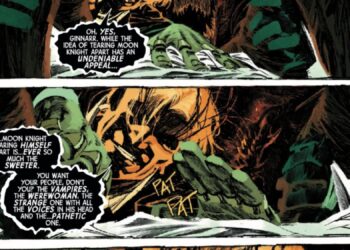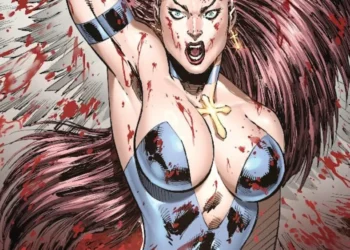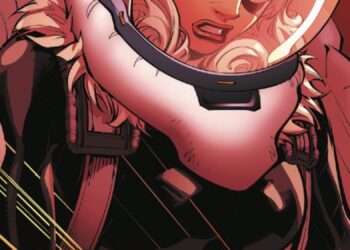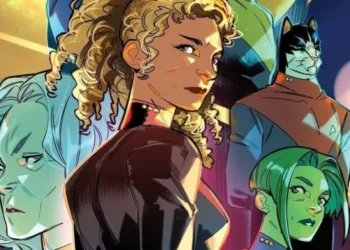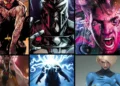

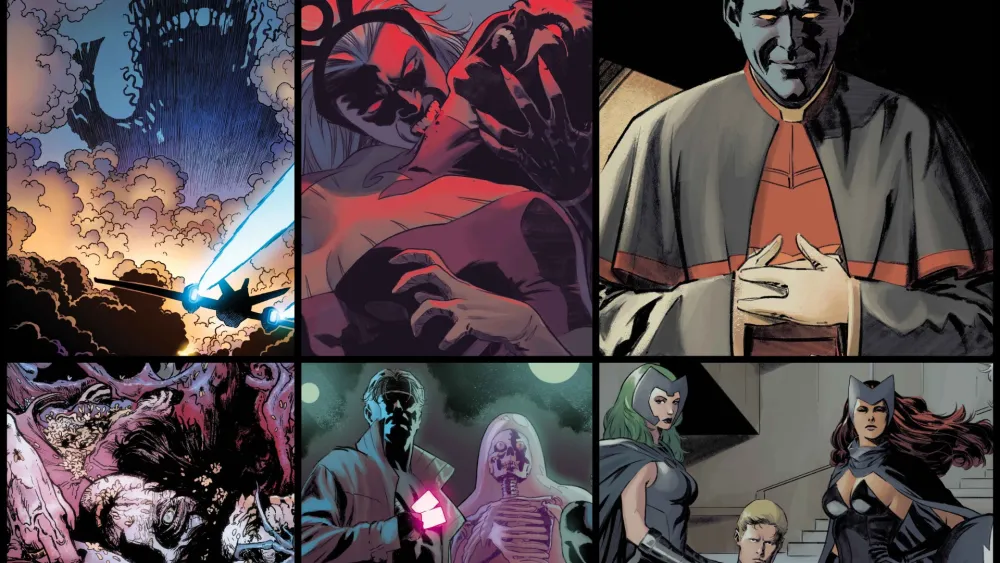
Marvel is opening the door to its new horror-focused Midnight Universe with three debut comics arriving October 7: Midnight Spider-Man #1, Midnight Fantastic Four #1, and Midnight X-Men #1. The publisher has now released preview pages from all three books, offering a clearer look at how Phillip Kennedy Johnson, Benjamin Percy, Jonathan Hickman, and their artistic collaborators are reshaping some of Marvel’s most recognizable heroes.
The launch is also notable because the three titles are scheduled to be Marvel’s only comic-book releases that week. That gives the Midnight Universe an unusually concentrated debut, placing its monstrous versions of Spider-Man, the Fantastic Four, and the X-Men under a single spotlight.
A shared universe built for radical reinvention
The Midnight line is not simply presenting darker costumes or familiar characters in traditionally grim situations. Each series appears to be rebuilding its corner of the Marvel mythology around horror, transformation, and fractured identities.
Midnight Spider-Man comes from writer Phillip Kennedy Johnson and artist ScieTronc, with Peter Parker’s origin taking a particularly unsettling turn. The preview pages tease a hero whose transformation is already pushing beyond the boundaries of the familiar Spider-Man concept, while the wider story promises grotesque new interpretations of figures connected to Peter’s world.
Johnson has indicated that the nature of the spider and its effect on Peter will be revealed gradually. That slow-burn approach should give the series room to treat Peter’s condition as an ongoing mystery rather than explaining the horror immediately. The result could be a Spider-Man story driven as much by dread and uncertainty as by action.
The series’ direction is especially significant because Spider-Man’s classic appeal is tied to the tension between ordinary teenage anxiety and extraordinary responsibility. In the Midnight Universe, that tension is being pushed toward body horror. Peter is not merely learning how to live with new abilities; he is struggling to understand what he has become.
The Fantastic Four lose their familiar foundation
Midnight Fantastic Four takes an equally dramatic approach. Written by Benjamin Percy and illustrated by Kev Walker, the series begins as an origin story in which Reed Richards does not already know Sue Storm, Johnny Storm, or Ben Grimm.
That change removes one of the most important assumptions in Fantastic Four history: that the team’s powers and adventures are inseparable from the family bond formed before their transformation. Percy’s version instead treats the group’s connection as something unstable and potentially dangerous, with a “far more toxic and complicated” family dynamic emerging as their stories collide.
The series also relocates much of its action away from the team’s traditional New York setting. The first three issues move toward cosmic horror, with the third installment taking Reed and the others to New Mexico’s Jornada del Muerto desert. The location carries real historical weight as the site of the Trinity nuclear test, but the comic adds an impossible element: residue from another world left behind by a crack in the firmament.
That premise places the Midnight Fantastic Four closer to forbidden-knowledge horror than conventional superhero science fiction. Reed’s curiosity remains central, but the search for answers may carry consequences that cannot be solved through intelligence, teamwork, or a last-minute scientific breakthrough.
Walker’s involvement should also make the title a strong draw for readers and collectors. Marvel’s preview material emphasizes unsettling imagery and warped transformations, giving the artist an opportunity to make the team’s altered forms feel strange rather than merely powerful.
The X-Men face a supernatural war
Jonathan Hickman and Matteo Della Fonte’s Midnight X-Men appears to be building the most overtly supernatural branch of the new universe. The series introduces a mutant mythology shaped by conflict among mutants, humans, and Empyres, with the threat described in terms of holy war, earthly weapons, and heavenly forces.
The third issue, titled “No Mutants. No Mercy,” offers one of the clearest hints about where the story is headed. Its cover teases Cyclops as the last of the X-Men, taking a young mutant under his protection. That image suggests a much smaller and more desperate version of the team than readers may be used to seeing.
Hickman’s previous Marvel work has often focused on reshaping the foundations of superhero worlds, and this project gives him an opportunity to approach mutant identity through vampire mythology, religious imagery, and apocalyptic horror. The preview details remain deliberately limited, but the combination of a surviving Cyclops and a young mutant successor points toward a story about legacy as much as survival.
Release schedule and collector details
All three debut issues are scheduled for October 7:
- Midnight Spider-Man #1, written by Phillip Kennedy Johnson with art by ScieTronc.
- Midnight Fantastic Four #1, written by Benjamin Percy with art by Kev Walker.
- Midnight X-Men #1, written by Jonathan Hickman with art by Matteo Della Fonte.
The second issues are scheduled to arrive together on November 18, followed by the third issues on December 16. Marvel has already announced regular covers and an extensive selection of variants for the first issues, including Midnight Bloodbath designs by Ryan Stegman, Midnight Special variants, horror homage covers, gallery variants, virgin editions, and a three-part connecting variant by Clayton Crain.
The variant program gives the launch immediate appeal for collectors, particularly those interested in horror-themed Marvel artwork or complete cover sets. The three-book structure also makes the line easy to approach: readers can sample one title, follow all three, or compare how different creative teams interpret the same dark-universe concept.
A new Marvel corner with room to grow
The most intriguing aspect of the Midnight Universe is the freedom built into its premise. These books do not appear designed to replace Marvel’s main continuities. Instead, they can push familiar characters toward extreme outcomes without requiring the regular versions of Spider-Man, the Fantastic Four, or the X-Men to follow them there.
For longtime readers, that creates an opportunity to see foundational Marvel ideas under pressure: Peter Parker’s humanity, Reed Richards’ obsession with discovery, and the X-Men’s fight for survival. For newer readers, the horror framing may provide a straightforward entry point into versions of these characters that do not depend on decades of continuity.
Marvel’s October 7 launch will reveal whether the Midnight Universe can sustain three distinct horror identities at once. Based on the preview material, the publisher is not treating the line as a minor alternate-world experiment. It is positioning Midnight as a concentrated showcase for body horror, cosmic terror, and supernatural mutant conflict.
Sources
aiptcomics.com
comicbook.com
marvel.com