
Image Comics is putting the pedal down with The Last Driver #1, a new five-issue series written and drawn by Sean Gordon Murphy. Arriving Wednesday, August 19, 2026, the book combines outlaw road action with a pointed science-fiction premise: in a future America where automated transportation has replaced—and outlawed—human driving, one aging rebel takes the wheel again to save his granddaughter.
A Future Where the Road Belongs to the Grid
The series begins in an America transformed by the GRID, a robotic transportation network created to make travel safer and more efficient. The system has done more than eliminate traffic and human error, however. It has made cars obsolete and illegal, removing driving from everyday life entirely.
That leaves “Clutch” as a living reminder of a forbidden past. When his granddaughter’s life is at stake, he has no choice but to return to the road. What starts as a desperate rescue mission quickly expands into something much larger: a rebellion against technological control, political extremism, and a nation divided by its own systems of power.
The premise gives Murphy room to explore more than nostalgia for classic cars. In The Last Driver, manual driving becomes a symbol of personal agency. The steering wheel represents the ability to choose a direction, make a mistake, and remain responsible for the consequences—ideas that become increasingly threatening in a society built around automated obedience.
Sean Gordon Murphy Gets Behind the Wheel
Murphy serves as both writer and artist, with Simon Gough credited on art. The creator’s long-standing interest in cars is central to the project, and the preview makes that enthusiasm immediately visible. Vehicles are not simply props in the story; they are part of its identity, atmosphere, and political language.
Murphy has described the series as an opportunity to examine the decline of car culture and the way people surrender control in exchange for convenience. That theme places the comic in familiar dystopian territory, but the automotive focus gives it a distinct visual and emotional engine. The book’s influences reportedly include the hard-edged escape fantasy of Escape from New York and the stripped-down road mythology of Vanishing Point.
Readers familiar with Murphy’s creator-owned work—including Punk Rock Jesus, The Wake, and Tokyo Ghost—will recognize the combination of social commentary, kinetic action, and densely designed environments. His superhero work on Batman: White Knight established him as a major name, but The Last Driver offers a chance to see that visual energy applied to an original world without the expectations of an established franchise.
Wide Panels, Neon Cities, and Mechanical Authority
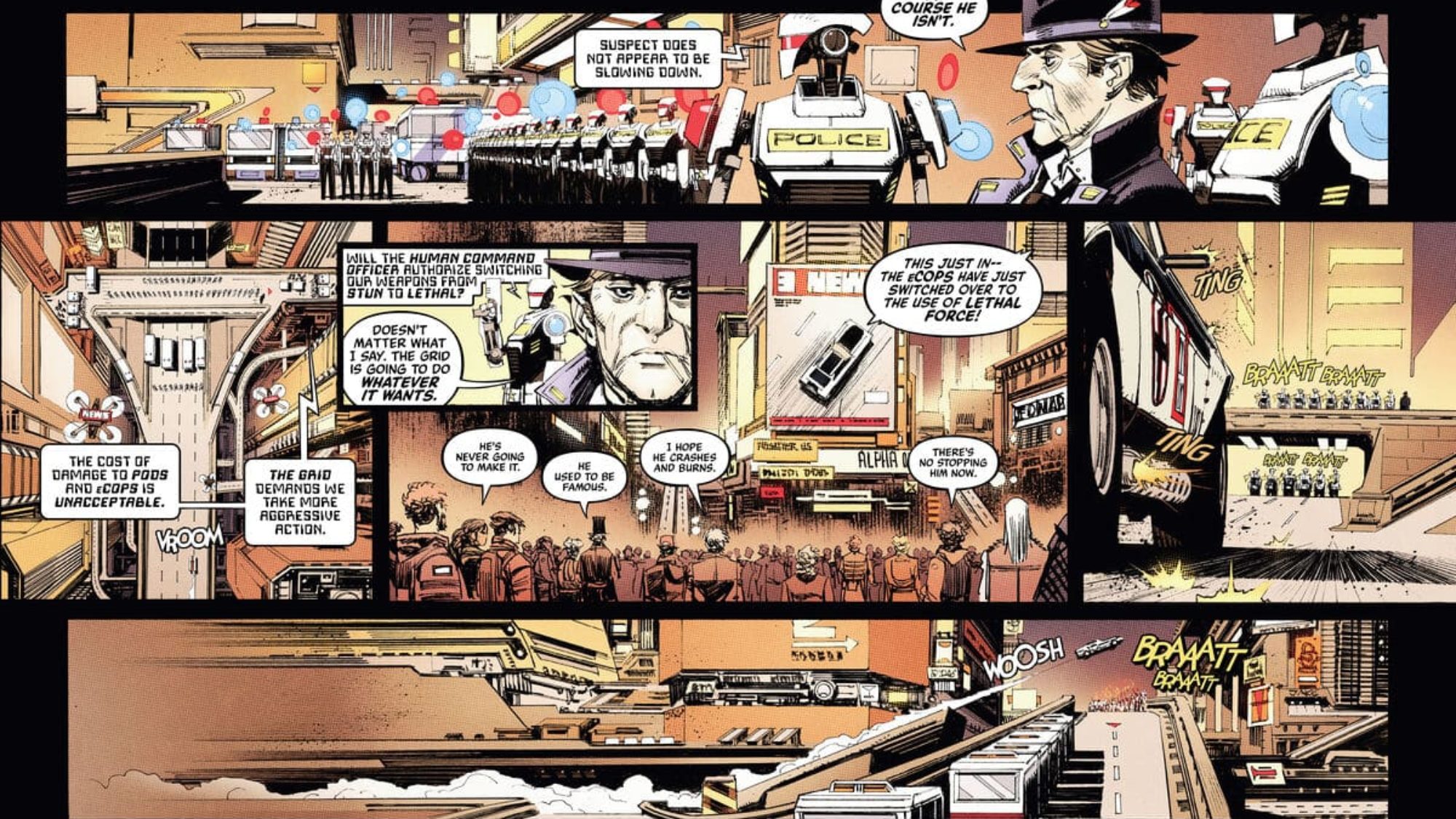
The preview pages emphasize the contrast between the freedom of the open road and the controlled spaces built by the GRID. A sprawling, neon-lit cityscape presents a future where wealth and technology coexist behind layers of surveillance, while poorer communities appear pushed toward the margins and the desert.
That world-building is paired with an ominous look at the GRID’s enforcement arm. Robotic officers known as eCops are shown operating under human authority, including a tense discussion over whether a weapon should be changed from stun to lethal. The scene suggests that the machines may be tools of oppression, but the humans directing them are hardly innocent bystanders.
Murphy’s landscape-oriented approach is particularly well suited to a comic about cars and pursuit. Horizontal compositions can stretch across the page like a highway, giving the action room to build momentum. The format also allows the vehicles, city grids, and long desert vistas to dominate the page in a way that a conventional portrait layout might not.
Based on the preview, the visual language is deliberately cinematic: wide establishing shots, hard angles, luminous city lights, and close-ups that turn the machinery of the GRID into a constant presence. The result is a world that looks polished and efficient on the surface while feeling increasingly hostile underneath.
A New Series With Collector Appeal
The Last Driver #1 is solicited as the first chapter of a five-issue series, giving readers a clear entry point into Murphy’s latest original project. The debut issue is priced at $3.99 and features multiple covers, including designs by Murphy and Corin Howell, along with additional incentive and blank sketch editions listed in the advance information.
Those variants should attract collectors, particularly because the comic’s premise lends itself to striking cover imagery. Classic cars, robotic infrastructure, neon dystopias, and the lone driver archetype all provide strong visual hooks. For readers, however, the larger draw is Murphy’s return to creator-owned storytelling and the chance to see whether this road-warrior premise can develop beyond its immediate style and atmosphere.
There is plenty of familiar genre material in the setup: authoritarian technology, a divided America, an outlaw hero, and one final drive across a hostile landscape. The comic’s potential lies in how Murphy connects those elements to the personal stakes of Clutch’s mission. Saving his granddaughter may be the immediate objective, but the preview frames the journey as a fight over who gets to control the future—and whether freedom is still meaningful when every road is managed for you.
For fans of Murphy’s work, automotive science fiction, and politically charged dystopian comics, The Last Driver #1 looks built for a fast, loud debut. The first issue arrives in comic shops on August 19, 2026.
Sources
bleedingcool.com
imagecomics.com
comicbookyeti.com