
Jeon Woo-won, the grandson of former South Korean military ruler Chun Doo-hwan, has turned a painful family history into an AI-assisted webtoon. Serialized through Instagram, Monggeuli—also reported under the title Mongletoon—uses sheep characters to revisit childhood abuse, family conflict, addiction, and the historical shadow of the Chun family.
The project matters to webtoon readers for two reasons. It is an unusually direct example of autobiographical storytelling built with generative AI, and it places intensely personal trauma beside one of the most contested chapters in modern South Korean history. What began as a small social-media comic later became a widely viewed serialized work, while also reopening familiar arguments about authorship, artistic labor, and the ethics of AI-generated images.
A Family Memoir Told Through Sheep
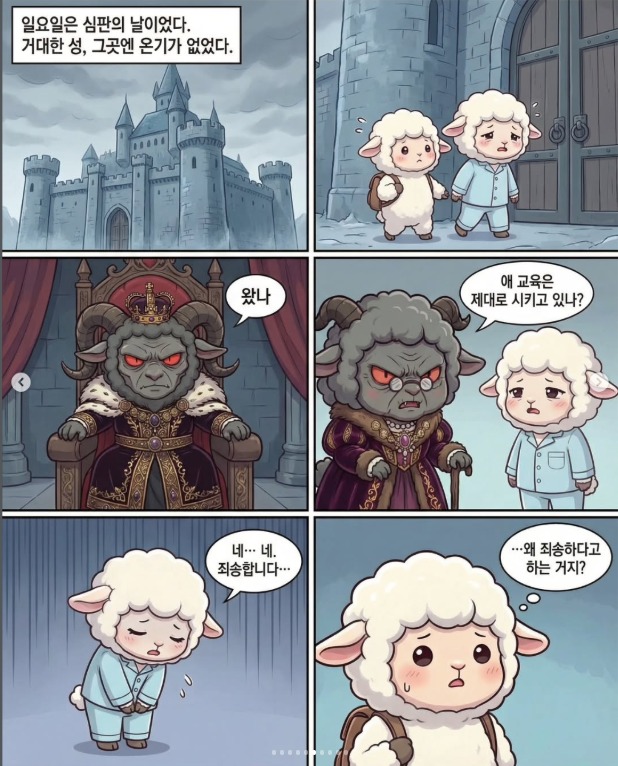
At the center of the series is Monggeuli, a white sheep who functions as a fictionalized version of Jeon Woo-won. Other members of the family appear as sheep as well, with Chun Doo-hwan, Lee Soon-ja, Jeon Jae-yong, and Park Sang-ah represented as black sheep; some of the older figures are drawn with red eyes, giving them an ominous, almost folkloric presence.
The allegory creates a buffer between the creator and the events he describes, but it does not make the material feel distant. Reported episodes cover his parents’ marital breakdown, his biological mother’s illnesses, frequent changes in guardianship, alleged abuse during childhood, and isolation while studying in the United States. The contrast between the soft, vulnerable appearance of Monggeuli and the severity of the experiences surrounding him gives the strip an unsettling emotional charge.
The comic also explores Jeon’s depression and drug addiction. Later sections connect his personal history to his growing awareness of the violence committed during the May 18 Gwangju Democratization Movement under his grandfather’s rule. In that sense, the webtoon is not simply a family memoir: it is also an attempt to understand how private suffering and national trauma can exist within the same household.
From Instagram Confession to Serialized Webtoon
Jeon began posting the series on December 4, 2025, accompanying the first installment with a caption expressing that he felt as though he had lost his mind (The Asia Business Daily). The early material presented Monggeuli’s childhood and family circumstances, while subsequent episodes moved toward his struggle with guilt and his confrontation with the historical record surrounding Chun Doo-hwan.
The first installment concluded in January 2026 with Monggeuli returning to Korea and being arrested at Incheon International Airport (Korea JoongAng Daily). That ending gives the project a clear autobiographical shape, connecting the childhood sections to the public events that made Jeon a prominent whistleblower in 2023.
Later reporting identified the work as Mongletoon and stated that its first season consisted of 51 episodes. The Korea Times reported in March 2026 that Jeon’s Instagram content had accumulated 67,804,452 views over a three-month period, with the webtoon appearing to drive much of that attention. Those figures were based on statistics Jeon shared through social media rather than an independent platform audit, but they demonstrate the scale of interest the project generated.
Why the AI Presentation Is Part of the Story
The use of AI is not a minor production detail. The artwork was generated with artificial-intelligence tools, allowing Jeon to convert memories and symbolic images into short, quickly published episodes without presenting the project as a conventional hand-drawn comic by a credited illustrator.
That approach may suit the work’s confessional quality. Monggeuli’s visual language is less concerned with polished realism than with instantly readable symbols: white and black sheep, a giant castle, red eyes, and spaces that suggest confinement or judgment. From an editorial perspective, the method makes the comic feel closer to an illustrated testimony than to a traditional commercial webtoon built around elaborate character designs and detailed action choreography.
It also places the series inside a larger Korean debate. A Korea Creative Content Agency survey of the webtoon industry found that 27 percent of surveyed companies had experience using AI for image creation in 2024. Among companies already using such tools, the most common applications were pre-planning and story development, followed by background design, editing, and storyboarding. In other words, AI is increasingly present in the production pipeline, even as its use remains contested.
Critics of generative imagery argue that many systems were trained on artists’ work without meaningful permission or compensation, while AI-generated production can reduce demand for human illustrators. Supporters point to speed and accessibility, particularly for creators who have a story to tell but lack the time, money, or technical ability to produce conventional artwork. Monggeuli does not resolve that conflict; it makes the debate more uncomfortable by attaching it to a deeply personal account.
Personal Testimony Meets Public History
Jeon Woo-won first drew widespread attention in 2023 after making allegations about his family and discussing his own drug use. He later apologized to victims and bereaved families connected to the Gwangju uprising. His webtoon continues that process of public reckoning, but it also depicts his own experiences as allegations and memories filtered through a symbolic narrative.
That distinction is important. Monggeuli can be read as an autobiographical testimony and an act of emotional processing, but it is not a neutral historical record. The series presents events from Jeon’s perspective, often through compressed visual metaphors rather than independently verified documentation. Readers approaching it as a work of comics journalism should keep that boundary in mind.
As a piece of webtoon storytelling, however, the format is striking. Instagram’s scrollable feed encourages brief installments that can land like diary entries, while recurring animal imagery gives the series a visual shorthand that readers can understand immediately. The result is an unconventional hybrid: part memoir, part allegorical family drama, and part public confession.
For digital-comics fans, Monggeuli is worth watching not because it represents a settled model for AI comics, but because it exposes the tensions that will shape the medium. The series asks whether an emotionally urgent story can gain power through imperfect machine-generated images—and whether that power comes at a cost to the artists whose work helped make such tools possible.
Sources
- bleedingcool.com
- asiae.co.kr
- koreajoongangdaily.com
- koreatimes.co.kr
- mk.co.kr
- welcon.kocca.kr