
DC’s Superman: Father of Tomorrow continues its Elseworlds reimagining with a third issue centered on invention, influence, and the dangerous pursuit of power. Written by Kenny Porter and illustrated by Danny Earls, the series asks a striking question: what if Jor-El, rather than Kal-El, became Earth’s Superman?
Issue #3 arrives Wednesday, July 22, 2026, with Jor-El attempting to transform the world through a revolutionary energy source. At the same time, General Sam Lane is developing his own plans for Kryptonian technology, while Lex Luthor begins a globe-spanning search for greater power. For readers interested in alternate takes on Superman mythology, the issue appears poised to widen the series’ political and technological stakes.
Jor-El’s Energy Revolution Meets Human Paranoia
The central conflict in this chapter is not simply about whether Jor-El can improve life on Earth. It is about who gets to control the future he is trying to build. The solicitation frames Jor-El’s energy source as a potentially world-changing breakthrough, but General Lane’s response suggests that government suspicion remains just as formidable as any super-powered threat.
That tension gives the story a familiar Superman theme from an unusual angle. In traditional versions of the myth, Clark Kent must decide how openly to use his abilities and how much humanity can be trusted with extraordinary power. Here, Jor-El is the outsider attempting to share advanced knowledge with an entire planet. His challenge is less about hiding what he can do and more about convincing Earth that his gifts should not automatically be treated as weapons.
General Lane’s involvement also adds a military dimension to the story. His interest in Kryptonian technology suggests that the conflict may not remain a debate over energy policy. The preview points toward a struggle over ownership, security, and the fear that one alien civilization’s science could permanently alter the balance of power on Earth.
Lex Luthor Takes His Ambition Worldwide
Lex Luthor’s role in the issue appears to be more expansive than a conventional confrontation with Superman. Rather than simply opposing Jor-El from Metropolis, Lex is traveling around the world in search of power. That phrasing leaves room for several possibilities, but the confirmed premise is clear: Luthor recognizes that Jor-El’s arrival has created an opportunity, and he intends to exploit it.
This version of Lex fits naturally into a story about technological progress. Jor-El represents knowledge used in the service of humanity, while Luthor embodies the belief that knowledge is valuable primarily because it can be converted into influence. The contrast does not require Lex to reject innovation. On the contrary, his interest in power suggests that he may be the character most eager to understand the future—provided he can make that future serve him.
Making Lex a global figure in this installment also helps broaden the scale of the Elseworlds setting. The series is not treating Jor-El’s presence as a local curiosity confined to Kansas or Metropolis. His technology has consequences far beyond one city, and Luthor is apparently moving wherever those consequences offer the greatest advantage.
A Metropolis Commute Turns Into a Crisis
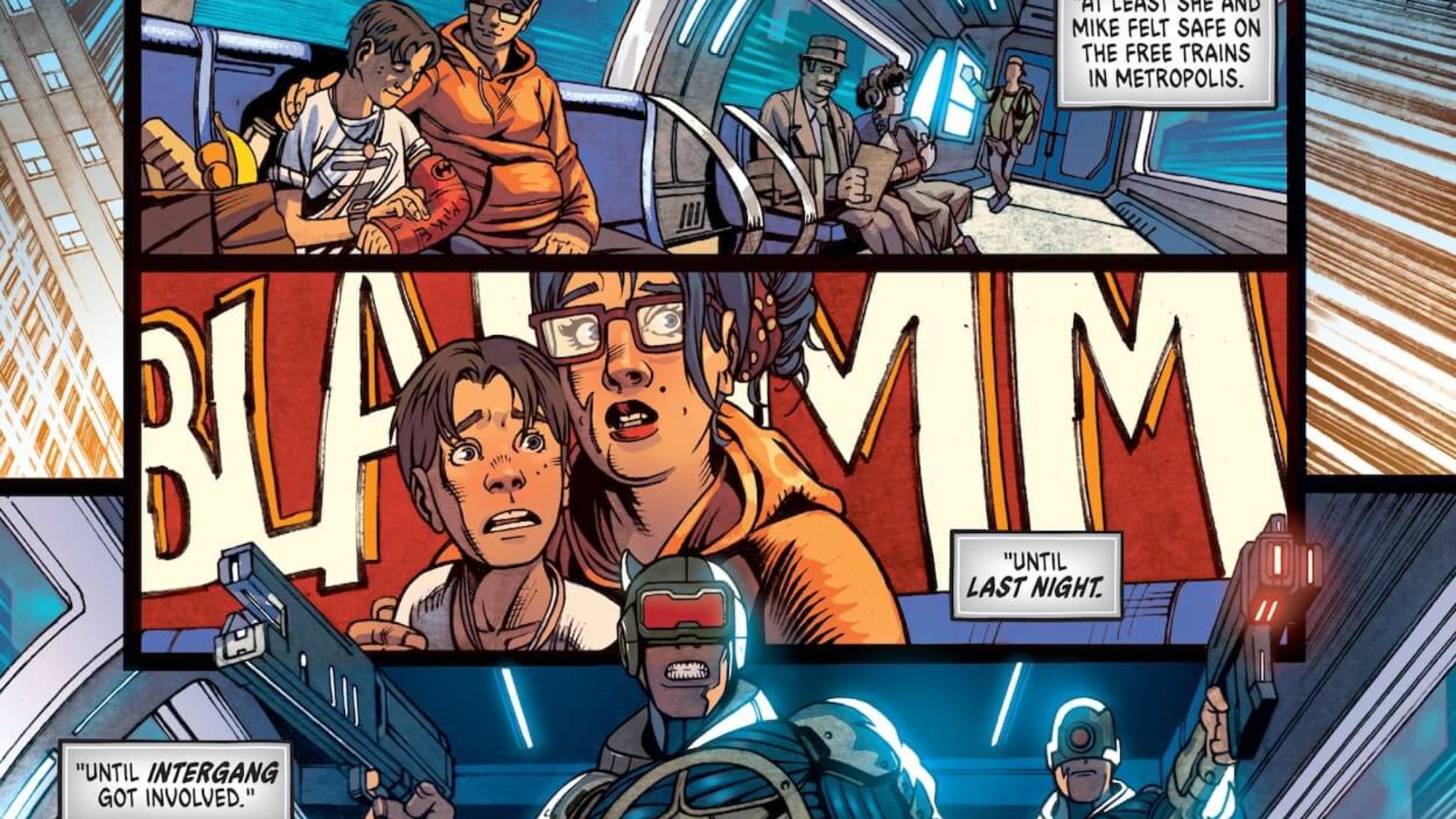
The preview pages bring the larger ideas down to street level through Sara Chalmers and her son. The pair are traveling home aboard a Metropolis maglev train when Intergang violence erupts. Armed criminals demand that witnesses be eliminated, turning an ordinary commute into a life-threatening confrontation.
The sequence gives the issue a grounded emotional entry point. Jor-El’s energy project and Lex’s international ambitions may operate on a grand scale, but Sara and her child experience the consequences of a world still struggling with violence and inequality. Their presence reinforces one of the most important questions raised by the premise: can a scientific revolution genuinely improve everyday life if powerful institutions and criminal organizations continue to treat people as expendable?
The preview also highlights Sara’s attempt to protect her son before Jor-El intervenes. That moment places maternal courage alongside Kryptonian power rather than presenting heroism as something only an alien can provide. Jor-El may possess extraordinary abilities, but the scene begins with an ordinary person making an extraordinary choice under pressure.
Danny Earls Brings a Distinct Elseworlds Identity
Danny Earls serves as the series’ artist and cover artist, with Nick Filardi credited as colorist on the first issue. Based on the preview material supplied for issue #3, the artwork shifts comfortably between science-fiction spectacle, urban action, and intimate character beats.
The maglev sequence appears designed to make Metropolis feel like a functioning future city rather than a backdrop of familiar landmarks. Public transportation, advanced infrastructure, and Intergang’s weaponry all contribute to a setting where progress and danger exist side by side. That visual contrast is especially appropriate for a story in which new technology promises to solve global problems while simultaneously attracting militaries, criminals, and billionaires.
The issue is also available with multiple covers, including a main cover by Earls, a Gabriel Hardman variant, and a Lucio Parrillo variant. For collectors, the range offers three different visual approaches to a series whose identity is still being established around Jor-El’s unfamiliar role as Earth’s leading protector.
Release Details and Reader Appeal
Superman: Father of Tomorrow #3 is published by DC Comics and goes on sale Wednesday, July 22, 2026. The issue is listed at $4.99, with the preview credits identifying Kenny Porter as writer and Danny Earls as artist and cover artist.
As an Elseworlds story, the series does not require readers to follow the current mainline Superman continuity. That makes it accessible to longtime fans looking for a radical reinterpretation, while the familiar presence of Lex Luthor, General Lane, Intergang, and Kryptonian technology gives established readers plenty of recognizable material to track.
The most intriguing element of issue #3 is the way it connects three different forms of power: Jor-El’s scientific idealism, General Lane’s institutional authority, and Lex Luthor’s personal ambition. The preview suggests that the biggest threat may not come from any single villain, but from the competing visions of what Earth should become once Kryptonian knowledge is placed within human reach.
Sources
bleedingcool.com
dc.com