
Spoilers for The Odyssey follow.
Christopher Nolan’s The Odyssey keeps the essential shape of Homer’s Cyclops episode, but it removes one of the poem’s most famous jokes. The decision changes Odysseus’ escape from a battle of wits into something darker and more physically brutal—an approach that fits Nolan’s grounded treatment of myth while making the Cyclops feel less like a character from an adventure story and more like a living nightmare.
The sequence is one of the clearest examples of how Nolan adapts ancient fantasy without abandoning his fascination with practical detail. Rather than leaning heavily on visible gods or broad supernatural spectacle, The Odyssey treats its monsters as tangible threats. Bill Irwin’s Cyclops is enormous, flesh-and-blood, and terrifyingly present, even when the film withholds the kind of dialogue audiences may expect from the creature.
Nolan Cuts Homer’s “Nobody” Trick
In Homer’s original poem, Odysseus introduces himself to the Cyclops Polyphemus under the name “Nobody.” After Odysseus and his men blind the monster, Polyphemus cries out that nobody is attacking him. The other Cyclopes misunderstand the warning, allowing Odysseus and his surviving crew to escape.
That exchange is missing from Nolan’s film, and the director has explained why. During an appearance on The Daily Show with Jon Stewart, Nolan described the moment as a pun that was difficult to preserve in translation. In the original Greek, Odysseus uses “Outis,” a word meaning “Nobody” that also echoes a diminutive form of “Odysseus.” The wordplay works on multiple levels in Greek, but it becomes much more straightforward—and arguably sillier—in English.
Without that linguistic trick, the Cyclops is no longer outsmarted through a verbal joke. The film instead emphasizes the immediate horror of the encounter: men trapped in a cave, a giant blocking the exit, and an enemy that barely needs language to dominate the space. The result is less playful than Homer’s version, but it also gives the sequence a more ominous tone.
The Major Beats Remain Intact
Nolan still preserves the central structure of the Cyclops episode. Odysseus and his men arrive on the creature’s island, follow the sheep to its cave, and find themselves trapped after the Cyclops begins devouring the crew. Because the monster blocks the entrance with a massive stone, the men cannot simply run for safety or kill it while it sleeps.
After blinding the Cyclops, Odysseus and the surviving sailors escape by hiding beneath the sheep. The wool conceals them from the creature’s hands as it checks the animals leaving the cave. It is one of the story’s most recognizable images, and the film retains the basic idea while presenting it as a desperate physical maneuver rather than a clever punchline.
The adaptation also keeps the episode’s devastating consequences. By attacking the Cyclops, Odysseus draws the attention of its father, Poseidon, and turns an already dangerous voyage into a personal conflict with the god of the sea. Nolan’s film does not need to place the Olympian gods constantly onscreen for their influence to be felt. Their power hangs over the journey as a threat that reaches far beyond the cave.
A Silent Monster Makes the Cave More Unsettling
One of the boldest changes is the Cyclops’ limited speech. The creature is mostly silent, communicating through movement, breath, violence, and an unsettling prayer to Poseidon after being blinded. Its voice carries a strange echo and is often difficult to understand, making the monster feel alien rather than theatrical.
Odysseus offers an explanation for the creature’s silence by comparing it to the way humans might regard ants. From the Cyclops’ perspective, the men in the cave are not fellow beings worthy of conversation. They are intruders, prey, or obstacles. That idea makes the monster’s lack of dialogue more disturbing than a string of threats ever could.
The choice also removes another element from Homer’s story. Because the Cyclops does not participate in the “Nobody” exchange, the film has little reason to introduce the other Cyclopes who appear in the original episode. Nolan narrows the encounter into a confrontation between Odysseus, his men, and one nearly incomprehensible predator.
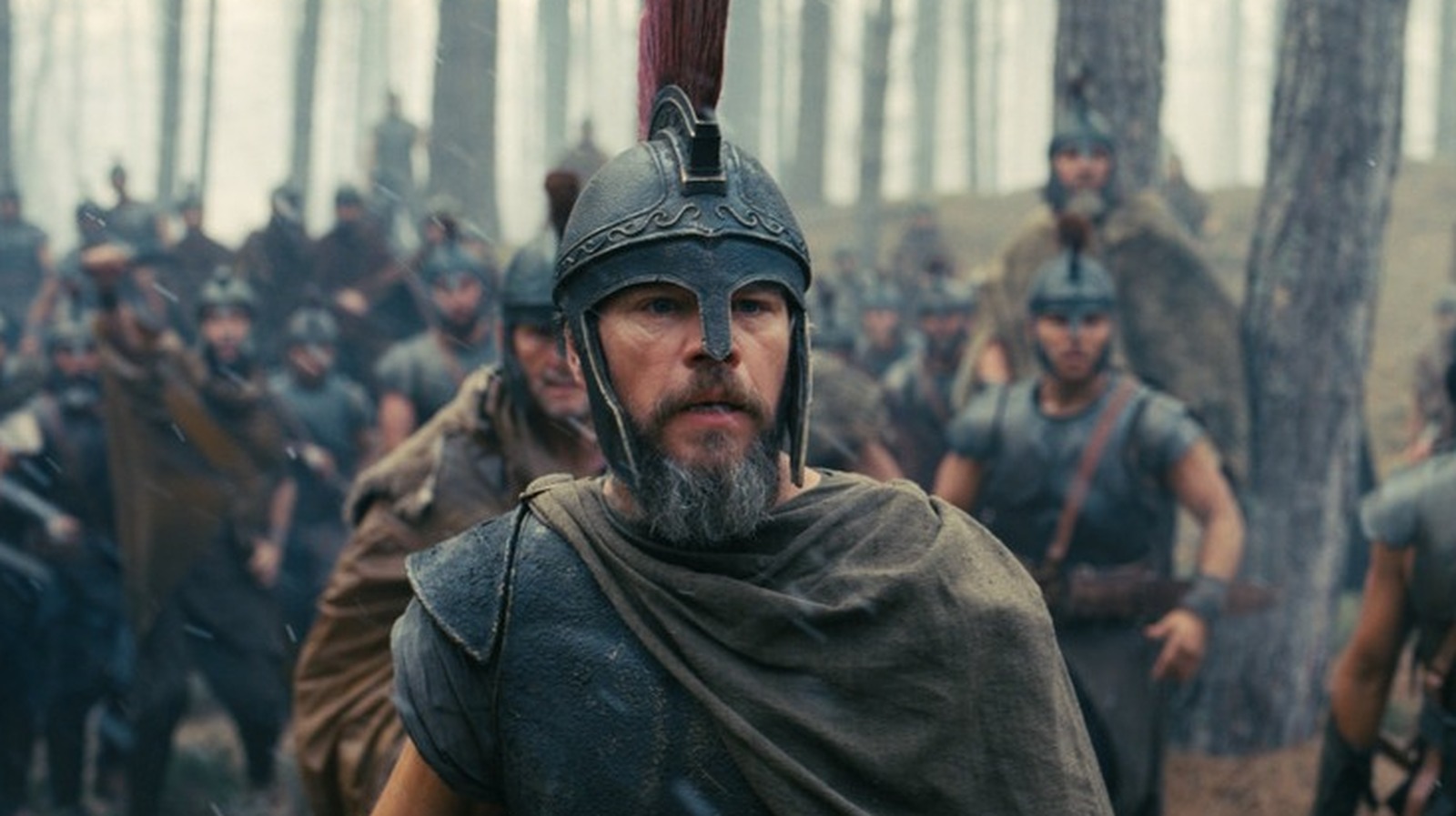
Odysseus still makes a fatal mistake, although the film changes the timing and nature of it. In the poem, he reveals his real name after escaping, allowing Polyphemus to identify him when asking Poseidon for revenge. In Nolan’s version, Matt Damon’s Odysseus shoots the sleeping Cyclops with an arrow after the escape begins. The wounded creature then pursues the men and kills more of them.
This adjustment gives Odysseus a more visibly aggressive role in the disaster. His downfall comes not only from pride, but from vengeance. The scene reinforces one of the film’s larger ideas: the hero’s journey home is shaped by the violence he carries with him from war.
Goya, Guillermo del Toro, and a Practical Monster
Nolan’s visual approach to the Cyclops was influenced by Francisco Goya’s disturbing painting Saturn Devouring His Son. Nolan told the Los Angeles Times that the painting was kept as a key reference during production, particularly as the filmmakers developed the technology used to create the creature.
The monster was brought to life through a combination of puppetry, animatronics, robotics, and Bill Irwin’s physical performance. That approach continues Nolan’s preference for making extraordinary images feel materially real. As with his efforts to depict the nuclear explosion in Oppenheimer without relying entirely on computer-generated imagery, the goal is not simply realism for its own sake. It is about giving the audience something with weight, texture, and presence.
Nolan has also cited Guillermo del Toro as an influence, particularly the idea that a monster must be treated like any other character. That philosophy is visible in the Cyclops’ behavior. It is not merely an obstacle waiting for the hero’s next move; it occupies the cave, controls the rhythm of the scene, and creates a world in which human beings are suddenly small and vulnerable.
The result is a version of the Cyclops showdown that is more horror sequence than comic adventure. Homer’s trick survives in spirit through the characters’ ingenuity, but Nolan replaces the original wordplay with silence, tactile menace, and a stronger emphasis on Odysseus’ moral responsibility. For longtime readers of The Odyssey, the changes may be noticeable, but they reveal exactly how Nolan is reshaping the epic: not by removing its mythic power, but by translating that power into physical danger and human consequence.
Released in theaters on July 17, 2026, The Odyssey has also drawn strong early critical attention for its scale, performances, and tactile filmmaking. Review coverage has frequently highlighted Nolan’s ability to make the ancient story feel emotionally immediate, even as his adaptation takes significant liberties with the gods, monsters, and structure of Homer’s poem.
Sources
- slashfilm.com
- apnews.com
- rottentomatoes.com
- theguardian.com
- rogerebert.com