
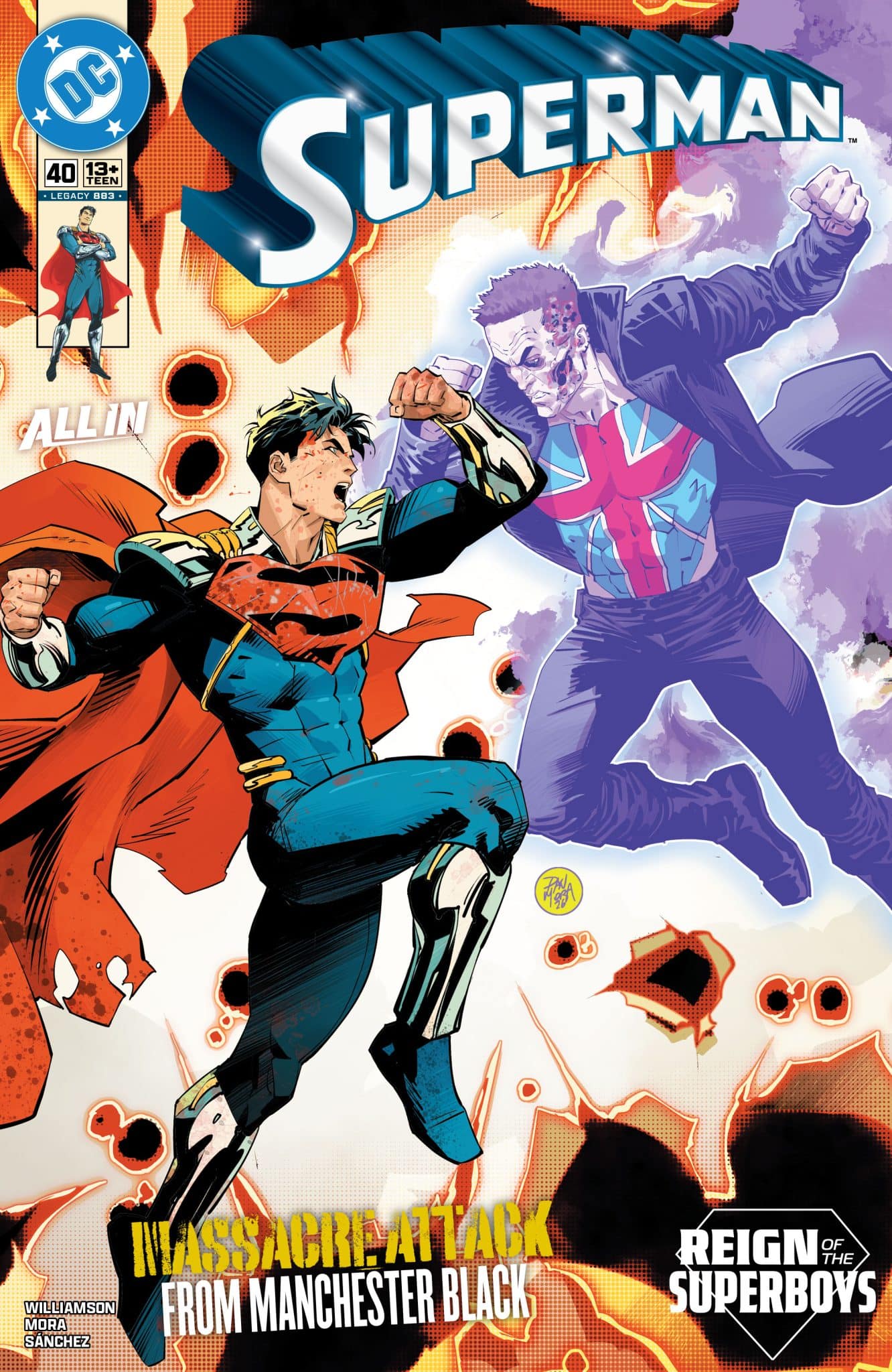
DC’s Superman #40 is positioning Superboy-Prime at the center of one of the Man of Steel’s strangest conflicts yet. Written by Joshua Williamson and drawn by Dan Mora, the issue pits the controversial former villain against Manchester Black in a battle that could blur the line between comic-book fiction and reality itself.
That premise makes the issue especially notable for readers following DC’s current “Reign of the Superboys” direction. Superboy-Prime is temporarily filling Superman’s place, but his attempt to become a hero is already being tested by enemies, history, and members of the Super-Family who have every reason to distrust him.
A Meta-Human Conflict With Real Consequences
The central confrontation is straightforward on the surface: Manchester Black wants to be resurrected, and he believes Superboy-Prime possesses the means to restore his life. But the conflict quickly expands beyond a conventional superhero fight.
Manchester Black’s goal is not merely to return from the dead. He wants to escape the fictional world of DC Comics and enter “our world,” turning the issue into what the preview describes as “meta versus meta.” That concept places two characters with unusual relationships to the comic medium against each other.
Manchester Black has long been associated with cynical ideas about superhero morality, while Superboy-Prime represents a fan who crossed the boundary between reader and character. Bringing them together creates an opportunity for DC to examine the nature of fictional heroes, audience expectations, and the often-blurry rules of superhero continuity.
The premise also gives Williamson room to push Superboy-Prime’s recent redemption arc into more uncomfortable territory. He may be trying to act like Superman, but his history makes him an unstable symbol for the role. If Manchester Black offers him a way to solve one problem, Prime may have to decide whether becoming Superman means protecting reality—or controlling it.
Superboy-Prime’s Complicated Second Chance
Superboy-Prime has evolved considerably since his debut as a heroic counterpart from Earth-Prime. Over the years, he became one of DC’s most destructive antagonists, particularly during Infinite Crisis, before later stories began exploring the possibility that he could change.
DC’s current material has embraced the character’s unusual position as both fan and participant. He understands superhero conventions, recognizes the importance of continuity, and carries the baggage of someone who knows exactly how fictional worlds are supposed to work. That makes him a natural fit for a story built around the idea of escaping the page.
Williamson has also described Prime as a character shaped by fandom, nostalgia, online arguments, and the desire to impose one’s own vision on a fictional universe. Those qualities make his temporary role as Superman more than a simple replacement storyline. Prime is not just wearing the symbol—he is attempting to prove that he understands what the symbol means.
The problem is that the Super-Family does not appear ready to accept him. The preview specifically notes that Prime will have to deal with members of Superman’s extended family who are unhappy about his desire to become Superman. That tension should give the issue an emotional counterweight to its high-concept premise.
Manchester Black Returns to the Spotlight
Manchester Black is one of Superman’s most distinctive adversaries because his threat has never depended solely on physical power. He is a provocateur, a telepath, and an ideological challenge to Superman’s belief in compassion and restraint.
His return in Superman #40 is therefore a strong match for Superboy-Prime. Both characters have a complicated relationship with the superhero genre, but they approach it from opposite directions. Manchester Black wants to break through the boundaries of the story, while Prime has spent much of his existence trying to force the story to conform to his expectations.
The issue’s resurrection angle also fits Manchester Black’s history as a character who repeatedly tests the limits of life, death, and identity. The preview does not reveal how he plans to cross into the real world, or whether the threat is literal, symbolic, or both. That mystery is likely to be one of the issue’s main attractions for readers who enjoy DC at its most self-aware.
Dan Mora’s Art Brings the Super-Family Era Into Focus
Dan Mora’s involvement gives the issue a strong visual hook. Known for expressive character work and energetic action, Mora is well suited to a story that needs to balance Superman-scale spectacle with the eccentricity of a fourth-wall-threatening plot.
The challenge for the artwork will be making the meta-fictional elements feel tangible. A battle between Superboy-Prime and Manchester Black needs to communicate the physical impact of a superhero fight while also suggesting that the rules of the world may be breaking down around them.
Mora’s designs should also help distinguish Prime’s imitation of Superman from the original hero’s established presence. Even without Superman at the center of the issue, the character’s influence will hang over every page. Prime is trying to claim the role, while the Super-Family serves as a reminder that the title of Superman cannot be earned simply by putting on the costume.
A Bridge Toward DC’s Summer Superman Story
The preview states that Superman #40 builds toward the following month’s major summer storyline. DC has separately announced “Kingdom of Zod,” a crossover involving Supergirl, Action Comics, Superman Unlimited, and Superman, with the story set to bring the wider Super-Family into conflict with General Dru-Zod.
That makes this issue potentially important as a transition point. The immediate story concerns Prime, Manchester Black, and the threat of a character escaping the comic-book world. The larger direction appears ready to bring the Superman line back toward a more traditional family-wide conflict, with Prime remaining part of the equation.
For collectors, the issue’s appeal comes from the combination of major characters and an unusually high-concept premise. For longtime readers, it continues one of DC’s most divisive characters at a pivotal point in his redemption story. And for newer readers, the conflict offers a clear entry point into the current status quo: Superman is absent, Superboy-Prime is trying to fill the vacancy, and not everyone is willing to let him.
Superman #40 is shaping up to be a collision of superhero action, continuity debate, and comic-book metafiction. Whether Superboy-Prime can survive Manchester Black’s challenge—and the judgment of the Super-Family—may determine how much longer he gets to call himself Superman.
Sources
graphicpolicy.com
dc.com