
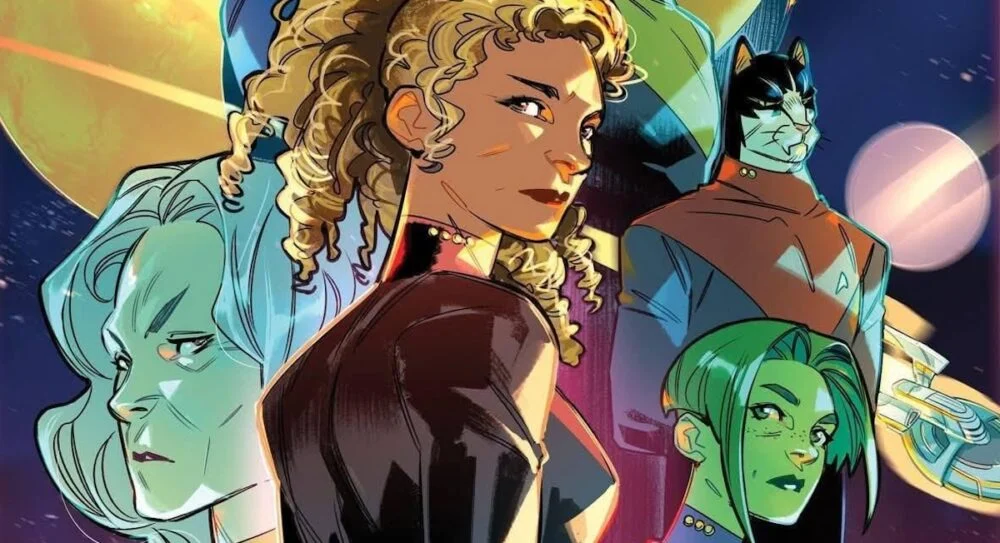
IDW Publishing is preparing a new chapter of its Star Trek comics line with Star Trek: Zero Point #1, a companion series written by Charlie Jane Anders. Set five years after Star Trek: Picard Season 3, the comic follows Captain Raffaela “Raffi” Musiker as she takes command of the U.S.S. Endeavor, placing one of the franchise’s most complicated recent characters at the center of a new mission.
For Star Trek readers, Zero Point stands out not simply because it expands the post-Picard era, but because Anders is approaching the franchise through a distinctly philosophical lens. As she explained in a recent interview, the series grew from a simple but loaded idea: hope versus paranoia. That conflict could make Zero Point one of IDW’s more thematically ambitious Trek projects in years.
Raffi Musiker Takes Command
Raffi has often occupied the uneasy spaces of the modern Star Trek universe. She is a skilled intelligence officer, a survivor of institutional failure and a character shaped by the fear that catastrophe is always just beyond the next horizon. In Zero Point, that anxiety becomes part of the command structure.
Anders described Raffi as someone who has repeatedly tried to prevent disasters, only to arrive too late. The events of Picard Season 3, along with the wider crises explored across the series, provide an important foundation for the comic. Starfleet is not entering this new era from a position of complete confidence. It has been battered, tested and forced to reconsider how it responds to threats.
That makes Raffi a particularly appropriate captain for a story concerned with risk assessment. She understands the need to prepare for the worst, but the comic appears poised to ask whether constant suspicion can become its own form of danger.
A Crew Built Around Big Questions
One of the most intriguing additions to the Zero Point crew is D’Vana Tendi, the science officer introduced in Star Trek: Lower Decks. The series is set 25 years after the end of Lower Decks, allowing Anders to explore Tendi as a middle-aged Starfleet officer rather than simply continuing the comedic dynamics of the animated series.
Tendi’s inclusion also gives the story a strong scientific foundation. Anders has discussed consulting physicists and exoplanet experts while developing the comic, with an emphasis on presenting its scientific concepts as accurately as possible within the conventions of Star Trek. Tendi’s enthusiasm for science makes her a natural guide through that material, while her commitment to Starfleet places her in direct philosophical opposition to Raffi.
Their disagreements reportedly concern ethics, the purpose of their mission and the kind of future Starfleet should be trying to protect. That contrast could give the series its central dramatic engine: Raffi’s caution against Tendi’s curiosity, with neither position necessarily presented as entirely correct.
The crew will also include Sybil, a fictional artificial intelligence with obvious echoes of Data. IDW’s official description identifies the AI as a powerful system that wears the face of a familiar ally, while Anders has pointed to Person of Interest as an influence on the story’s approach to threat-seeking technology. The result suggests a Star Trek narrative interested in the difference between prediction and understanding.
Star Trek After Picard
Zero Point is launching alongside a new flagship Star Trek comic by Christopher Cantwell, part of IDW’s plans for the franchise’s 60th anniversary in 2026. While the flagship title follows a different command structure, the two books are being developed in conversation with one another, and Anders has confirmed that the creative teams are planning a future crossover.
That connection gives Zero Point a potentially important place in IDW’s larger Trek continuity. The series is not being presented as an isolated side story, even though its focus on Raffi and the Endeavor gives it a distinct identity. Readers can expect the book to stand on its own while gradually contributing to a broader vision of Starfleet’s future.
For longtime fans, the creative influences are equally significant. Anders has cited Star Trek: The Next Generation, particularly its recurring debates about ethics and personal responsibility, as an important touchstone. At the same time, the comic is rooted in the aftermath of Picard, where the optimism of the Federation has been repeatedly challenged by conspiracies, technological threats and political instability.
Creative Team and Release Details
Star Trek: Zero Point #1 is written by Charlie Jane Anders, with art by Isaac Sánchez González and lettering by Jodie Troutman. The issue is being published by IDW Publishing and is listed at 32 pages with a $4.99 cover price. It is scheduled to arrive in comic shops on October 14, 2026, with preorders due September 7.
That timing places the series directly within Star Trek’s 60th-anniversary publishing push. It also gives collectors a new launch issue featuring a recognizable character, a fresh ship and a creative team with a clear interest in both science-fiction spectacle and moral debate.
Anders’s central question may be the best indication of what readers should expect. Hope is what allows Starfleet to move forward, while paranoia can be what keeps its people alive. Star Trek: Zero Point appears ready to explore what happens when those two instincts stop working together—and when a captain must decide which one should guide the mission.
Sources
comicsbeat.com
idwpublishing.com
prhcomics.com