
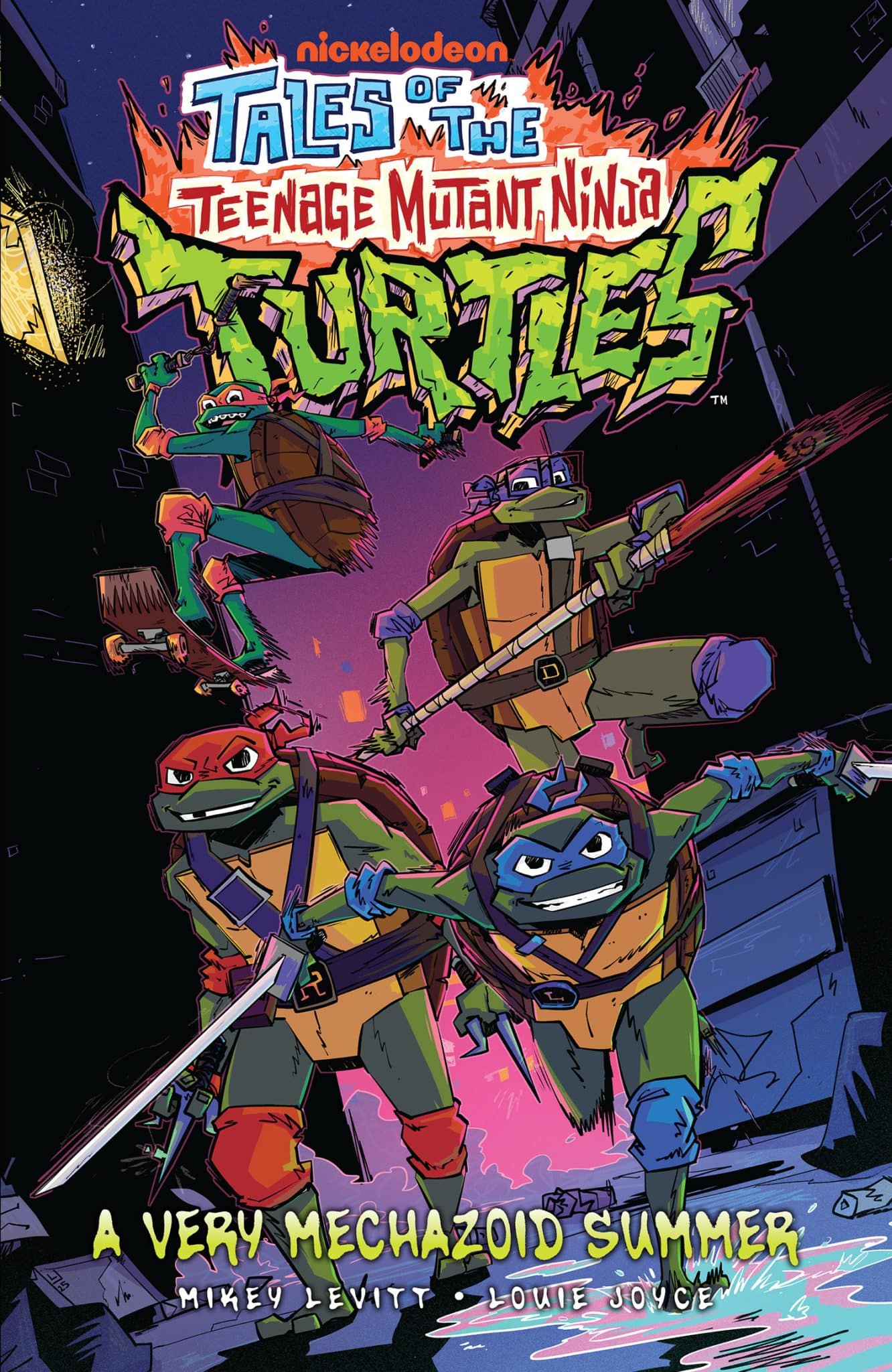
IDW Publishing is bringing the animated world of Tales of the Teenage Mutant Ninja Turtles to graphic novels with A Very Mechazoid Summer, a Donatello-focused mystery built around robotics, competition, and the return of Metalhead. The three-issue story is now collected in paperback, giving readers a compact new adventure based on the hit Netflix series.
For longtime TMNT readers, the premise offers a familiar combination of high-tech gadgetry and suspicious villains. For fans coming directly from the animated series, it provides another accessible entry point into the brothers’ world—this time with Donnie’s intelligence and engineering skills at the center of the action.
Donatello Takes the Spotlight
The story begins when Donatello receives an invitation to an elite robotics camp for young geniuses. Naturally, Donnie sees the event as an opportunity to showcase his talents and rebuild his trusted robot companion, Metalhead. The setup plays directly to one of the character’s defining traits: his confidence in technology and his desire to solve problems through invention.
That confidence is tested when the camp’s competition begins to spiral out of control. What initially appears to be a chance for Donatello to compete among fellow young inventors soon takes on a more dangerous shape. The central questions are straightforward but effective: Who sent the invitation? Why is Metalhead being targeted? And what is hidden beneath the camp’s circuits, code, and machinery?
Those questions give the book a mystery framework without moving too far from the colorful action expected of a Teenage Mutant Ninja Turtles adventure. The result appears designed to balance puzzle-box intrigue with mutant mayhem, while giving Donatello a personal stake in the conflict.
A New Creative Team With Animation Roots
A Very Mechazoid Summer comes from debut comics writer Mikey Levitt, who is part of the production team behind Tales of the Teenage Mutant Ninja Turtles. That background is particularly relevant for a licensed series based on an animated property. Levitt’s connection to the show gives the project a direct creative link to its source material, rather than positioning the graphic novel as a disconnected reinterpretation.
Louie Joyce provides the art. Joyce’s previous work includes Godzilla: Skate or Die and Haphaven, projects associated with an energetic, stylized approach. The preview pages point toward a visual language that suits the book’s premise: mechanical designs, expressive characters, and a bright collision between science-fiction technology and the Turtles’ exaggerated world.
The Donatello-centered concept also creates room for Joyce to emphasize the contrast between the orderly logic of robotics and the chaotic personality of the Turtles. Metalhead, in particular, gives the story an appealing visual anchor. The character is both a machine for Donnie to improve and a companion whose apparent vulnerability drives the mystery forward.
What the Collection Includes
The paperback collects Tales of the Teenage Mutant Ninja Turtles #1–3 in an 80-page edition. IDW Publishing lists the book at $10.99, with a July 21, 2026, release date. The format is aimed at readers ages 9–12 and grades 4–7, making it a natural fit for younger fans discovering the Turtles through Netflix as well as families looking for an approachable graphic novel.
That compact length should make the collection easy to pick up in one sitting, while the three-issue structure gives the story enough room to establish the robotics camp, introduce its mystery, and build toward a larger confrontation. Readers who prefer complete story arcs over monthly single issues will have the entire adventure available in one volume.
Collectors may also find the book notable as one of the early graphic-novel extensions of the newest animated incarnation. The project is not presented as part of the main ongoing comic continuity associated with IDW’s broader Teenage Mutant Ninja Turtles publishing line. Instead, it is explicitly based on the Netflix series, preserving the tone and characterization of that animated universe.
A Promising Fit for Animated-Series Fans
The strongest appeal of A Very Mechazoid Summer is its focus. Donatello is often the Turtle most naturally associated with machines, computers, and scientific problem-solving, so placing him in a robotics competition feels like an organic extension of his role on the team. Metalhead’s involvement adds emotional stakes without requiring readers to know a large amount of franchise history.
The premise also leaves space for the other Turtles to enter the story without taking the spotlight away from Donnie. A conspiracy surrounding a robotics camp gives the brothers an obvious reason to investigate, while the threat of a technological trap creates a different kind of challenge from the usual street-level battles and supernatural dangers.
At this stage, the available material establishes the book’s premise, creative team, and format but does not provide enough information to assess the complete pacing, character work, or resolution. What is clear is that Levitt and Joyce are using one of the franchise’s most recognizable strengths—its love of inventive technology—to build a fast-moving mystery for a new generation of Turtle fans.
With its animated-series setting, Donatello-led story, and Metalhead at the heart of the conflict, A Very Mechazoid Summer looks positioned as a colorful, accessible addition to the TMNT library. It is a particularly natural recommendation for readers who enjoy all-ages superhero comics, robot-centered adventures, and graphic novels that treat younger audiences as capable mystery solvers.
Sources
graphicpolicy.com
penguinrandomhouse.com
prhcomics.com
idwpublishing.com